10 AI Essentials Revealed at Roundtables
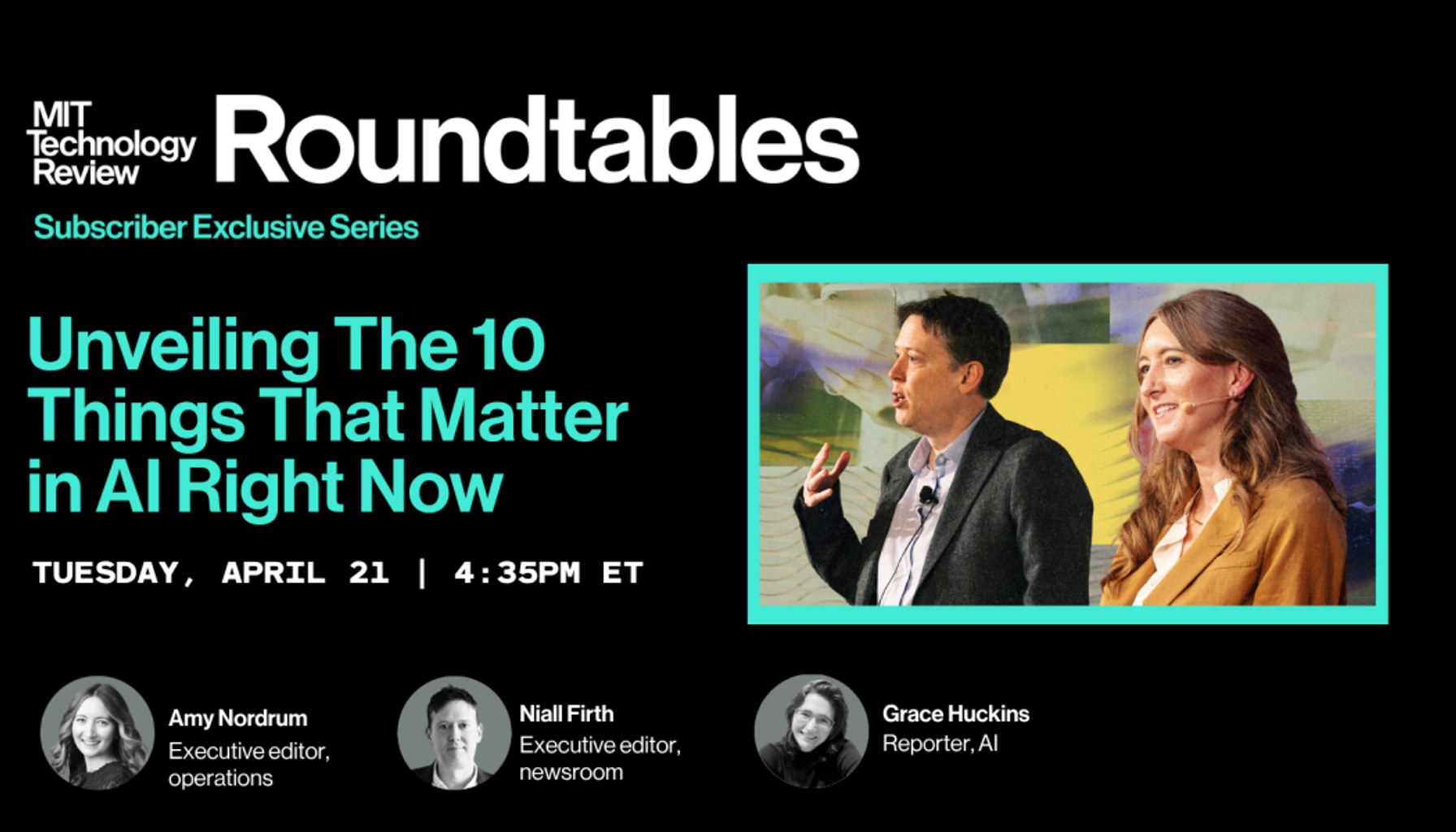
MIT’s EmTech AI roundtables just dropped a blueprint for 2026—ten things that actually matter in AI.
The MIT Technology Review event, taped in front of an audience of executives and researchers, framed a year of rapid progress as a set of practical, business-facing themes rather than abstract breakthroughs alone. Grace Huckins moderated, with Amy Nordrum and Niall Firth unveiling the list onstage. The vibe was pragmatic: the technology isn’t the headline—what you do with it, how you govern it, and how you prove it work in the real world is.
What makes the roundtables notable is not a single blockbuster model but a distilled map for organizations trying to navigate a landscape where pace outruns caution. The speakers pushed past the hype and argued that in 2026 the real traction will come from how teams manage scope, cost, safety, and accountability as they deploy ever-larger, ever-more capable systems. It’s a reminder that the most consequential AI work this year may be the plumbing you didn’t see: governance processes, data provenance, and repeatable evaluation before you ship.
For product builders, two through-lines stand out. First, reliability now travels with every release: you can’t rely on raw capability alone to win customers. The organizers’ emphasis on governance, risk management, and robust evaluation aligns with rising enterprise demand for auditable AI—where you can explain decisions, justify outputs, and demonstrate compliance in regulated contexts. Second, efficiency remains a hard brake on ambition: the era of “throw more GPUs at it” is being tempered by cost visibility, better data curation, and smarter model use. Expect teams to lean into modular architectures, cheaper-but-apt foundation models, and task-specific adapters that can be swapped without rewriting major systems.
Analogy time: imagine tuning a symphony while the theater lights are still flashing. The orchestra (the model stack) hits incredible notes, but without a conductor’s discipline—clear goals, measured benchmarks, and safety checks—the performance can spiral into noise. The roundtable framing is that conductor’s baton: a shared, enterprise-ready approach to evaluation, governance, and cost discipline.
Two to four practitioner takeaways for shipping this quarter are clear. First, start with a rigorous eval-and-guardrails framework. The roundtables’ emphasis on practical impact means you should pair any new model with red-teaming, self-critique steps, and guardrails that surface and mitigate failure modes before customers see them. Second, invest in data governance and provenance. If outputs depend on data quality, you need lineage, versioning, and licensing baked into your pipeline so that downstream teams can trust what the model learned yesterday. Third, optimize for efficiency, not just capability. Small, well-tuned adapters, quantization, distillation, and selective use of off-the-shelf models can deliver the same business value with far lower runtime cost and risk. Fourth, plan for governance as a product feature. Compliance, privacy-by-design, and auditability aren’t add-ons; they’re governance rails that guide product decisions and stakeholder confidence—especially in regulated sectors.
The roundtables don’t deliver benchmark scores or dataset reports; this was a strategic briefing about where the field is headed and what enterprises should prioritize. The absence of fresh “scorecards” isn’t a gap—it’s a reminder that the quarter’s real wins will hinge on how teams implement measurement, governance, and cost controls in parallel with capability gains.
Limitations are obvious: high-level lists can gloss over implementation detail and risk masking. The real world will ruin optimizations if teams skip data governance, underinvest in guardrails, or ignore vendor risk. The takeaway—when you’re planning Q2 shipping—should be practical: build a measurable eval loop, document data lineage, architect for cost-efficient deployment, and embed governance as a first-class design constraint.
- Roundtables: Unveiling The 10 Things That Matter in AI Right Nowtechnologyreview.com / Source role not classified / Published APR 21, 2026 / Accessed APR 22, 2026