10 AI Trends That Matter in 2026
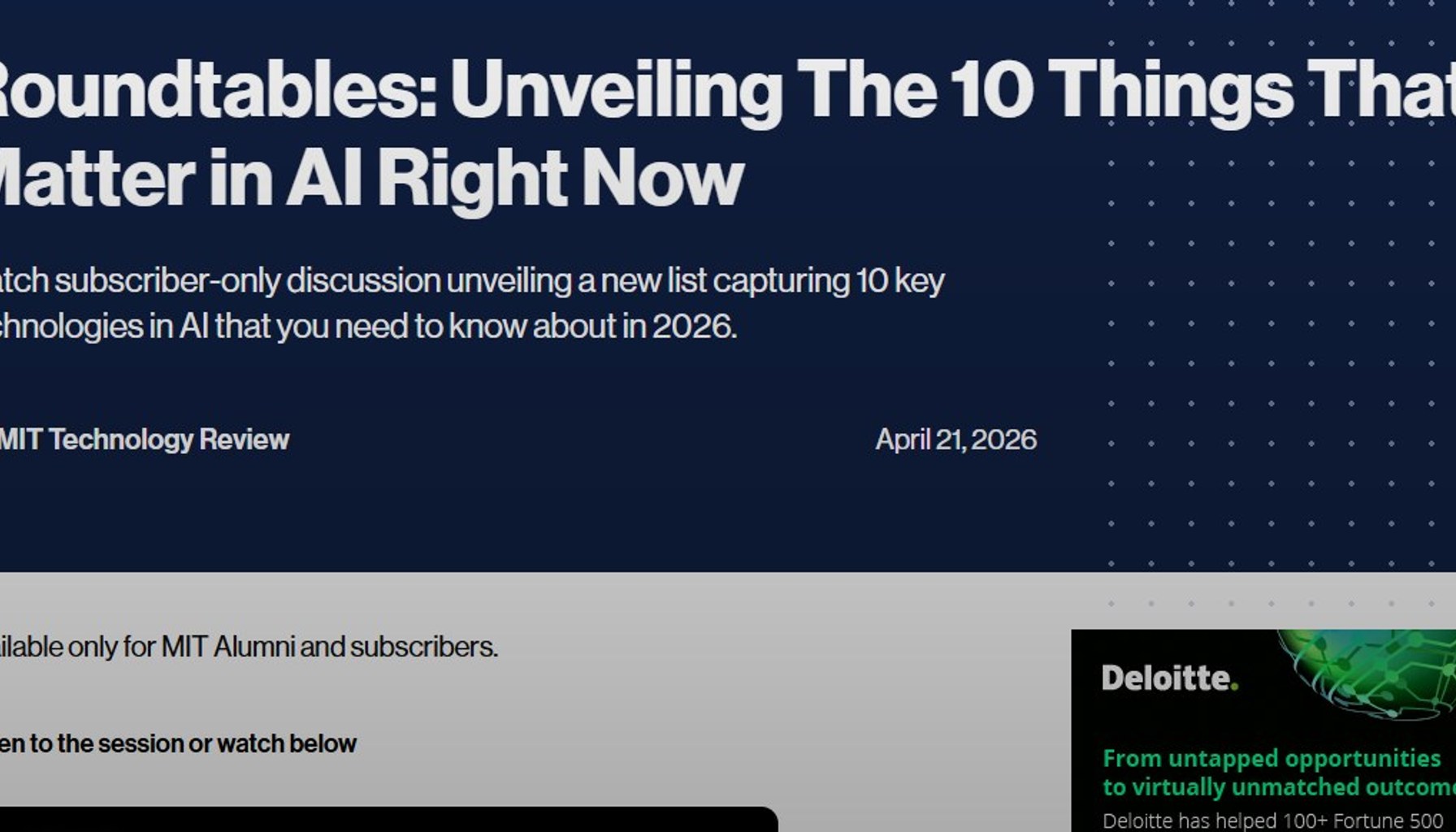
MIT's AI roundtable just handed engineers a 2026 playbook.
A fresh round of conversations at EmTech AI, hosted by MIT Technology Review, produced a new list of 10 technologies, trends, and bold moves that executives say will shape AI this year. The organizers emphasize that the guide isn’t a hype sheet, but a synthesis of what leaders across research labs, startups, and big tech regard as the levers that actually move products and risk profiles in 2026. For product and engineering teams, that means a sharper lens on what to optimize for—reliability, governance, and cost efficiency—rather than chasing the latest flashy capability.
The format matters as much as the content. By bundling emerging capabilities with strategic movements—ranging from safety and evaluation to data governance and deployment logistics—the list acts like a compass for teams staring down a quarterly roadmap constrained by budgets and regulatory uncertainty. In practice, it’s a reminder that “what you ship” depends not only on what your model can do, but how you measure it, how you manage data, and how you operate it in production.
Two takeaways jump out for practitioners racing to ship this quarter. First, the emphasis on evaluation and benchmarking is escalating from a back-office activity to a core product requirement. Teams are being urged to build robust test harnesses that simulate real-world drift, data distribution shifts, and adversarial inputs. The takeaway isn’t just better metrics; it’s a shift to trust engineering. As one founder who sat in the room put it, you don’t ship a model that can pass a single test—you ship something that survives a bending, messy real world where data will mutate and users will push it in unexpected directions.
Second, governance and data provenance are moving from “nice-to-have” to “must-have” for any AI-enabled product. The roundtable frames privacy, consent, and data lineage as central to the product’s risk profile, not as an afterthought. For consumer apps and enterprise offerings alike, this translates into concrete steps: tighter data governance rails, transparent model usage disclosures, and auditable tools that can trace decisions back to input, model, and prompt. In markets leaning toward tighter regulation and consumer distrust, that provenance is a feature, not a bug—especially for features that influence sensitive outcomes or automated decisions.
Beyond these, the list implicitly nudges teams to balance capability with cost. Compute budgets are not shrinking; they’re shifting toward smarter engineering—efficient fine-tuning, on-device inference where latency and privacy matter, and modular architectures that allow swapping components without retraining end-to-end. That’s a practical caution for startups racing to MVPs: the fastest path to an MVP is no longer the best path to a scalable, fair, and explainable product. The “right-sized” model may win on reliability and price, even if it trades a sliver of peak capability.
Analysts and engineers should watch for a few risk factors. First, evaluation regimes that don’t generalize will give a false sense of safety; drift must be anticipated and mitigated. Second, governance work can slow time-to-market unless it’s integrated into product reviews and deployment pipelines from day one. Third, costs can spiral if teams default to cloud giants’ latest runtimes without reining in inference efficiency or data-transfer overheads. And finally, the push toward transparency and accountability can collide with user experience if not handled gracefully—explanations must be useful, not just technically correct.
For product teams shipping this quarter, the headline is clear: you’ll win by building for reliability, traceability, and responsible use as much as for capability. The roundtable’s signal is not a single breakthrough but a disciplined blueprint—one that rewards systems-thinking: robust eval, careful data governance, modular deployment, and cost-aware design.
The event’s true value, in the end, may be that it reframes what counts as leadership in AI product work: not who has the flashiest new model, but who can prove a product is safe, private, and scalable enough to trust every day.
- Roundtables: Unveiling The 10 Things That Matter in AI Right Nowtechnologyreview.com / Source role not classified / Published APR 21, 2026 / Accessed APR 22, 2026