Huawei Drives DriveONE Into Mass Production
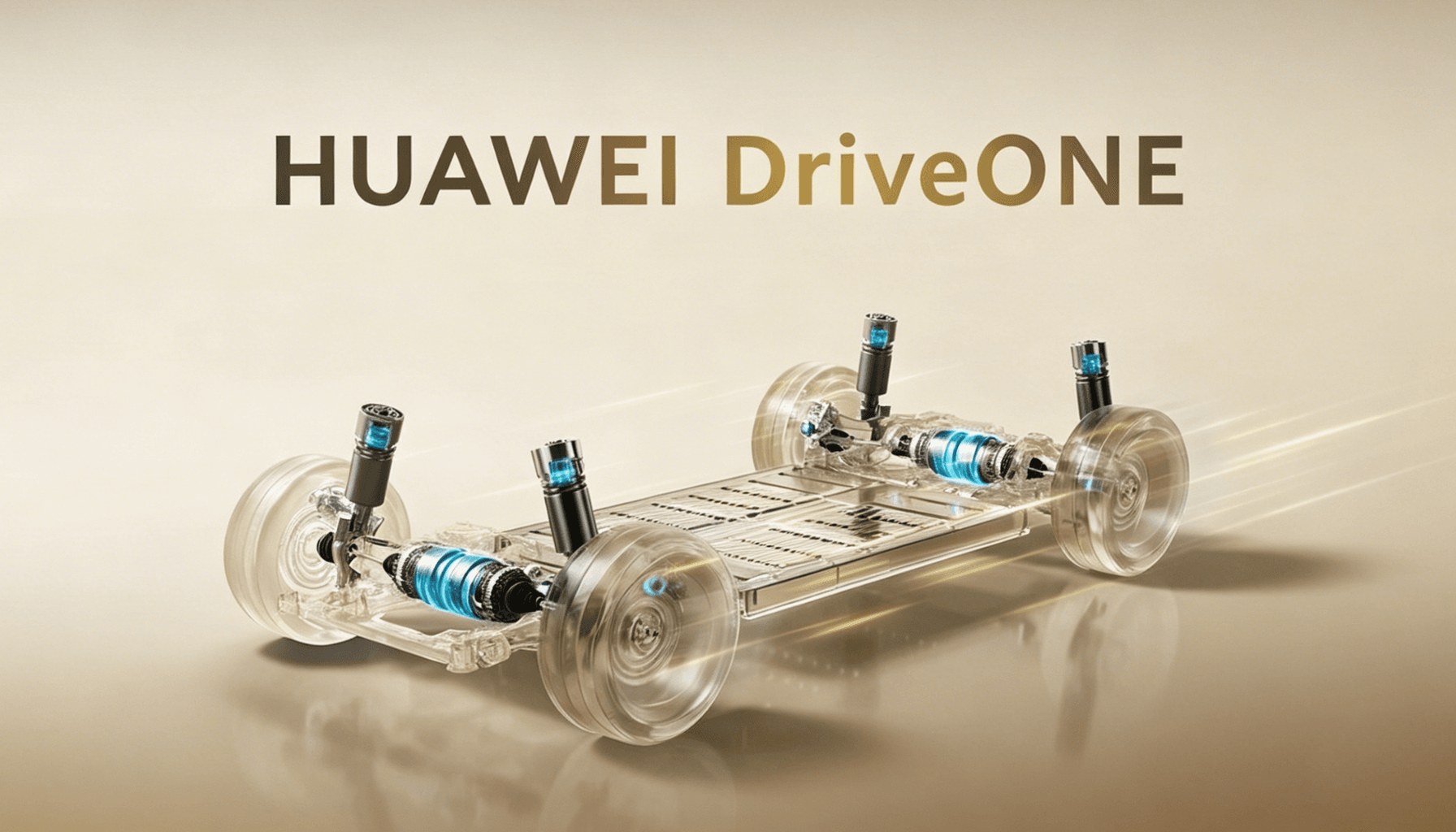
Huawei’s latest powertrain push is not a brochure—DriveONE is already rolling onto China’s roads, bent on reshaping who actually controls the electric drive in China’s EVs. At the HarmonyOS Smart Mobility Spring Launch Event, Huawei executive Yu Chengdong unveiled DriveONE as a self-contained EV powertrain brand, claiming a leadership position in both powertrain quality performance and shipments for cars priced above RMB 300,000.
Chinese-language reporting indicates the DriveONE platform is built on a dual silicon carbide (SiC) power architecture, delivering industry-leading efficiency figures: a range-extender generation efficiency of more than 94% (versus a 91% industry average) and a pure electric efficiency exceeding 94% (vs. roughly 92% for rivals). Huawei also highlighted an automatic off-road mode with an adaptive dog-clutch differential lock and crawling capability down to 0.5 km/h, designed to dampen speed fluctuations on rough terrain by more than 55%. In short, the company pitched DriveONE as not just a motor and inverter, but an integrated drive system tuned for both urban EVs and tougher terrain.
The technical briefing placed heavy emphasis on vertical integration. Huawei’s presentation showcased in-house SiC modules, a 56-turn high-efficiency motor, and AI-driven control algorithms, all feeding a planetary gear architecture with low-viscosity lubricants and a 0.15 mm ultra-thin insulation system. The combination, Huawei argued, enables what it calls “intelligent energy management” to redefine EV powertrain efficiency standards. The claim is not just performance numbers; it’s a cohesion story: a powertrain stack designed to minimize losses from battery to wheels while maintaining precise control through software.
DriveONE isn’t theoretical. Huawei said the system has entered mass production, and the moment has tangible uptake on the ground. The GAC Toyota Bozhi 7, launched in March 2026, comes equipped across all variants with Huawei’s integrated electric drive system. That collaboration—within a joint venture framework that China’s auto ecosystem has long used to accelerate domestic tech adoption—serves as a real-world vote of confidence for DriveONE’s scalability and integration readiness.
From a manufacturing and supply-chain lens, DriveONE underscores a broader shift in China’s automotive tech stack: system-level ownership moving closer to the platform level, with the automaker and the silicon carbide value chain binding more tightly to a single OEM-friendly ecosystem. The Mandarin-language reporting underscores Huawei’s aspiration to be more than a chipset supplier or software layer; DriveONE is framed as a complete, ship-ready solution for high-end EVs that could standardize how OEMs spec their powertrains in a market where margins tighten with competition.
Two to four practitioner angles worth watching:
In the broader arc, DriveONE signals Huawei’s intent to anchor itself not as a peripheral software layer or a chip supplier, but as a full-stack powertrain partner for a domestic EV ecosystem that’s simultaneously racing toward higher efficiency, better control, and greater local content. The question for buyers and rivals alike is whether DriveONE’s real-world performance and scalable production can outpace established EV powertrain stacks—while keeping the delicate balance of cost, localization, and supplier risk in check.
- Huawei Launches New EV Powertrain Brand “DriveONE” at HarmonyOS Eventpandaily.com / Source role not classified / Published APR 23, 2026 / Accessed APR 23, 2026