Schaeffler to Deploy 1000 AEON Humanoids by 2032
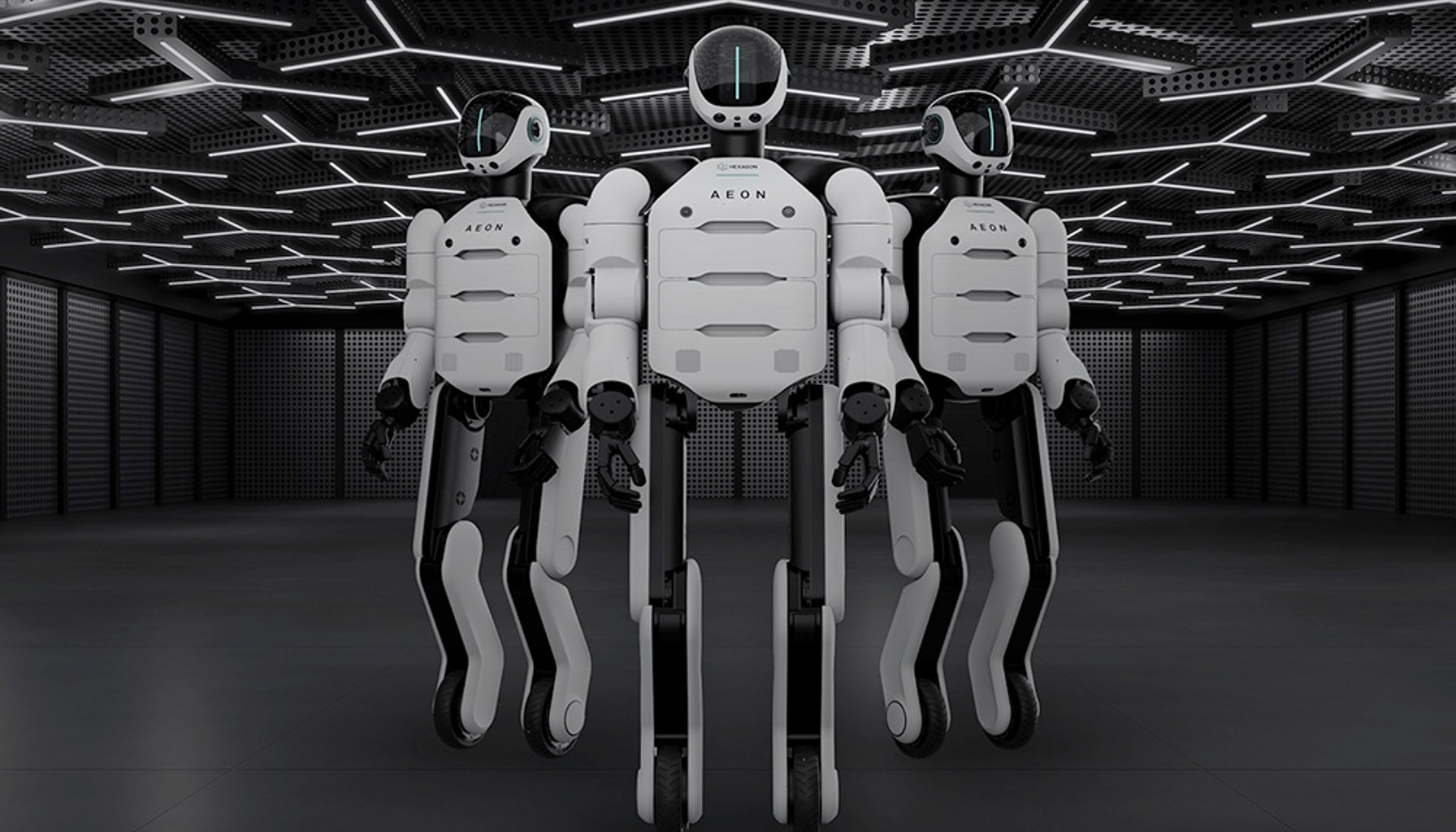
A thousand AEON humanoids with wheel-ended legs are headed to Schaeffler’s factories by 2032.
Schaeffler and Hexagon’s robotics arm have cemented a scaling plan that would move the industrial humanoid from pilot tests into real production lines across the globe. The partnership aims to deploy at least 1,000 AEON robots in Schaeffler’s manufacturing system by 2032, with Schaeffler supplying its high-precision actuators to power the machines. Arnaud Robert, president of Hexagon Robotics, frames AEON as an industrial specialist designed to unlock consistent throughput in varied factory environments. “We have developed a humanoid specifically for the industrial market, leveraging our core expertise in sensor fusion, spatial intelligence, and physical AI,” he said, signaling a tighter integration between sensing, decision making, and physical action.
AEON’s design leans into a pragmatic hybrid of locomotion and manipulation. The robot is described as two-legged but with wheels at the end of its limbs, a layout intended to blend stability with the ability to navigate cluttered factory floors more fluidly than a traditional bipod. The goal is to perform high-precision manipulation, loading, unloading, and inspecting parts across a multi-machine station, while not sacrificing adaptability to different lines or products. The collaboration surfaces Hexagon’s emphasis on spatial awareness and paired sensing with Schaeffler’s actuator knowhow, a pairing that is meant to reduce the calibration overhead that typically slows deployment.
Engineering documentation shows that the public materials accompanying the announcement do not disclose DOF counts or payload capacity for AEON. The technical specifications reveal these figures are not published for this model, a common reality for early-scale industrial platforms where the real value lies in demonstrated performance rather than raw spec sheets. Demonstration footage from pilot work confirms AEON’s capacity to participate in coordinated, multi-step tasks at a production station, but the exact torque budgets and gripping limits remain opaque, an omission that matters for systems integrators planning line-by-line automation budgets.
The pilot phase completed last year set the stage for a broader rollout. In that program, AEON demonstrated high-precision manipulation while loading, unloading, and inspecting parts at an actual manufacturing operation, not a test rig. That is a meaningful signal for buyers who chase repeatable outcomes, but it also highlights a perennial caveat of humanoid automation: the edge cases tend to arrive when you scale. The current plan pushes deployment into multiple sites, with additional applications such as automated parts inspection slated to begin rollout by the end of 2026. The shift from a controlled pilot to multi-site deployment is a classic inflection point for industrial humanoids and a litmus test for field readiness.
Two to four practitioner-level insights stand out for engineers and procurement leads watching this story:
For Schaeffler, this is not just a marketing milestone but a test of industrial robot economics. The promise of thousand-unit scale hinges on lifecycle costs, availability of hexapod-like precision in ongoing production, and the ability to maintain consistency across global sites. If the AEON program nails the required reliability and ease of integration, it would mark a notable step forward from most single-site pilots to a truly global, production-grade humanoid platform.
The real-world takeaway will be balance. Between the promise of higher throughput and the realities of maintenance, safety, and total cost of ownership, the first wave of 1,000 AEONs will tell us how much industrial humanoids truly can shoulder in the factory of the 2030s.
- Schaeffler plans to deploy 1,000 Hexagon humanoids by 2032therobotreport.com / Source role not classified / Published APR 29, 2026 / Accessed APR 29, 2026