Humanoid AI Hits Siemens Factory Floor
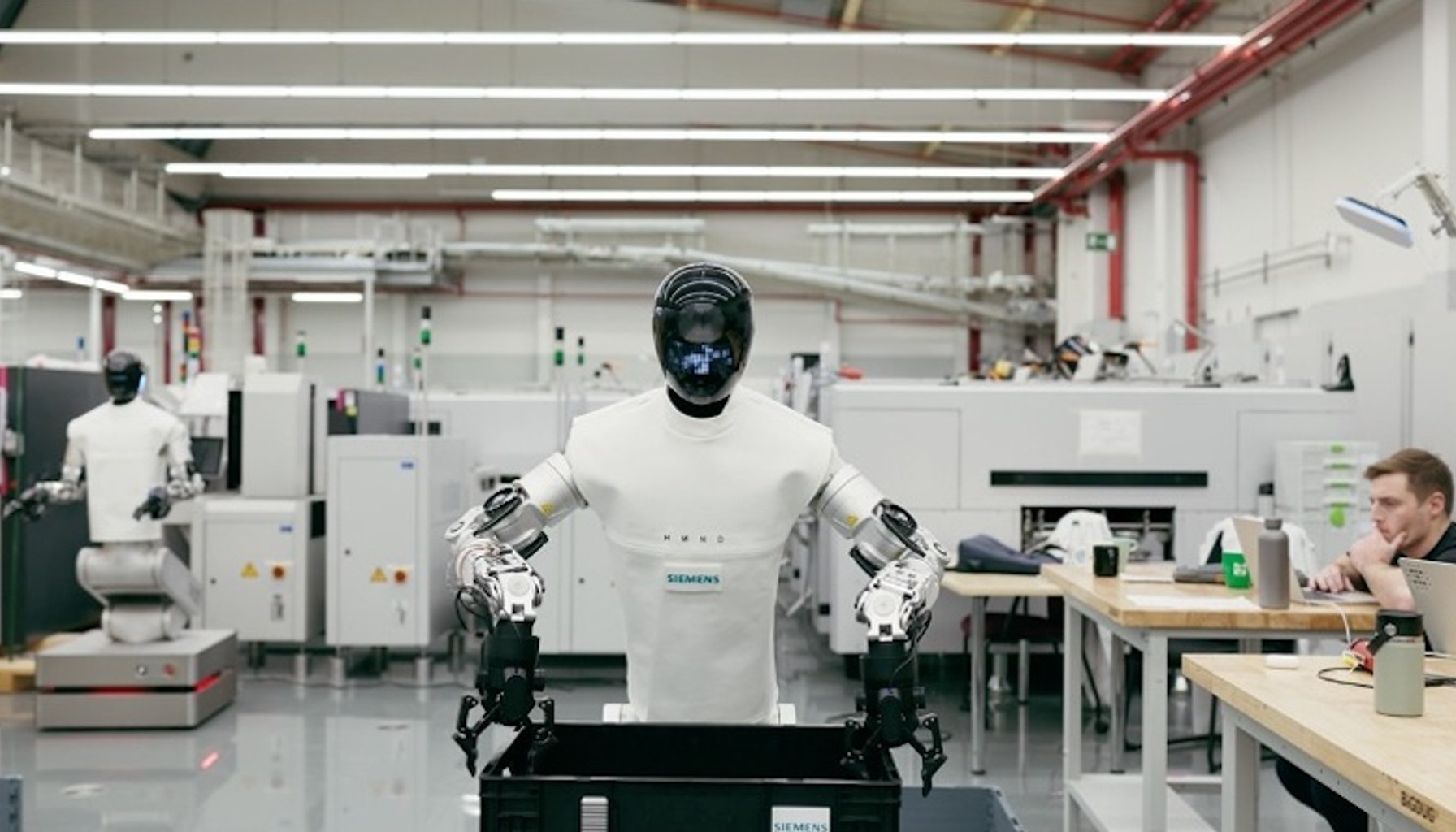
A humanoid robot is rolling through Siemens’ Erlangen plant—and this isn’t a marketing demo, it’s a real test of “physical AI” on the shop floor.
Siemens, Nvidia and Humanoid announced the HMND 01 Alpha, a wheeled humanoid designed for autonomous logistics tasks, has been deployed in Siemens’ electronics lines in Erlangen. Built on Nvidia’s physical AI stack, the robot is meant to navigate production areas, move materials, and perform basic material-handling duties with minimal human intervention. The announcement frames this as a milestone in translating AI vision and decision-making into concrete, operational automation, rather than a glossy lab exercise.
Industry observers will want to separate rhetoric from reality here. The HMND 01 Alpha is not a telepresence or a single-use demo arm; it’s pitched as a self-guided logistics agent capable of planning routes, avoiding people and obstacles, and executing routine transport tasks. Production data shows the robot attempted autonomous logistics tasks on the Erlangen line, illustrating the blend of perception, decision-making and motion control that Nvidia’s stack promises. But the release does not publish cycle-time improvements, throughput gains, or a payback calculation. For executives, that absence matters: ROI and impact on headcount, overtime, and rework are the metrics that justify a capital excursion this size, and the numbers aren’t on the record yet.
From a practitioner’s perspective, the implication is clear but still uncertain: you don’t need a full “lights-out” robot cell to extract value, but you do need a solid plan for where autonomy actually adds efficiency. Integration teams report that a real factory deployment extends beyond the robot’s cleverness. In practice, operators must reconfigure material flows enough to accommodate autonomous units, provision reliable power and network connectivity at the edge, and design training that yields operators who can supervise, troubleshoot and recalibrate the AI as conditions change. Analysts expect the Erlangen pilot to illuminate how much autonomy you can squeeze from a platform like this without compromising safety or reliability, but the specifics—how many hours of operator training, how much floor space, how many kilowatts of power, and how long the system stays up between maintenance cycles—will emerge only after a longer run.
Hidden costs are the quiet variable in these equations. Vendors tend to foreground capabilities while downplaying licensing, cybersecurity, software updates, and the ongoing cost of keeping the AI stack current across a live line. In field deployments, the bill for integration tends to include interface work with ERP/MMS systems, data storage for logs and performance metrics, and downtime during switchover to autonomous transport. The Erlangen test signals potential gains, but ROI documentation reveals a lot of what-ifs until production data solidifies.
Looking ahead, Siemens’ collaboration with Nvidia and Humanoid is likely to spawn follow-on pilots across other electronics and assembly lines, testing how broadly physical AI can replace or augment mid-range logistics tasks. The question many in the floor alike are asking is: can a humanoid–style platform prove itself in consistently high-throughput environments, or will it prove best as a flexible, low-footprint helper for edge cases and bottlenecks? The early signs are encouraging, but the numbers—and the real payback—will come with time, extended runs, and careful measurement.
- Siemens, Nvidia and Humanoid partner to bring physical AI into factory operationsroboticsandautomationnews.com / Source role not classified / Published APR 16, 2026 / Accessed APR 18, 2026