Humanoid Robots Move Into Honda's China Supply Chain
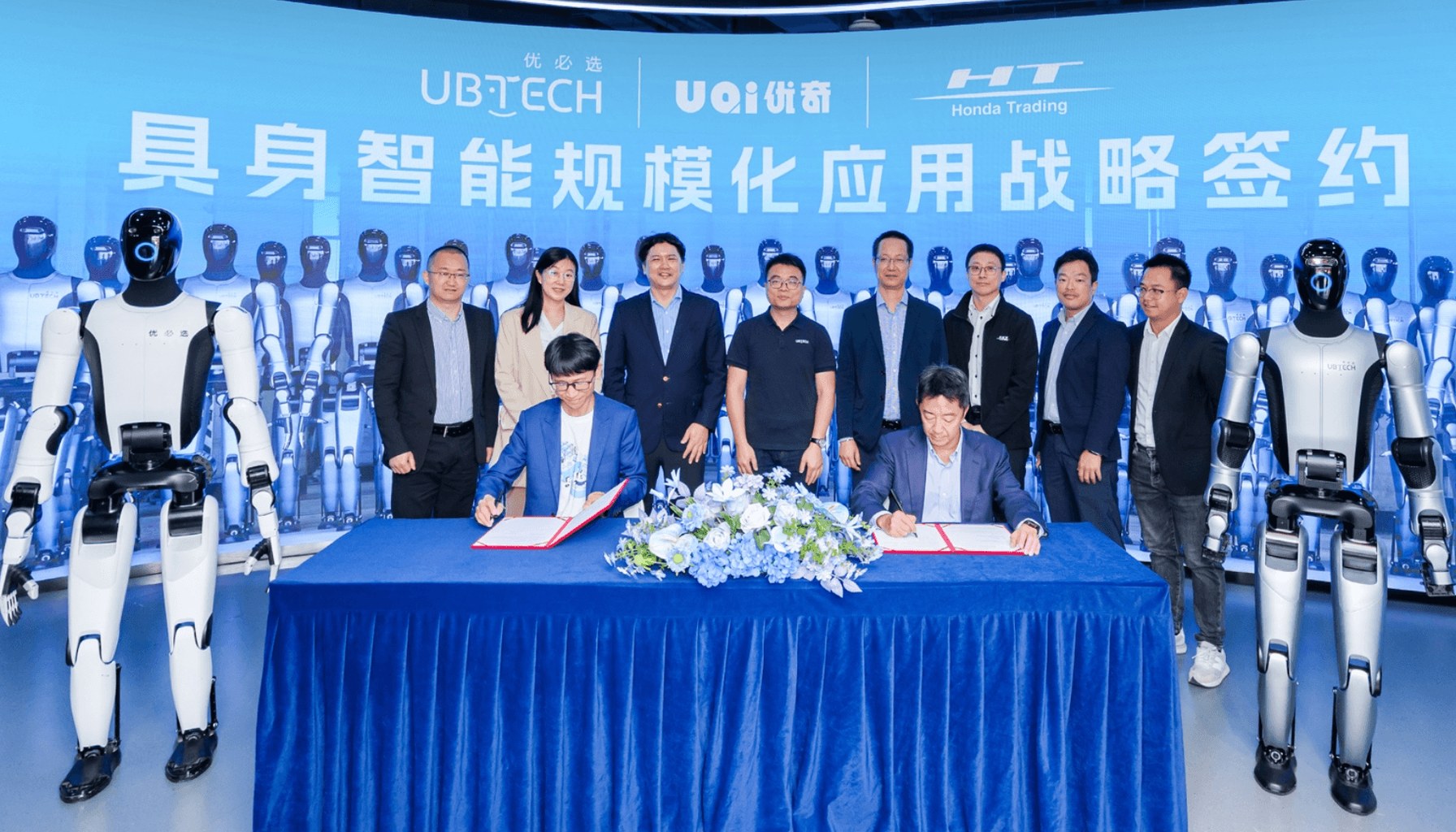
Humanoid robots are about to clock in at Honda's supply chain.
UBTECH Robotics has struck a strategic partnership with Honda Trading (China) Co., Ltd, channeled through its smart logistics unit UQI, to accelerate the commercialization of embodied AI humanoid robots and autonomous logistics vehicles. According to Mandarin-language reporting, the two sides will jointly explore applications of embodied intelligence in industrial manufacturing and warehousing, with pilots planned in Honda Trading’s supply chain and the potential to replicate successful models at scale once conditions mature. The Walker series humanoid robots, UBTECH’s flagship, and autonomous logistics vehicles are central to the plan, aimed at boosting system-level efficiency in automotive and related manufacturing sectors. The collaboration also opens up opportunities to distribute industrial mobile robots regionally and to push joint technological innovation.
This isn’t a one-off tech showcase; it’s a deliberate move to turn robotics from a lab curiosity into a repeatable, scale-ready asset on factory floors. UBTECH brings embodied AI and the Walker platform, while Honda Trading (China) brings deep industrial logistics know-how and a broad supply-chain footprint. The pact signals a push to validate real-world use cases — from assembly-line tasks to warehouse sorting and autonomous transport within manufacturing ecosystems — with a view to broader deployment if pilots prove economically viable and technically reliable.
Industry observers will note how this aligns with a longer-running push in China to translate robotics capability into actual productivity gains. The partnership emphasizes scenario validation and business-model exploration, not merely hardware sales. If pilots prove durable, the model could unlock regional rollouts in sectors hungry for efficiency gains but wary of high upfront costs and integration friction. The plan to “roll out pilot projects within Honda Trading’s supply chain and replicate successful models at scale” underscores a staged approach common in Chinese manufacturing automation: experiment at a controllable scale, then scale up once the ROI and safety case are proven.
From a practitioner’s perspective, there are several critical inflection points to watch. First, the pilot-first approach will heavily shape how success is measured — throughput improvements, error reductions, and uptime gains will need to outpace maintenance and integration costs for a credible business case. Second, integration with existing enterprise systems (MES/WMS, ERP, and factory-floor sensors) will determine how quickly robots can move from isolated tasks to end-to-end process automation. Third, reliability in real-world factory environments remains a gatekeeper: perception, navigation, and safety in dynamic manufacturing settings will test the Walker platform’s robustness against Chinese- and global-supplied automation stacks. Fourth, a successful scale-out will likely hinge on regional deployment capabilities — Honda Trading’s network can serve as a testing ground across multiple sites, which could standardize deployment templates and reduce deployment risk for other multinational manufacturers in China.
The deal also signals a broader competitive dynamic. As China’s robotics ecosystem matures, end-to-end offerings — hardware, AI software, and after-sales services — become more attractive to global buyers seeking a domestically embedded automation stack. Yet execution remains the watchword: pilots must translate into reliable, measurable gains in a diverse mix of manufacturing environments, or the enthusiasm may evaporate as quickly as it appeared.
In short, the UBTECH–Honda Trading partnership reads like a practical blueprint for moving humanoid robotics from the whiteboard to the warehouse floor — with the Walker robots as the first test pilots and Honda Trading’s supply chain as the proving ground.
- UBTECH Partners with Honda Trading to Advance Commercialization of Humanoid Robots and Autonomous Vehiclespandaily.com / Source role not classified / Published APR 07, 2026 / Accessed APR 08, 2026