The company’s July 21 technical posts tie next generation GPU, CPU and rack scale systems to two costly workloads: multi-step agent inference and communication-heavy mixture-of-experts training.
NVIDIA has published three technical posts outlining how it intends to position its next generation AI infrastructure for agentic inference and mixture-of-experts, or MoE, model training.
The company’s July 21 posts describe the Rubin GPU, the Vera CPU and the GB300 NVL72 rack-scale system as parts of a tightly co-designed AI factory. NVIDIA’s argument is that faster accelerators alone will not resolve the bottlenecks created by agent loops and sparse MoE models. The company is instead emphasizing CPU responsiveness, memory capacity, GPU compute, and high-bandwidth networking as interdependent parts of the system.
For agentic AI, NVIDIA claims the Vera Rubin platform can deliver up to 10 times more agentic throughput per unit of energy than Blackwell. The figure is based on an internal 2 trillion-parameter MoE workload, not an independently published benchmark suite.
NVIDIA describes agentic workloads as sustained inference processes rather than one prompt and one response. Those systems may reason through multiple steps, retrieve context, call tools, execute code, verify intermediate outputs and generate further responses. That raises pressure on decode throughput, per-step latency, long-context attention, KV cache capacity and the ability to distribute models across closely connected GPUs.
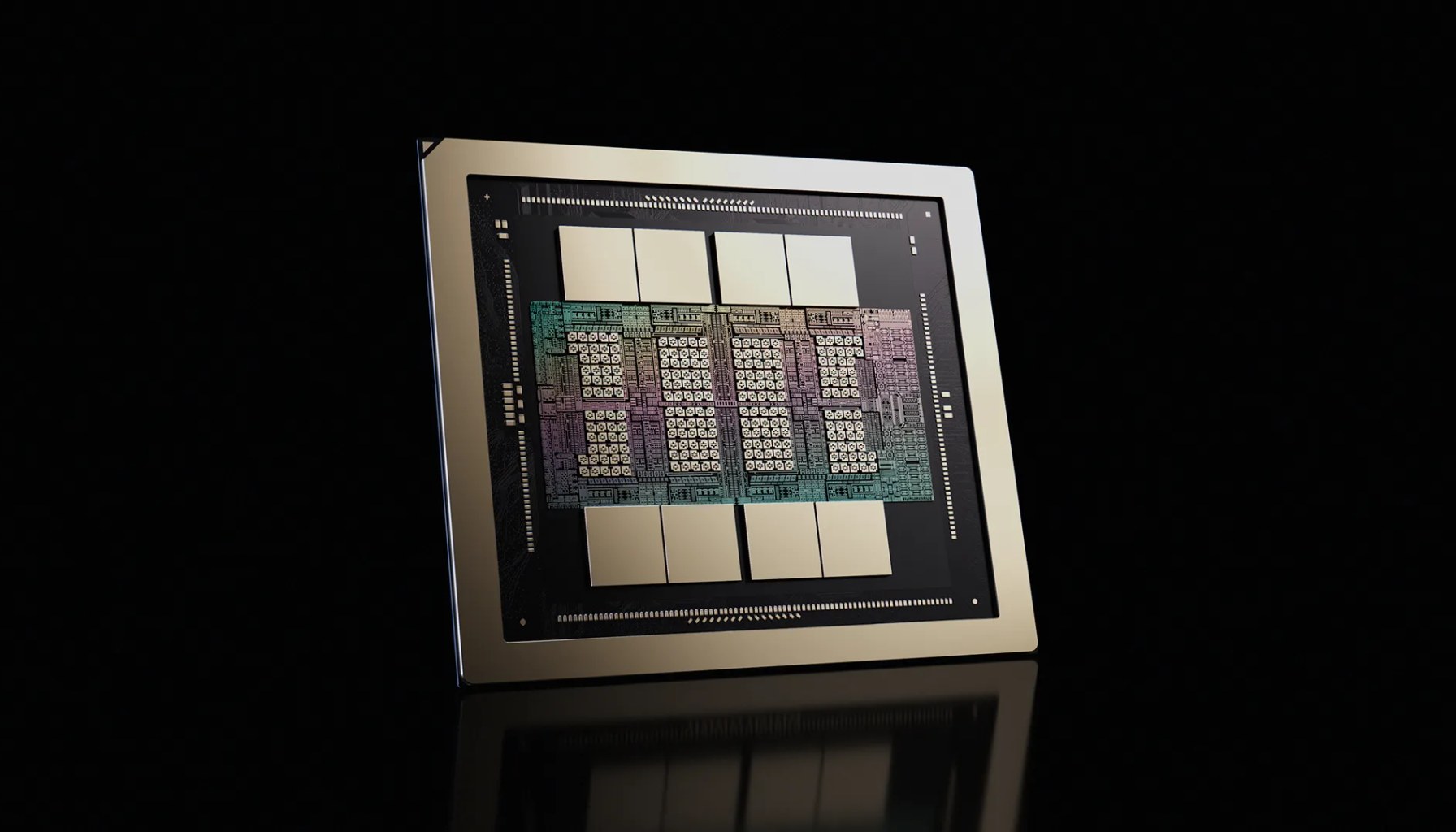
The Rubin GPU is the accelerator NVIDIA is presenting as the compute foundation for those systems. It contains 336 billion transistors, 224 streaming multiprocessors and 896 Tensor Cores, according to NVIDIA. Two reticle-limited compute dies are joined in one package through the company’s High-Bandwidth Interface, or NV-HBI.
NVIDIA says Rubin’s third-generation Transformer Engine and HBM4 memory subsystem are designed to improve both compute efficiency and data movement. The company quotes up to 50 petaflops of NVFP4 inference performance, while noting that the Transformer Engine can adapt numerical precision across formats.
That low-precision figure is useful for estimating the hardware’s theoretical capability, but it does not by itself predict end-to-end agent performance. Tool calls, retrieval systems, CPU-side code execution, network delays and model serving software can all determine the latency users see. NVIDIA’s 10x claim is consequently most relevant as a statement about a specific internal workload and system configuration, rather than a general multiplier for every AI application.
The Vera CPU fills the host-side role in that configuration. NVIDIA says agent systems place more of the critical execution path on CPUs because agents use sandboxes, databases, retrieval systems and external tools alongside GPU inference.
The company says its Olympus CPU core targets high instructions per cycle, strong single-thread performance and predictable latency while a socket is under load. Those priorities differ from conventional cloud processors optimized primarily for high core density and uniform throughput workloads. NVIDIA is particularly targeting branch-heavy, irregular and pointer-heavy software paths, which can limit agent responsiveness even when GPU capacity is available.
The third post shifts from inference to pre-training. NVIDIA said its GB300 NVL72 system set a world record while pre-training DeepSeek-V3, a 671 billion-parameter MoE model, at 1,648 TFLOPs per GPU.
DeepSeek-V3 activates roughly 37 billion parameters per token, NVIDIA said, despite holding 671 billion total parameters. That sparse activation reduces compute per token compared with a dense model of the same total size, but moves a major constraint to communication. Tokens must be dispatched to experts that may reside on other GPUs, then gathered after processing, using all-to-all communication during both forward and backward passes.
NVIDIA’s GB300 NVL72 argument is therefore less about peak GPU math than about delivered training throughput after networking overhead. The company says MoE training requires a scale-up domain with non-blocking, uniform high-bandwidth GPU communication, followed by predictable scale-out networking between domains. NVIDIA identifies NVLink, networking, infrastructure processing and software as parts of that design.
The DeepSeek-V3 result is a company-reported record and has not been externally confirmed in the material published by NVIDIA. The post also does not provide a directly comparable set of configurations, competing systems or full benchmark methodology in the available record. Readers should treat the 1,648 TFLOPs-per-GPU result as evidence of NVIDIA’s intended GB300 positioning, not as a complete independent comparison of MoE training platforms.
The practical message across the three posts is clear. NVIDIA is framing its roadmap around workloads where infrastructure utilization depends on more than a GPU’s peak floating-point throughput. Agent systems need fast sequential progress through CPU and GPU work, while MoE training needs communication performance that remains efficient across large GPU counts.
That framing could matter for infrastructure buyers, competitors and investors because it broadens the comparison from accelerators to full rack and cluster design. It also gives NVIDIA a technical rationale for selling more tightly integrated CPU, GPU, networking and software platforms rather than treating each component as an interchangeable part.
Uncertainty remains around the commercial timeline. NVIDIA’s posts do not specify Rubin or Vera availability, pricing, customer deployments or shipment volumes. They also do not establish whether the three July 21 publications represent a single coordinated product launch or separate technical explanations of systems already on the company’s roadmap.