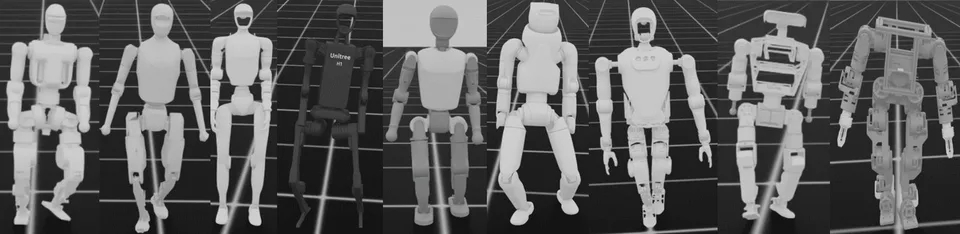
A University of Nevada, Reno paper proposes progress-based rewards to reduce robot-specific tuning in locomotion training.
Researchers at the Advanced Robotics and Automation Lab at the University of Nevada, Reno, propose Multi-Potential-Based Reward Shaping, or MPBRS, for humanoid locomotion. The paper reports a simulation study that reused one reward configuration across nine simulated humanoid robots in a common training pipeline.
In reinforcement learning, a reward is a score that guides which actions a robot should repeat. Engineers often adjust reward weights to balance speed, posture, and stability. Those settings can change when a robot’s body shape, joints, or movement dynamics change.
MPBRS rewards progress between two moments instead of simply rewarding a robot for holding a particular pose. Its three shared signals cover base height, uprightness, and joint regularization, which encourages a suitable joint posture. The method still needs robot-specific joint-name mappings and nominal height targets, so it reduces reward redesign rather than eliminating setup work.
The researchers compared MPBRS with direct reward shaping while keeping the learning setup fixed. Their sensitivity analysis varied shaping weights from 0.1 to 500. On the simulated Fourier N1 robot, the paper reports that MPBRS still converged and tracked commands at a weight of 500, while direct shaping at that setting caused the robot to stand still.
The practical gain was steadier tuning, not much faster learning. The paper reports only modest convergence-speed improvements; direct shaping sometimes appeared faster because it used a different reward scale.
The experiments ran in NVIDIA IsaacLab with 2,048 simulated agents per training run. The paper reports simulation experiments, not a physical-hardware test, so the next step is testing whether this lower tuning burden survives real sensors, motors, and contact forces.