NVIDIA’s TensorRT 11.1 tests multiple engine-building routes, removes inaccurate candidates, and keeps the fastest one that passes.
NVIDIA’s Global Performance Tuner treats TensorRT optimization as a measured search, not a single guess. It builds several versions of an engine for the same model, checks each version against the developer’s accuracy requirement, and selects the fastest version that remains acceptable.
The feature shipped in TensorRT 11.1, according to NVIDIA. It is designed for developers who need more inference speed but cannot simply accept every aggressive optimization.
Why one TensorRT build is not always best
TensorRT turns a trained neural network into an engine that runs on a target GPU. That conversion involves many linked decisions, including how to combine operations, choose implementations, place data in memory, and use numerical precision.
These choices are part of scheduling. A scheduling decision that helps one model may slow another. The best choice can also change when the input shapes, GPU, software stack, or TensorRT version changes.
That makes a universal “best” build route unlikely. TensorRT’s default route uses its standard settings, but those settings may leave performance on the table for a particular model and deployment environment.
The tuner addresses this by exposing compiler knobs. A knob is a setting that changes one part of the build process, such as a fusion decision or code-generation path. TensorRT 11.1 provides more than 200 knobs for tuning, NVIDIA says.
A build route is one concrete combination of those settings. For example, one route might use one fusion strategy while another uses a different strategy. TensorRT then builds a complete engine from each route rather than judging one isolated operation at a time.
How the accuracy boundary works
The developer supplies reference data, an accuracy metric, and a tolerance. These define the application’s acceptance boundary.
The reference data might represent the inputs and expected outputs that matter for the application. The metric defines how the candidate engine’s outputs are compared with those references. The tolerance says how much difference is acceptable.
The tuner uses accuracy as a filter, not as a score that can be traded freely against speed. A candidate that fails the stated accuracy test is removed from consideration, even if it is very fast.
This is important because some optimizations can change numerical results. Lower-precision operations, for example, may improve performance while producing output differences that exceed the application’s limit. A slower, more precise candidate may pass while a faster candidate fails.
In NVIDIA’s described workflow, TensorRT builds each fixed route separately. It measures accuracy and performance for that route, excludes candidates that crash during building or fail the accuracy check during inference, then selects the engine with the best measured end-to-end performance among those left.
In plain English: accuracy decides who is allowed into the race; performance decides the winner.
What “fastest” means here
The tuner compares complete engines in the target environment. That matters because an operation that looks fast by itself may interact poorly with the rest of the model.
End-to-end performance includes those interactions. A route that improves one layer may cause extra memory traffic or reduce the benefit of later operations. Measuring the completed engine captures the result that the deployed application is more likely to experience.
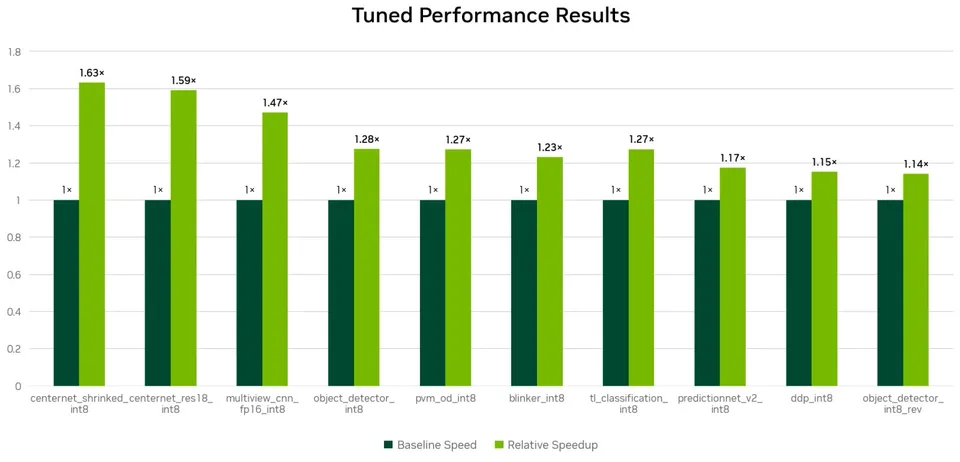
NVIDIA reports that tuning improved performance from 1.14 times to 1.63 times over the default build route across ten evaluated workloads. Those are NVIDIA’s measurements, and the supplied details do not identify the workloads, hardware, software configurations, accuracy metrics, or absolute latency values behind the range.
The result should therefore be read as evidence that route exploration can help, not as a promised gain for every model.
The cost is a larger build search
Trying more routes requires building and measuring more engines. The possible combinations can grow quickly as developers vary more knobs.
NVIDIA recommends treating the default route as a baseline. Its fast search varies one knob at a time, while a mixed search first looks for useful individual changes and then explores combinations involving them. Full search examines every combination in a selected group of knobs, so it is better suited to smaller search spaces.
Developers can inspect the routes before building them with a dry-run option. A tuning cache can record completed routes, performance measurements, and accuracy results so an interrupted search can resume later. NVIDIA also provides a sample implementation through trtexec, its command-line TensorRT tool, and exposes application programming interfaces for custom tuners.
Those controls make the process more manageable, but they do not remove the need to choose sensible tests. The accuracy dataset and metric should represent the conditions that matter in production. A candidate that passes a narrow test has only passed that test.
What changes for developers
The Global Performance Tuner changes the default question from “Which TensorRT setting should we use?” to “Which tested route is fastest for this model and environment while meeting our requirement?”
That is a more practical engineering process. Developers can define the quality boundary first, search within it, and compare complete engines rather than relying only on general compiler rules.
The winning route is also specific to the deployment. NVIDIA says developers should retune after relevant changes to the model, input shapes, GPU, software stack, or TensorRT and tuner versions. A route that helps one deployment may do nothing—or cause a regression—in another.
For teams considering it, the next step is to benchmark the tuner against the default route using representative inputs, a clearly defined accuracy threshold, and the hardware and software stack they actually plan to run.