PriMoRetarget is an arXiv research paper that tests a priority-based way to move human actions onto humanoid robots.
A humanoid robot copying a person’s movement faces a basic engineering problem: human bodies and robot bodies do not line up. A person may reach for a box while standing in a particular stance, but a robot’s joints, proportions, and balance limits are different.
Motion retargeting is the software step that translates one body’s movement into another body’s movement. PriMoRetarget, proposed by researchers from FieldAI, Simon Fraser University, NVIDIA, and the Alberta Machine Intelligence Institute, focuses on difficult actions involving feet, objects, and other characters.
Its central idea is simple: do not treat every part of a motion as equally important.
Why ordinary motion transfer breaks
Many retargeting systems use a weighted list of goals. One goal may match the robot’s pose to the human’s pose. Another may keep a foot near the ground. A third may preserve a hand’s contact with a box.
The system assigns each goal a numerical weight, then searches for a compromise. This works when the goals do not strongly conflict. But a robot may need to choose between matching a person’s upper-body pose and keeping its foot planted.
A weighted compromise can produce motion that looks close to the original but works poorly for a machine. The foot may slide, a hand may drift away from an object, or two robots may lose the spacing needed to carry something together.
PriMoRetarget replaces those soft preferences with an explicit order of importance. In the paper’s experiments, the order is:
- Match foot positions.
- Preserve contact with objects or other characters, when needed.
- Match the remaining pose and interaction details.
That hierarchy answers a practical engineering question: when goals conflict, which one must survive?
How the priority system works
The method adjusts a robot motion through optimization, a repeated search for better joint positions and body movements. At each step, it handles the highest-priority goal first.
For a lower-priority goal, PriMoRetarget calculates which direction that goal would push the robot. It then removes the parts of that direction that would damage higher-priority goals. The remaining update can improve the pose only where it does not immediately disturb the feet or required contacts.
The researchers describe this as projecting an update into a “nullspace.” In plain English, the robot searches for movement still available after protecting the more important constraints.
Suppose a robot must keep both feet planted while holding a box. It may still adjust its hips, shoulders, or elbows to better match the source motion. But it should not improve its arm pose by moving a foot that needs to remain stable.
This differs from simply giving foot placement a very large weight. A large weight still creates a trade-off: enough pressure from another objective can move the foot. PriMoRetarget instead makes the relationship explicit. Lower-priority changes must preserve higher-priority objectives, at least to the first approximation used during each update.
The implementation also divides long motion sequences into per-frame calculations. That makes the priority process less expensive for long clips. Smoothness, joint limits, and avoiding ground penetration are treated as additional objectives outside the strict priority ladder.
What the experiments tested
The paper evaluates PriMoRetarget across four settings: ordinary single-character movement, character-and-object interaction, character-to-character interaction, and multi-character object manipulation.
The experiments primarily use the Unitree G1 as the target robot. The researchers compare PriMoRetarget with three other motion-retargeting methods, including systems based on weighted objectives and constrained optimization.
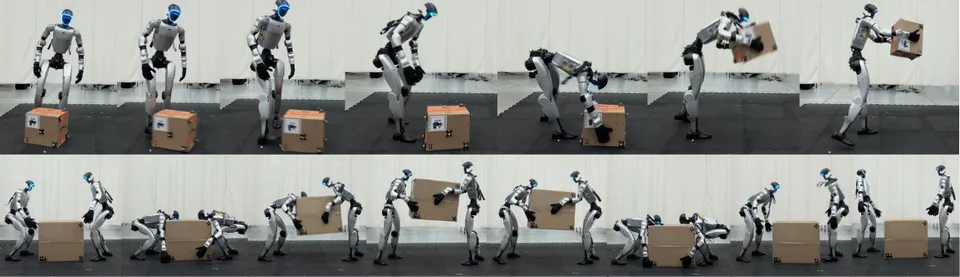
The authors report that PriMoRetarget achieved the highest contact preservation across the interaction settings. It also generally reduced foot sliding compared with the comparison methods. In box-manipulation examples, other methods sometimes distorted the interaction or lost hand contact, while PriMoRetarget kept the intended relationship more closely.
The team also used the generated motions as reference paths for control policies in simulation. These policies attempt to make a simulated robot follow the target motion. Across the reported datasets, the authors say PriMoRetarget produced the highest success rates and lowest body-tracking errors, with larger benefits on interaction-heavy movements.
That result matters because a retargeted motion is not useful merely because it looks correct in an animation. It must also give a robot controller a path that can be followed.
The paper says selected motions were additionally deployed on real humanoid robots, including hardware demonstrations for box manipulation. The supplied research record does not establish how many real robots or motions were used, or how their physical performance compared with the simulated tests. The demonstrations show a hardware step, not a complete deployment evaluation.
What changes for engineers and operators?
Prioritizing contacts does not make every transferred motion physically correct. It tells the optimizer what to protect first.
If the source motion contains jitter, body intersections, or an inconsistent object path, those flaws can pass into the robot motion. The authors also say that priorities are manually chosen today. A hierarchy that works for carrying a box may not be right for climbing, pushing, or recovering balance.
There is a second trade-off. Preserving a hand-object contact may require changing the object’s path or the robot’s pose. The current method largely follows the source object trajectory, which can limit adaptation when that trajectory does not suit the target robot.
So can foot and contact priorities change how human motion transfers to humanoids? Yes: they turn an unclear compromise into an explicit engineering decision. A team can say that keeping a foot planted or a hand on a box matters more than matching every shoulder angle.
But this does not eliminate tuning. Teams still need to choose the hierarchy for each task and inspect whether the source motion is physically sensible. The next useful test is whether the reported gains in simulation and selected hardware demonstrations lead to more reliable performance across varied real-world tasks.
PriMoRetarget is not a robot that understands motion like a person. It is a clearer optimization strategy for transferring motion: protect the contacts that make an action meaningful, then use the remaining freedom to match the rest.