A UC San Diego arXiv research paper reports tool recognition and teleoperation tests, not a clinical product.
A University of California, San Diego team has presented DASH, an adapter system that lets general-purpose robots operate da Vinci Classic and Xi surgical instruments. The work could give robotics labs access to established surgical tools without a complete da Vinci installation, but it remains a research demonstration.
DASH uses each instrument’s built-in latch, so the tools themselves do not need modification. An RFID reader scans a sticker on the inserted tool, then loads that instrument’s joint limits and coupling matrix—the map connecting motor movement to tool movement.
After insertion, the system runs a short zeroing routine. It moves the adapter’s motors and returns them to establish a mechanical reference before accepting teleoperation commands.
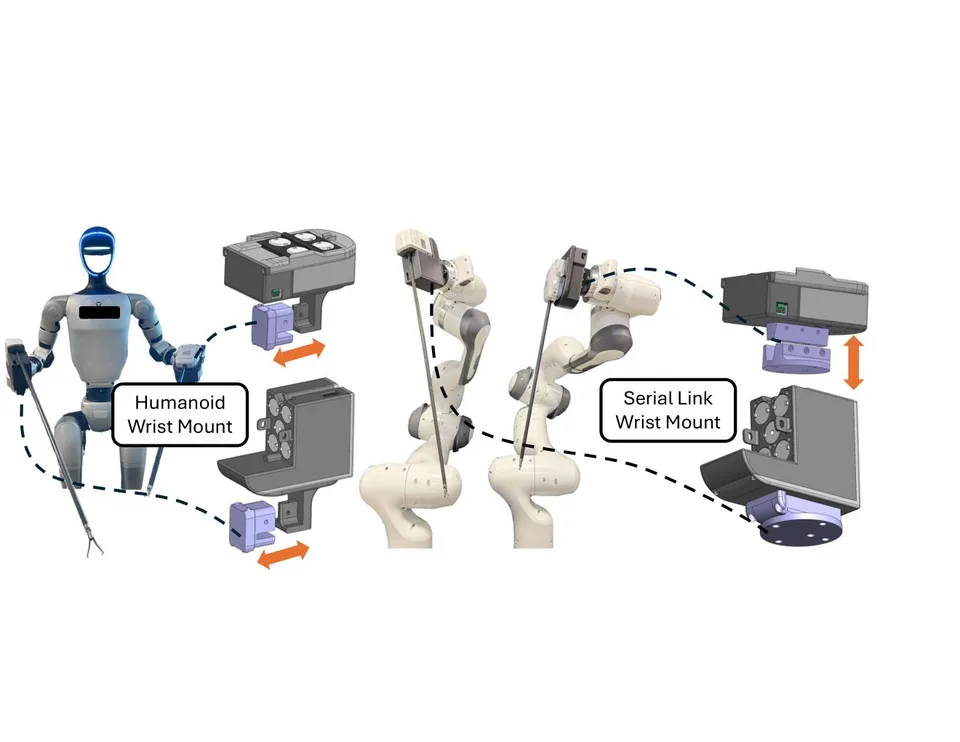
The researchers mounted DASH interfaces on a Unitree G1 humanoid robot and a Franka Emika Panda robot arm. Each adapter weighs less than 0.5 kilograms with a tool inserted, according to the team’s arXiv paper.
In teleoperated tests, an operator used a master tool manipulator to command the robot’s arm and instrument. The paper reports total end-to-end latency of 20.3 ± 15.7 milliseconds. When commanded to draw a 40-millimeter-radius circle, the system produced a 41.45 ± 0.30-millimeter radius across three trials.
DASH also kept the instrument’s shaft within the researchers’ stated remote-center-of-motion requirement, with reported pivot errors of 3.37 ± 2.44 millimeters and 2.64 ± 1.54 millimeters.
The authors say they have not validated a full surgical task, sterilization constraints, or surgeon operation of the control interface. The paper does not establish hospital deployment, regulatory clearance, or commercial availability, so the next practical step is clinical and safety testing—not purchasing a surgical robot.