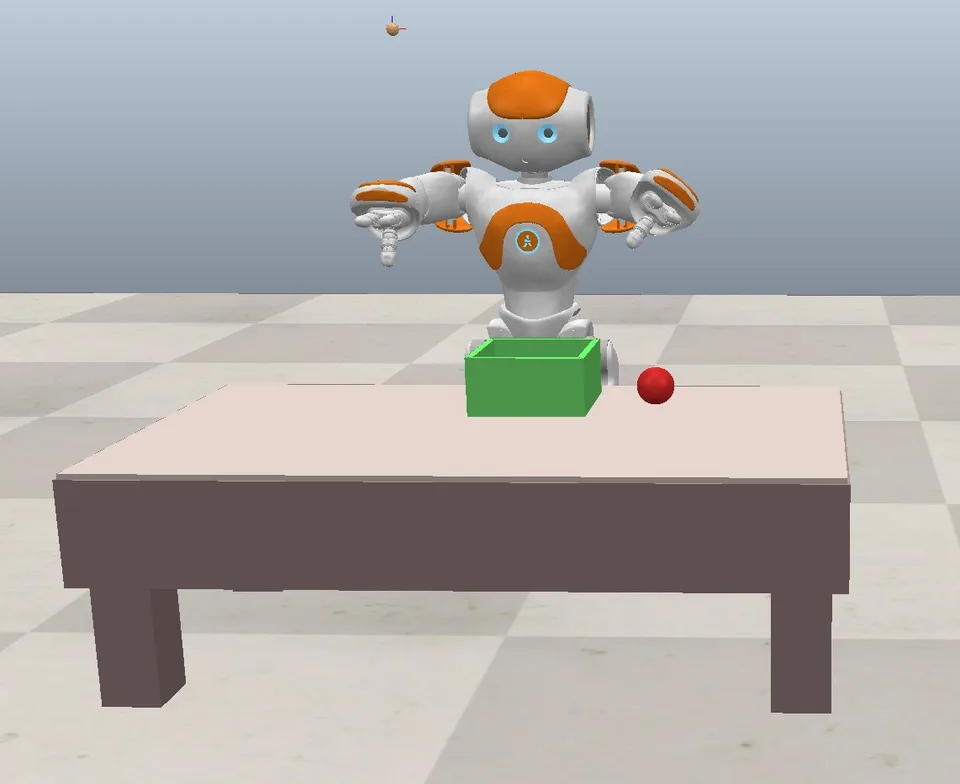
A research paper reports simulation success with 16 demonstrations, while physical tests remain feasibility demonstrations.
Researchers at the University of Tehran and Oakland University propose a learning system that teaches a NAO humanoid robot simple manipulation skills without feeding a model raw video frames.
The system first turns demonstrations into a compact list of useful signals. A Kinect camera tracks a person’s arm joints, while prompt-based object detection identifies items such as a “red ball” or “green box.” Kinect depth data then estimates each object’s three-dimensional position.
A temporal model—software that uses recent moments to predict the next movement—combines those features with task state and execution progress. It outputs robot joint angles, allowing NAO to follow a learned arm trajectory. Because the model learns from task-relevant positions and angles instead of every pixel, the researchers aim to reduce the amount of training data and computation required.
In CoppeliaSim, the paper reports a 78% success rate for pick-and-place after 16 demonstrations, rising to 86% with 100 demonstrations. A separate pushing task reached 71% success with eight demonstrations, including 37 of 50 right-to-left trials and 34 of 50 left-to-right trials.
The researchers also ran representative pick-and-place demonstrations on physical NAO hardware. Those tests showed the pipeline could transfer to the robot, but they were not a broad statistical deployment test.
The practical catch is important: the ball was attached to NAO’s hand with a magnet. That reduces grasping uncertainty, so these results show trajectory learning more than dexterous grasping. The next meaningful test is whether the same feature-based approach works with ordinary gripping, varied objects, and less controlled workspaces.