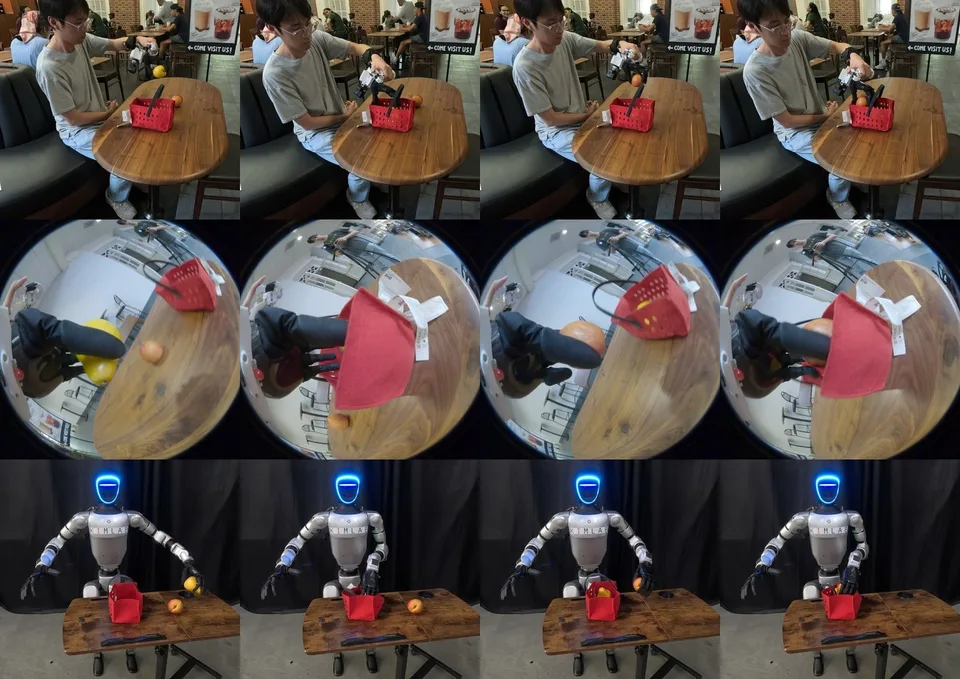
The reported research system logs finger motion, contact, and video, then replays selected demonstrations on a physical humanoid robot.
DEX-PHD is a handheld research system from KIMLAB at the University of Illinois Urbana-Champaign. It combines a dexterous robot hand with triggers and a thumb knob, allowing an operator to control individual finger joints directly.
As the operator handles the device, it records hand positions, fingertip force signals, and wrist-camera video. The paper reports 30 force-sensitive resistors sampling at 100 times per second, a camera capturing 60 frames per second, a total weight of 1.1 kilograms, and a practical runtime of 1.5 hours.
The useful idea is portability. The paper says DEX-PHD could be set up and calibrated in less than one minute. Operators collected demonstrations in a cafe, campus buildings, picnic tables, and courtyards, then replayed them on the physical humanoid setup described in the paper.
That replay was open-loop: the humanoid followed recorded motion rather than continuously correcting its actions from fresh contact feedback. The paper also reports Unitree G1 experiments in simulation, while the physical replay used the humanoid hardware setup.
Researchers evaluated peg-in-hole insertion, multi-object grasping, and drilling. They collected 10 demonstrations for each task, then chose one feasible, lowest-error example for a single physical replay.
The results show replayability, not dependable autonomy. Drilling preserved the main grasp-and-trigger timing, but the full screw-fastening sequence proved difficult to reproduce reliably. The paper’s measurements cover one selected demonstration-replay pair per task, not repeated trials or task success rates. Repeated physical runs will show whether this portable teaching workflow can become reliable enough for real operations.