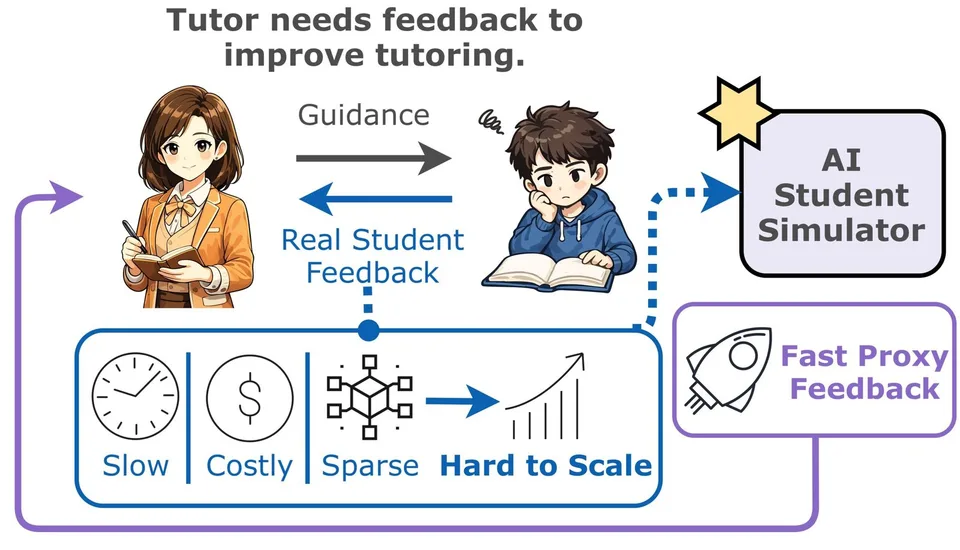
The research system models how individual students answer questions and respond after receiving help, before researchers work with real learners.
An AI tutor’s answer is only part of a lesson. Researchers also need to know what happens next: Does the learner fix the mistake, change the answer after a useful hint, or simply follow a suggestion without understanding?
Microsoft’s StudentSim is a research system built to study that reaction. It creates a personalized simulator for an individual student, allowing researchers to test tutor guidance during development. Microsoft says StudentSim is not a product, is not deployed in classrooms, and is not intended to replace teachers.
The practical appeal is speed. Studies with real learners remain important, but they are slow and costly to run. A simulated student could give researchers an earlier way to compare tutoring strategies before moving to human studies.
What StudentSim represents
StudentSim trains personalized artificial-intelligence student simulators from publicly available learner records with identifying information removed. The system first learns from records pooled across many students in the same subject.
That stage helps it learn common answer patterns, common mistakes, and common ways students revise their work after guidance. The system then specializes in one student’s records, creating a simulator meant to represent that learner.
This approach addresses a weakness in simple role-playing. A general language model can imitate the tone of a struggling math student, but still solve problems using knowledge far beyond that learner’s ability. Such a model might make a tutor appear effective because the simulated student is too capable.
Microsoft’s StudentSimEval benchmark tests two separate abilities. Behavioral fidelity measures whether a simulator matches a particular student’s recorded responses on problems it has not seen during training.
Guidance responsiveness measures whether the simulator changes its response after reading a tutor’s guidance. That guidance could be an explanation, hint, or question.
Both measures matter. A simulator that matches past behavior but never responds to teaching cannot help researchers study whether guidance works. A simulator that follows every tutor suggestion may respond smoothly while failing to represent a specific learner’s strengths, weaknesses, and likely mistakes.
How it tests a tutor
Microsoft describes StudentSimEval across three areas: chess, second-language English writing, and mathematics.
In chess, the simulator predicts a player’s next move and how that move might change after coaching. In writing, it generates essays with error patterns matching a learner and predicts corrections after teacher feedback. In mathematics, it predicts a student’s multiple-choice answer and whether the student changes that answer after an explanation.
The process gives a tutor a simulated learner to work with. The tutor provides guidance, and the simulator produces a revised response. Researchers can then compare the learner’s starting response with the revised one.
That does not directly show whether the learner understood the lesson. It gives researchers a way to examine whether the guidance changed the simulated response in a way that resembles a particular student.
Microsoft reports that StudentSim outperformed the comparison systems across the three domains. In its chess results, StudentSim reached a behavioral-fidelity score of 0.5150 and a guidance-responsiveness score of 0.9067.
GPT-5.4 reached 0.2316 and 0.7186 on those measures. Microsoft also reports that Maia2, a chess-specific human-move prediction model, reached 0.4535 for behavioral fidelity and 0.2721 for guidance responsiveness.
Using the simulator to improve a tutor
The research also tests whether simulated student reactions can help train an AI tutor.
In Microsoft’s chess reinforcement-learning study, the tutor received a chess position and a real student’s previous wrong move. It then generated guidance. The StudentSim simulator read that guidance and produced a revised move, while its own parameters stayed fixed.
The reward depended on how much the revised move improved over the previous move, using Stockfish, an independent chess engine, as the signal for move quality. Researchers compared that tutor with a supervised tutor that received no reinforcement learning and another tutor trained with GPT-5.4 as the simulated-student reward source.
Microsoft reports that the StudentSim-reward tutor reached 90.5% accuracy. The no-reinforcement-learning baseline reached 75.7%, while the GPT-5.4 reward condition reached 71.6%. Human chess experts rated the StudentSim-trained tutor highest across the reported dimensions, including guidance quality and personalization.
Those are results from Microsoft’s reported research study. They show that a student simulator can provide a useful training signal in this chess setup, but they do not establish that simulated feedback reliably predicts what real students will learn.
What changes in practice
For AI-tutor developers, StudentSim could serve as an engineering filter. Teams could compare hints, explanations, and questions against simulated learners before spending the time and money required for a larger human study.
It could also help identify guidance that improves an immediate answer without addressing the learner’s underlying mistake. A useful simulator needs to represent both the learner’s starting ability and the way that learner responds to support.
The limits are important. Microsoft says human studies remain necessary to measure learning outcomes, safety, usability, and classroom fit. StudentSim is an early research signal, not a classroom product or a replacement for real learners.
The next useful test is whether simulator scores track outcomes from people. If they do, systems like StudentSim could help researchers reject weak tutor ideas earlier and focus human studies on the most promising ones.