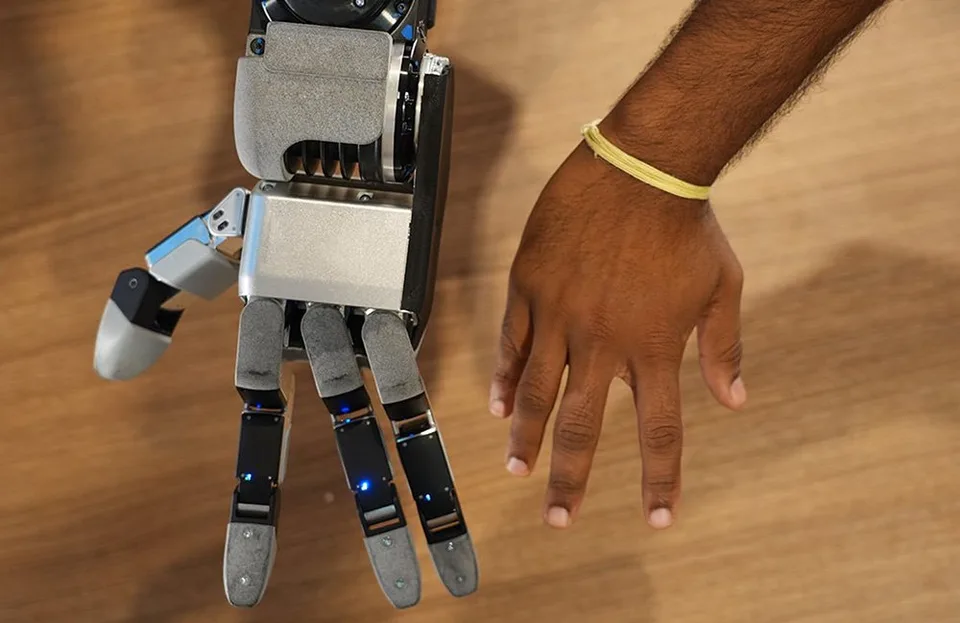
The announced four-finger hand uses identical sealed actuators and has been tested at headquarters, but it is not yet across the Atlas fleet.
Boston Dynamics is designing Atlas’s new hand around a practical question: how can a humanoid hand be built, tested and trained without becoming too complicated to trust?
The announced design has four fingers and 13 degrees of freedom. A degree of freedom is one independently controlled movement, such as bending a finger joint. Boston Dynamics says the hand is intended for mass manufacturing, rather than as a one-off research component.
That choice matters because humanoid hands must balance several competing goals. More joints and mechanisms can create more dexterity, but they also add cost, failure points, control problems and manufacturing work. A hand that looks impressive in a laboratory may be difficult to repair or repeatably build.
Fewer parts, more repeatability
The new hand uses 13 identical, fully enclosed actuators, according to Alberto Rodriguez, Boston Dynamics’ director of robot behavior for Atlas. An actuator is the motor-and-mechanism package that creates movement.
The actuators have no fragile cables crossing the joints. That design can make the hand easier to assemble and service because the same type of unit appears throughout the mechanism, while important transmission parts remain protected inside their housings.
Boston Dynamics also dropped the pinky finger and reduced the gripper’s size. The company says earlier hands were already strong enough to lift objects weighing more than 100 pounds, so increasing strength was not the priority. Instead, the company considered reducing strength somewhat to improve how directly the hand responds to outside forces.
That is a deliberate trade. The hand may give up some possible movements compared with a more elaborate design, but the company is focusing on tasks it expects Atlas to perform. Rodriguez described examples including sliding the thumb along another finger, making a dexterous pinch, and gripping the handles of powered tools.
The company also considered a two-thumb design. It could have allowed one common hand assembly for both sides of the robot, but Boston Dynamics rejected it because the extra mechanisms would add degrees of freedom, cost and physical volume.
This is what “manufacturable” means in an engineering system: not simply that one unit can be built, but that many units can be built with consistent parts, processes and performance.
Testing before the factory floor
Boston Dynamics says it starts with early hardware prototypes and gives them to its systems, controls and behavior teams. Those teams use the prototypes to find problems that are difficult to predict from drawings alone.
The company then subjects the hands and their subcomponents to validation and verification testing. In plain English, that means checking whether the design behaves as expected and whether the hardware meets its requirements.
The testing is not limited to picking up generic objects. The Robot Report quoted Boston Dynamics describing representative industrial tasks such as using handheld power tools, handling cables and fishing for screws. The company also uses comparison tasks and more experimental activities to explore the hand’s limits.
This testing process is meant to catch trouble before deployment. A hand that fails during a controlled test can be redesigned. A hand that fails during a robot’s work assignment may interrupt operations, damage an object or require a difficult field repair.
Rodriguez said reliability helps the company capture data faster and run more experiments. For operators, that points to a basic requirement for useful humanoids: the robot must work often enough to generate learning data, not spend most of its time being repaired.
Why simulation affects the hardware
The hand is also being designed to behave predictably in simulation. Simulation is a computer model that lets engineers test movements and control software before running them on physical hardware.
Boston Dynamics says it designed the hand’s actuation and transmission with “backdrivability” and “transparency” in mind. Backdrivability means an outside force can move the mechanism through its drivetrain. Transparency means the robot’s controls can better reflect what is happening physically, instead of hiding those forces behind motor resistance or mechanical friction.
The company uses control methods to compensate for some actuator problems, including different kinds of friction. That can help the simulated hand behave more like the physical one.
This connection matters for reinforcement learning, a training method in which software improves by practicing many attempts and using the results to adjust its behavior. Training in simulation can provide far more practice than collecting every example on a physical robot, but only if the simulated mechanism is close enough to reality.
Boston Dynamics says the hand can use proprioception in this process. Proprioception is the robot’s sense of its own position and forces, such as recognizing that an actuator is being pushed back. The company’s stated approach is to build actuators that simulate well, then use reinforcement learning at scale.
That could be useful for dexterous work, where contact forces change quickly as fingers touch, slide or squeeze an object. Such movements can be difficult to teach through remote operation or simple demonstrations.
What is ready now?
The new hand remains an announced engineering design, not a broadly deployed Atlas component. Boston Dynamics told The Robot Report that it had used the hands extensively at its headquarters but had not yet deployed them across the entire robot fleet.
The company has not provided a fleet-wide deployment date in the reported interview. It also has not established, through the reported material, how the design will perform across long industrial shifts, what it will cost to produce, or how many units it can build.
For now, the important design decision is clear: Boston Dynamics is not chasing maximum mechanical complexity. It is trying to make a hand with repeatable parts, protected mechanisms and behavior that can transfer from simulation to hardware.
The next meaningful step is broader fleet use and repeated industrial work. That is where the four-finger design will show whether its simpler architecture can deliver reliable tool use outside headquarters testing.