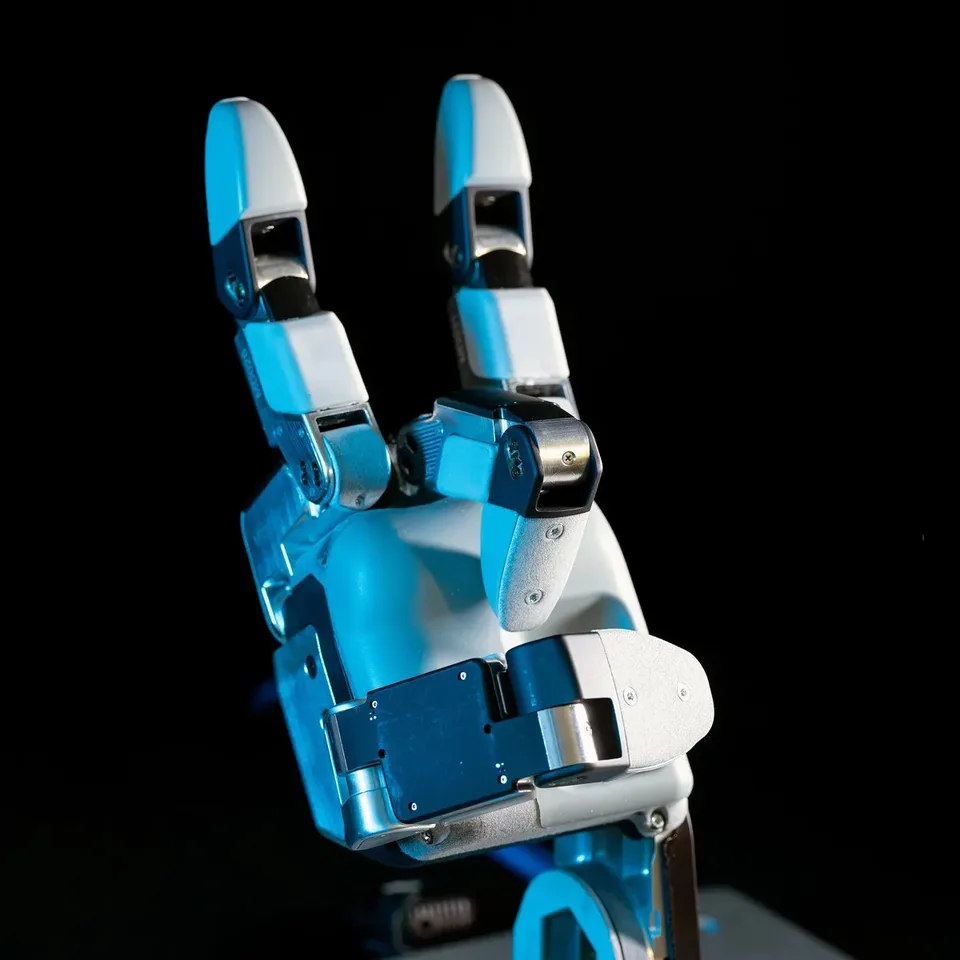
Boston Dynamics trades a humanlike shape for simpler production, tool use, and replaceable hardware.
Boston Dynamics has announced a redesigned hand for Atlas, shifting its focus from research hardware toward a hand that could scale into a product. The redesign is an announcement, not a deployed or commercially available system.
The new hand has four fingers and 13 degrees of freedom, up from seven in the previous Atlas hand. IEEE Spectrum reports that the fingers can spread apart, helping Atlas grip tool handles and operate triggers on equipment such as drills or welding torches.
That extra motion does not mean the hand copies a human hand. Boston Dynamics removed the pinky and accepted a bulkier shape. Alberto Rodriguez, the company’s director of robot behavior, described hands as a “ruthless design trade-off”: adding dexterity can increase fragility, cost, and manufacturing difficulty.
The engineering choice is to use fewer, larger actuators—motors that move the joints. They sit directly inside the joints, rather than pulling delicate tendons or cables across them. Each actuator pack is designed as a replaceable unit, which could simplify repairs if the architecture performs as intended.
IEEE Spectrum says the company is still working through design details for a target of 100,000 hands per year. That is a production goal, not an achieved output. The available report does not establish the hand’s price, release date, durability, or real-world performance.
For operators, the important next step is seeing Atlas use these hands in sustained work, where tool handling, failures, repair time, and operating cost matter more than a convincing human silhouette.