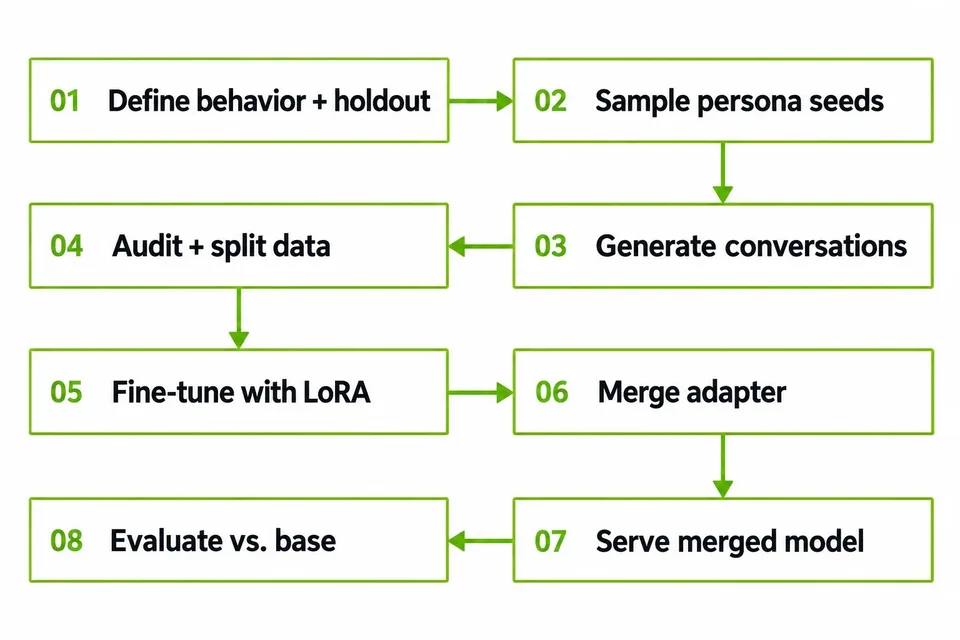
NVIDIA’s workflow combines official procedures, simulated residents, synthetic conversations and LoRA fine-tuning. It is a development recipe, not a ready-made government service.
A developer adapting Nemotron for public-service questions should treat local accuracy as a data and testing problem, not a prompt-writing trick.
NVIDIA’s tutorial shows how to adapt an open Nemotron model for French public-service support. The example covers identity documents and vehicle registration, where a generally fluent answer can still give the wrong fee, filing route or required document.
The workflow uses four main ingredients: a behavior contract, locale-grounded personas, official procedure text and a comparison with the original model. It is directly relevant to engineers building regional AI assistants because it turns vague instructions such as “answer like a French agent” into training data and measurable checks.
Start with a behavior contract
The first step is a behavior contract: a plain-language specification for what the assistant should do and avoid.
NVIDIA’s French example calls for short answers in French, a calm and respectful tone, and facts drawn only from the official procedure text supplied for each question. The assistant should not invent fees, deadlines, documents or filing methods.
The contract also defines safety rules. The assistant should never request passwords, bank details or software installation. When it cannot confirm something, such as office hours, it should say so and point the user to the town hall or an official government website.
These rules address a common failure in general-purpose models: producing a confident answer that sounds reasonable but conflicts with local instructions.
NVIDIA illustrates the problem with a passport question from someone who cannot travel for health reasons. An unadapted model might suggest mailing the application. The tutorial says the relevant procedure instead calls for an official agent to visit the person’s home.
That difference is not mainly about French grammar. It depends on knowing a local exception and presenting the correct next steps.
Give the model varied local questions
The next stage uses Nemotron-Personas datasets. Each persona is a synthetic resident grounded in regional demographic, geographic, language and cultural patterns.
A generic persona might be “a French adult who needs a passport.” A more detailed persona can include a commune, occupation, household and daily-life profile based on French census data. These details shape how the person asks a question and what situation the question describes.
The goal is to vary communication, not to guess someone’s needs or ability from sensitive traits. NVIDIA’s instructions say to leave names and unnecessary demographic details out of the final training data.
The Nemotron data program includes locale-grounded persona datasets for 12 countries. NVIDIA built the France dataset with French AI startup Pleias, and the Belgium dataset with Pleias and KU Leuven. The Belgium dataset covers Dutch, French, German and English.
For the French example, the tutorial samples 2,000 personas and uses them to generate 2,000 customer messages and assistant replies. The conversations are synthetic, but the facts in the answers come from official procedure text paired with each persona.
That pairing is important. Personas create a wider range of questions, while the official documents constrain the answers. Without that grounding, synthetic data could simply multiply the original model’s mistakes.
Filter the data before training
Synthetic conversations are not automatically reliable. NVIDIA’s workflow previews a small batch, checks the output and then audits the full set.
The audit looks for formatting problems, leftover reasoning text and leaked persona names. The accepted records are split into training and validation sets so the same persona does not appear in both.
The tutorial also uses a separate judge model to check generated records. That can speed up screening, but it does not remove the need for human review, especially for government guidance where a small factual error can send someone to the wrong office or process.
The developer then fine-tunes Nemotron with LoRA, short for Low-Rank Adaptation. LoRA adds a relatively small set of learned parameters instead of changing the entire model. In practical terms, it gives the base model an adapter for a particular language, domain and response style.
The adapter can be merged with the base model and served as an adapted checkpoint. NVIDIA’s example uses its NeMo training tools and lists a DGX Station GB300 or DGX Spark as the hardware path for following the tutorial, although the workflow can be adapted to other NVIDIA GPU systems.
That requirement is a useful engineering detail: local adaptation has compute and data-generation costs before an assistant answers its first user.
Test against the original model
Training loss alone cannot show whether the assistant gives better public-service guidance.
NVIDIA recommends sending the same frozen test prompts to both the base model and the adapted model, then comparing the answers one by one. Human review is recommended rather than relying only on an automated score.
The test cases should cover local facts, safety and uncertainty. NVIDIA’s examples include passport costs in Cayenne, whether someone can apply without internet access, and whether a town hall is open on a particular morning. Another test covers a caller who asks a user to install software while claiming to represent the administration.
Reviewers should check exact policy facts, French fluency, regional fit, safety behavior and resistance to typos or short prompts. They should also check whether the model still handles general French instructions outside the public-service task.
The tutorial’s improved answer for the medical-travel case includes a home visit, a medical certificate less than three months old, possible application routes and required documents. NVIDIA presents this as the expected result of the workflow, not as independent proof of a successful live deployment.
The practical lesson
A developer seeking locally accurate answers should not rely on a system prompt alone. The stronger approach is to define allowed behavior, generate varied local questions, tie answers to official procedures, filter the data, fine-tune with LoRA and compare the result against the base model.
Pleias describes the value of grounded training data this way: “Better grounded data is what makes a small efficient regional-specific model viable.” That may improve coverage and reduce blind spots, but persona grounding does not guarantee fairness or proper representation.
The next practical step is to create the holdout test set before training. Include regional exceptions, uncertain questions and safety traps, then require human reviewers to approve the model’s critical answers before putting the assistant in front of the public.