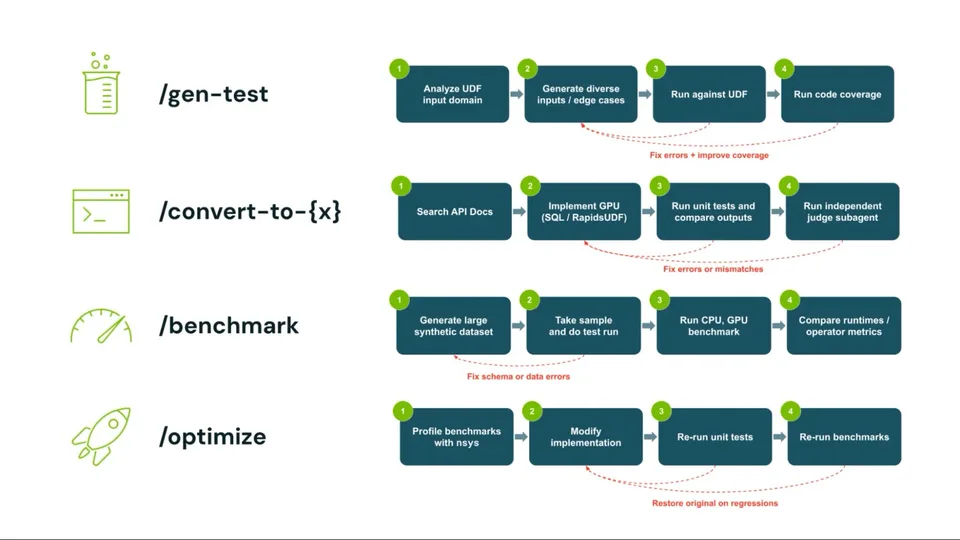
The proposed workflow combines generated code with executable tests and performance benchmarks before deployment.
NVIDIA has published a workflow that uses coding agents to convert Apache Spark user-defined functions, or UDFs, into GPU-ready code. UDFs are custom routines, but they can force an otherwise GPU-accelerated Spark pipeline to move data back to the CPU.
That makes this an engineering tool for AI-assisted software work, not an autonomous replacement for testing. NVIDIA’s cuDF skills give an agent a prepared project with Spark and GPU libraries, test harnesses, output checks, and benchmark tools.
The agent searches unfamiliar programming interfaces, creates a candidate rewrite, runs executable tests, measures performance, and uses the results to revise the implementation. The workflow divides that work into testing, conversion, benchmarking, and optimization feedback loops.
NVIDIA describes three rewrite paths. Simple logic can become a Spark SQL expression. More complex routines can use the cuDF RapidsUDF interface, which processes whole columns on the GPU. The most demanding cases can call a custom CUDA kernel for lower-level control.
The practical safeguard is comparison with the original CPU function. NVIDIA says candidate implementations are selected using measured correctness and performance, rather than accepting generated code merely because it runs.
NVIDIA also reports that an unnamed major consumer technology company converted more than 30 production UDFs. In one example, a 600-billion-row workload reduced operator time from 274.55 hours to 12.78 hours, a reported 22-fold improvement.
Those production and benchmark results come from NVIDIA’s account. The source does not identify the company, hardware, software configuration, or benchmark method, so teams should begin with representative UDFs and compare outputs and runtimes before wider rollout.