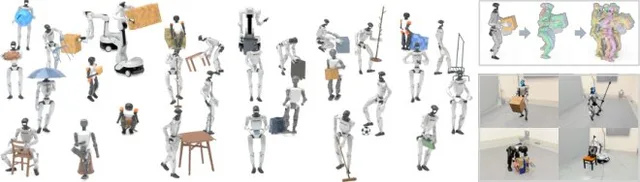
The proposed research keeps a task intact while changing the robot’s posture, object position, or movement—and tests each variation in simulation.
A humanoid robot learning to lift a box needs more than one successful example. A single demonstration shows one body posture, object location, grasp, and balance strategy. InterMimicGen, a research framework from the University of Illinois Urbana-Champaign and NVIDIA, aims to turn that narrow example into a larger collection of executable motions.
The answer to the central question is straightforward: InterMimicGen changes the way a robot performs a task, not the task’s intended result. It then uses physics simulation to decide which new versions are safe enough to add to the training set.
The authors describe the system as “a self-evolving motion-imitation framework in which robot motion data and a tracking policy improve each other.” The work is a research paper, not a product available for purchase.
From human movement to robot movement
The process begins with captured human-object interactions. The researchers combine two motion collections into 16,059 motions, totaling 140.68 reference hours and 157 object entries, according to the paper on arXiv.org.
Human movement cannot simply be copied onto a humanoid. People and robots have different proportions, joints, hands, and balance limits. InterMimicGen uses retargeting, the process of adapting movement from one body to another.
First, the system transfers the relationship between the person and the object. It considers the robot’s whole body, including its feet, pelvis, arms, hands, and the object’s shape. This matters because a robot carrying a box must coordinate its grasp, balance, and steps together.
The method also pays special attention to dexterous hand contact. For example, it encourages the thumb and fingers to approach an object from opposing sides instead of clustering on one surface.
A second cleanup stage reduces collisions, foot sliding, jitter, and unwanted movement. It also preserves hand-object contact. The output is a robot reference motion: a target sequence describing how the robot and object should move together.
That reference is still only a plan. A mathematically valid pose may fail once balance, friction, collisions, and motor limits affect the robot.
A simulated tracker tests the plan
InterMimicGen next trains a physics-based tracker. In plain English, this is a control policy that tries to follow the reference while obeying simulated physics.
The tracker observes the robot’s current state, upcoming motion, and the geometry around the object. It produces joint targets for a lower-level controller, which converts those targets into movement in the simulator.
This is different from playing an animation. An animation can show a hand reaching a box even if the robot would fall or pass its fingers through the object. A physics-based tracker must keep the body upright, preserve the intended interaction, and respect the robot’s movement limits.
The tracker becomes the system’s first execution filter. It shows which modified motions the simulated robot can actually perform.
The system changes motion in two ways
After a reference succeeds, InterMimicGen creates nearby variations.
Object edits change where the interaction happens. A box might be placed farther to the left, for example. The robot must then adjust its reach, stance, and body movement while still grasping and placing the box.
Body edits change how the robot performs the same interaction. The robot might crouch more deeply, widen its stance, turn its pelvis, shift an elbow, or change its toe angle. The object path and intended hand contacts remain fixed.
These edits do not create an unrelated skill. They produce different physical realizations of an interaction already shown in the original demonstration.
The system then fine-tunes the tracker on the new candidates and runs them in simulation. A candidate is kept only when its rollout reaches the end without early termination or a fall, passes motion-smoothness checks, and preserves the task outcome, such as holding or placing the object.
A failed candidate does not become the starting point for another edit. Successful candidates become parents for the next round. This creates the feedback loop: the motion collection grows, and the tracker learns to execute the new motions.
What the reported growth means
The paper reports five rounds of self-evolving motion imitation.
For bimanual interactions with a G1 robot and Inspire hands, the verified reference collection grew from 21.8 times the original size after round one to 150.5 times after round five. For G1 with Dex3 hands, reported growth increased from 21.3 times to 142.0 times.
For grasping interactions with Inspire hands, the collection grew from 19.6 times the original size after round one to 146.4 times after round five.
These figures count accepted simulated references. They do not mean the robot gained 150 times more general-purpose intelligence. The variants are generated around existing demonstrations and must pass the researchers’ simulation and validation process.
The paper also reports that the evolved tracker completed nearly all accepted references while retaining performance on the original ones. Average foot sliding rose from about 1% to about 2% of contact frames as the accepted motions moved farther from the original demonstrations.
That is a familiar engineering tradeoff. A wider operating range can introduce small quality costs. The important question is whether those costs remain acceptable on physical hardware.
Where deployment reality begins
The work is mainly a simulation-based training and validation method, with reported real-robot executions as a transfer demonstration. The paper shows box lifting and placement, suitcase pulling, tripod carrying, and chair relocation across several robot platforms.
Those demonstrations indicate that some generated trajectories can run on real robots. However, the paper describes the real-robot transfer qualitatively rather than giving comparable success and failure rates for each platform.
That distinction matters for operators. A simulator can reject falls and failed placements under the conditions it models. It cannot automatically represent every change in floor friction, object weight, sensor error, or workspace layout.
InterMimicGen is therefore best understood as a way to expand training data, not as a ready-made humanoid deployment system. Its practical next step is clear: test whether accepted motion variants remain reliable with unfamiliar objects, surfaces, loads, and real operating conditions.