The proposed research turns two-person videos into robot-ready interaction sequences, then demonstrates them on a Unitree R1 Edu using mostly predefined motions.
A robot cannot simply copy a person’s pose and expect a hug, handshake, or dance to work. Human bodies have different proportions from humanoids, and interaction depends on details such as distance, timing, facing direction, balance, and contact.
HumiTransfer is a proposed research framework designed to handle those relationships. In a paper published on arXiv, its authors describe a pipeline that starts with ordinary videos of people interacting and ends with motion that a humanoid can execute. The work is a research demonstration, not a consumer robot product people can buy.
First, the system reconstructs the people
The input can be an “in-the-wild” video from sources such as YouTube, TikTok, or Facebook. These videos may have unstable cameras, poor image quality, or people partly blocking one another.
HumiTransfer first tracks the two people in each frame and detects important body positions, such as joints. It then reconstructs a three-dimensional body model for each person. This process estimates where the body parts were in space, not just where they appeared in a flat image.
The system also corrects the feet. A video estimate might show a foot sliding across the floor or sinking below it. HumiTransfer fine-tunes the reconstruction so feet maintain realistic ground contact and the body remains better aligned with the ground.
That step matters because small errors at the feet can become large errors when the motion is transferred to a machine. A humanoid that begins with an unstable stance may fail before the interaction even starts.
The researchers applied this process to 1,200 two-person interaction videos. The resulting HumiMimic dataset contains about 500,000 processed frames, or roughly 4.6 hours of video. The examples include co-movement, social exchanges, sports, and sparring.
It transfers relationships, not just poses
A basic motion-retargeting system might match a human’s arm, leg, or head positions to the nearest robot joints. That can produce a recognizable pose while ruining the interaction.
For example, the robot’s hand might reach toward the right place but stop too far from its partner. A robot scaled to a different body shape might also raise its shoulder or turn its torso in a way that breaks the intended contact.
HumiTransfer instead models relationships between the two bodies. It compares directions and distances between joints on the acting person and joints on the partner. In plain English, it asks questions such as: Which hand is near the partner’s shoulder? How far apart are their torsos? Is the robot facing the same way?
The method gives extra importance to body parts that appear central to the interaction. It also gives more weight to nearby body parts, where a small error can change whether contact succeeds.
The robot first receives a rough pose through inverse kinematics, a standard method for calculating joint angles needed to place a hand, foot, or other body part at a target location. HumiTransfer then adjusts that pose to preserve the important spacing and directional relationships from the original human interaction.
This adjustment is not identical across robots. The paper reports transfers to the 26-degree-of-freedom Unitree R1 Edu and the 23-degree-of-freedom HighTorque Mini-hi. “Degrees of freedom” here means independently controlled joint movements.
A final pass checks physics
The transferred motion can still contain problems. A robot may lean too far, collide with its partner, or lose intended contact while trying to follow the reference pose.
HumiTransfer adds a post-retargeting optimization stage. It works to maintain balance, preserve intended contact, and avoid unwanted collisions between the robot and the human.
The authors report that the method scored better than the comparison methods on joint-position error, interaction-distance error, and contact preservation for both humanoid embodiments. Those are useful engineering measures, but they describe the paper’s experiments rather than a guarantee that every new video will work.
Body shape remains a hard limit. The paper says the HighTorque Mini-hi’s broad shoulders and short arms prevent it from hugging a human partner in the same way as the Unitree R1 Edu.
What reached a real robot?
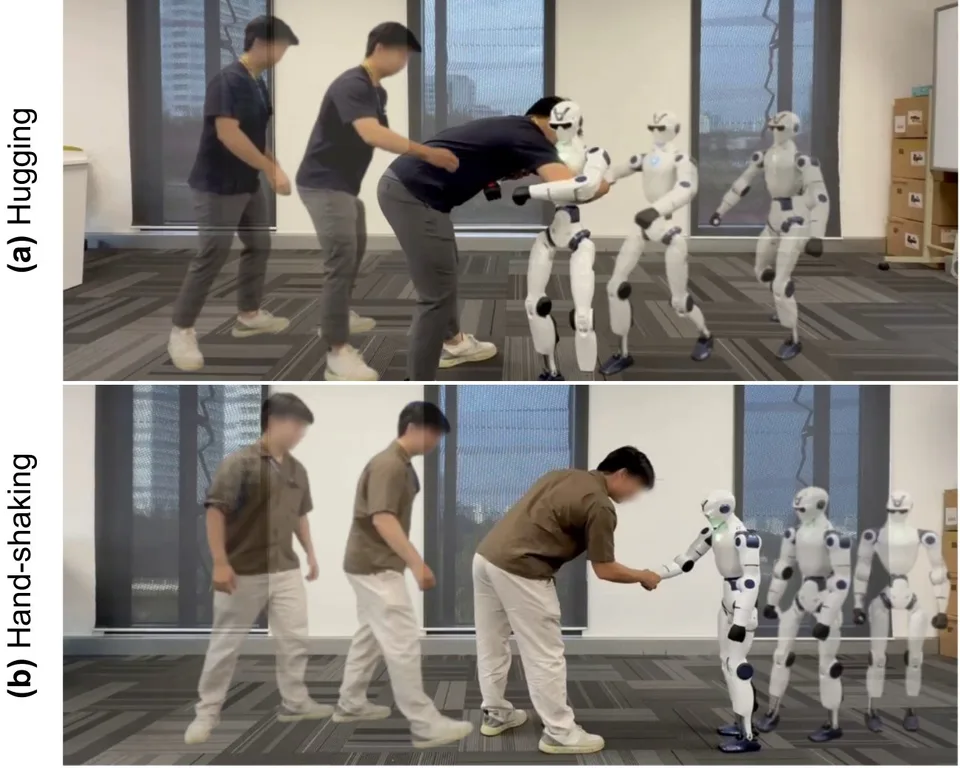
The authors physically demonstrated transferred interaction tasks on a real Unitree R1 Edu with a human partner. The reported examples include hugging and handshaking.
Before execution, the team optimized the HumiMimic motions for the robot’s joints and checked them against the robot’s motion constraints. They trained a 26-action motion-tracking policy in simulation, then ran the resulting controller on the robot. The controller reads the robot’s motor states and inertial measurement data at 50 times per second.
That sounds like a live social robot, but the deployment has an important boundary. The authors say the current real-robot system mainly relies on predefined motion sequences and does not yet explicitly account for the human’s movement during execution.
In other words, the robot can perform a prepared interaction sequence after the motion has been planned. It is not yet shown to watch a partner in real time and continuously change its movement when that person steps closer, pulls away, or moves unexpectedly.
Why the approach matters
The practical idea is to use the internet’s large supply of human interaction videos as a source of robot motion. That could reduce reliance on specialized motion-capture equipment or lengthy teleoperation sessions.
The difficult part is not making a humanoid move. It is making the movement preserve the reason the interaction works: the right distance, orientation, timing, contact, and balance for a particular robot body.
HumiTransfer shows a structured way to do that and demonstrates selected motions on one real humanoid. The next useful test is broader physical operation with partners who move unpredictably. Until the system responds to those changes rather than following mostly fixed sequences, it is best understood as a promising motion-transfer pipeline—not a ready-made social robot.