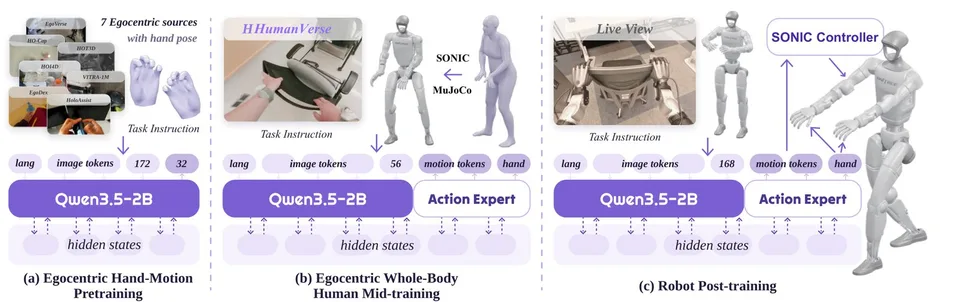
The proposed HumanVerse pipeline aligns first-person recordings with Unitree G1, then uses robot data to finish training.
Researchers describe HumanVerse, a 500-hour dataset pairing first-person video with synchronized body and hand motion. The corpus contains 32,993 episodes and 87 million pose frames, covering whole-body activity rather than isolated hand movements, according to the authors’ arXiv paper.
The pipeline matches the human camera viewpoint and capture height to the Unitree G1 humanoid. It masks human forearms and wearable trackers, fills those regions in, and composites rendered G1 arms into the images. This makes the recorded scenes closer to the robot’s view without requiring a robot during human data collection.
The harder step is turning human movement into robot-compatible actions. The authors scale and adjust body motion for G1’s proportions, use inverse kinematics—a method for calculating joint positions from target locations—and refine motion references and controller inputs offline.
On about one hour of data across 50 tasks, the authors report reducing average end-effector position error from 17.03 to 3.83 centimeters. Orientation error fell from 36.06 to 10.85 degrees.
Training has three stages: egocentric hand-motion pretraining, whole-body training on HumanVerse, and robot post-training. The final policy uses G1’s camera image, a language instruction, and internal body-state readings; it does not need human motion streams while operating.
In the authors’ reported evaluations, the policy reached 90% success in the SIMPLE simulation benchmark and 62.5% average success across four real-world tasks. The results are research experiments on G1, not a commercial product or deployment. The key next test is whether the alignment works reliably on other robot bodies, tasks, and operating conditions.