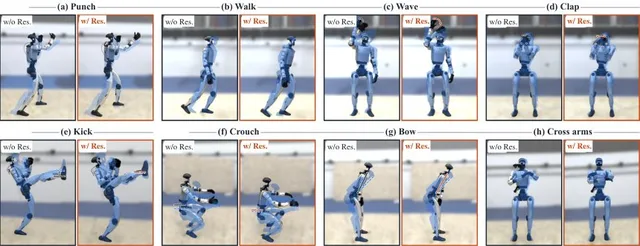
A University College London research paper adds small, activity-aware corrections while a Unitree G1 follows a whole-body motion plan.
A humanoid robot can perform the correct action and still make it look wrong. It may wave with too little reach, bow with too little forward lean, or crouch without lowering its body enough.
Researchers at University College London propose a control method for that problem. Their paper adds a correction layer to an existing whole-body motion tracker instead of replacing it. They report simulation and physical experiments on a Unitree G1 across eight motion categories.
This is a research method tested in simulation and on robot hardware, not a consumer product people can buy.
Why tracking accuracy is not enough
A whole-body tracker takes a reference motion and turns it into joint-position targets. It must also keep the robot stable and work within physical limits. Those demands can force the executed motion away from the original reference.
A common way to score the result is positional error: how far the robot’s joints or body points are from their targets. But a low average position error does not guarantee that the robot preserved the movement’s important qualities.
For example, a robot might follow the general path of a wave while moving its hand through a smaller arc. During a bow, it might place several body points near their targets while keeping its torso too upright.
The paper turns those qualities into five measurable features:
- Amplitude: how far selected body parts move.
- Energy: a measure of how much joint angles change, not mechanical energy.
- Body expansion: how open or compact the upper body is.
- Body lean: how much the torso bends forward.
- Pelvis height: how high or low the robot’s central body sits.
These measures give the controller specific goals instead of asking it to make motion generally “more expressive.”
A correction layer, not a replacement brain
The method starts with a pretrained whole-body tracker, which the researchers keep fixed. That tracker supplies the robot’s normal joint-position targets.
A second controller, called a residual policy, adds a limited correction to those targets. In plain English, the original tracker proposes the motion, and the residual policy nudges it toward the desired amplitude, posture, or movement intensity.
The correction is bounded so it cannot freely rewrite the original action. This helps the added controller preserve the tracker’s existing behavior while addressing expressive differences.
The researchers train the residual policy with reinforcement learning. This approach improves a controller through repeated trials and reward signals. Here, the reward combines preservation of the five selected features with tracking limits and smooth changes in the corrections.
The training has two stages. First, the researchers train separate correction policies for different motion categories. They then distill those policies into one unified policy for each frozen tracker. Distillation means training a shared policy to reproduce useful behavior learned by several specialists.
How motion-aware gating works
The method’s distinctive feature is its motion-aware gate. The gate gives larger correction ranges to body parts that are more active in the reference motion and smaller ranges to quieter parts.
During a wave, for instance, the arms may receive more freedom than the legs. During a bow, the torso and legs may need larger adjustments while other body groups remain more restricted.
The gate does not shut down quieter regions completely. They retain some correction capacity for postural changes. That matters because changing posture can require coordinated adjustments beyond the body part that appears most active.
This design addresses a basic engineering tradeoff. Large corrections may restore a gesture’s intended quality, but they can also interfere with tracking. Small corrections protect the original motion but may not change the visible result enough.
The residual policy therefore works within the tracker’s existing control structure rather than competing with it at every joint.
What the experiments found
The authors evaluated the method in simulation and on a physical Unitree G1. The eight motion categories were walking, kicking, punching, crouching, waving, clapping, crossing the arms, and bowing.
For the physical evaluation, they selected three references per action and tracker. Each reference ran once in each condition, for 144 executions overall.
The researchers report lower errors for all five selected characteristics on the tested Unitree G1 references when residual compensation was enabled. In simulation, they also report better preservation of those characteristics than the corresponding comparison methods.
That improvement involved a tradeoff. In the main comparison, positional tracking error was higher than with a tracking-focused residual method, although it was slightly better than frozen tracking for one tracker.
In other words, the controller was not improving every score at once. It was giving priority to selected movement qualities, such as lean or amplitude, while accepting some additional positional difference.
The simulation comparison also reported high completion rates: 100% for one tracker, a small change from 98.33% to 98.27% for another, and an increase from 99.48% to 99.89% for the third when compensation was added. Those figures belong to the simulation evaluation, not the physical executions.
What this does—and does not—show
The five descriptors are useful engineering targets, but they do not represent every expressive feature a person might notice. Agreement on those measures does not prove that every expressive cue was preserved.
The paper also reports that improving one feature can hurt another. Adjusting body lean may require compensating motion from the hips or legs, which can change limb amplitude, movement energy, or pelvis height.
The physical test covered selected references on one humanoid platform. It shows how the method performed on those tested Unitree G1 motions, not how it would behave during unpredictable work, contact-heavy tasks, or operation on other robots.
The practical answer to the reader’s question is simple: the controller preserves selected expressive features by measuring how the robot’s motion differs from the reference, then adding bounded corrections to the original joint targets. Motion-aware gating concentrates those corrections where movement is most active while leaving the underlying tracker in charge.
The next important test is whether that balance holds across new robots, motion libraries, and real-world tasks where stable execution matters as much as expressive movement.