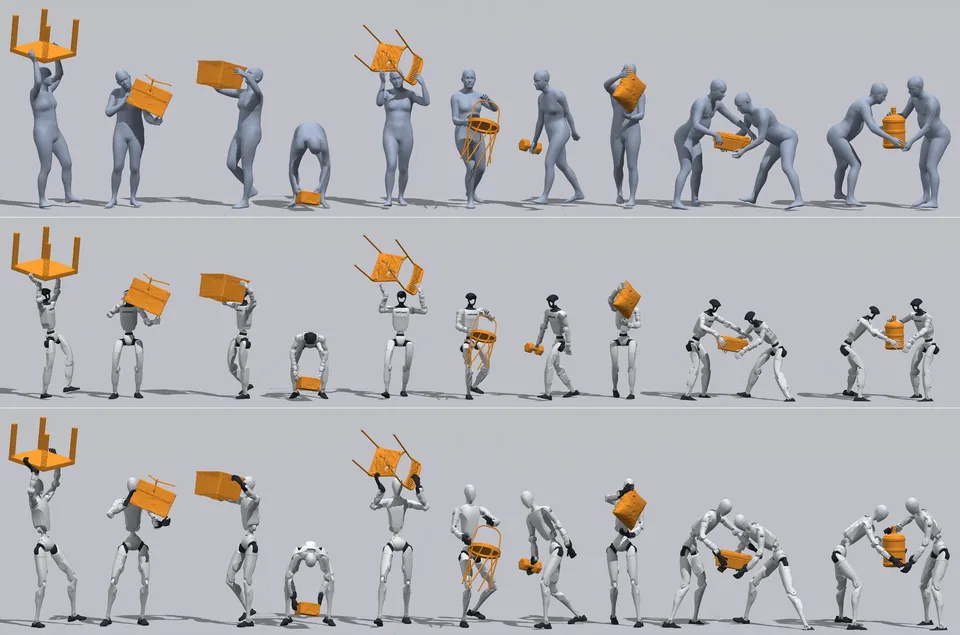
ETH Zürich researchers propose a contact-focused pipeline for turning human demonstrations into robot motion references, not a ready-to-run humanoid system.
A person’s hand may touch a chair, box, or table at a very specific spot. HOI-Retarget preserves that location by measuring contact relative to the object, rather than copying body pose alone, according to the ETH Zürich Robotic Systems Lab authors.
The pipeline first uses inverse kinematics, which maps a human pose onto a robot’s joints. It rescales the object and its movement to fit the robot’s body, then runs a windowed trajectory optimization over short, overlapping motion segments.
That optimizer balances four goals: matching the human’s movement, reaching labeled contact points, keeping the feet supported, and staying within the robot’s joint and speed limits. Because the contact target is stored in the object’s coordinate frame, it moves with the object if the robot carries it elsewhere or changes its size.
In the paper’s common comparison subset, the method was tested on 3,997 clips that all compared methods could solve. Contact metrics covered 3,604 clips containing hand-object contact. On that subset, the authors report reducing average contact-point error from 18.3 centimeters with OmniRetarget to 0.5 centimeters, while cutting processing time from 156.2 to 33.7 seconds per clip.
The authors also released code and 6,952 robot interaction clips totaling 13.8 hours across 75 objects, with references for multiple humanoid platforms. Their dynamic-refinement tests used simulation rather than deployed robots.
The current model treats each hand as a palm contact. It does not preserve finger closure, detailed contact patterns, or grasp forces. Future hardware trials will need to show how these references handle friction, balance, sensing errors, and other conditions outside simulation.