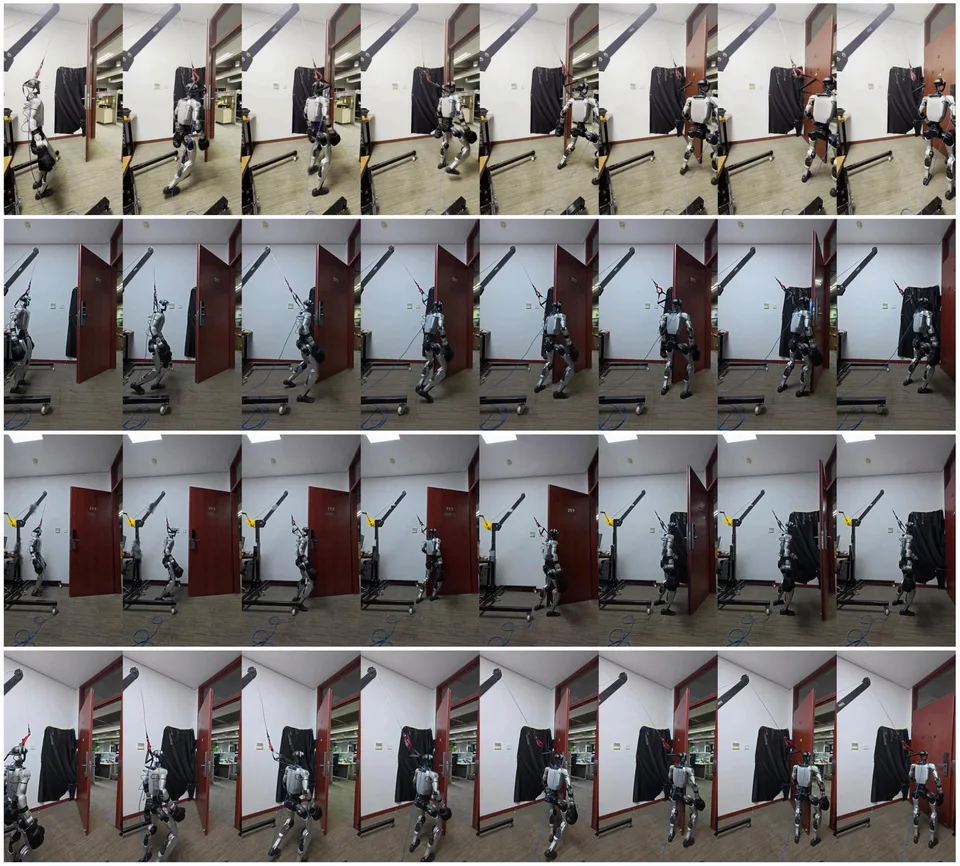
The research demo combines human motion, physics simulation, and onboard depth sensing.
ViLoMan is a research framework that helps a Unitree G1 humanoid approach, contact, and close a door. Researchers affiliated with the Chinese Academy of Sciences, the University of Chinese Academy of Sciences, and the Beijing Academy of Artificial Intelligence describe it in an arXiv paper.
The system starts with partial human door-closing demonstrations, which mainly show the interaction itself. It retargets those motions to the humanoid, adds approach paths from different starting positions, and refines the movements with physics-based simulation so they remain physically executable.
During training, a “teacher” policy uses extra information, including motion references and door states. A student policy then learns from that teacher through Dataset Aggregation, which adds corrective examples from situations the student encounters during training.
At runtime, the student uses head-mounted depth images and proprioception—measurements of the robot’s own joints and body motion—to produce joint-level actions. It needs neither a scripted motion reference nor intermediate task commands.
The authors evaluated ViLoMan in simulation and on a physical Unitree G1. In the physical test, the robot completed 32 of 40 trials across eight combinations of door angles and starting poses, an author-reported 80% success rate. Successful attempts averaged 6.6 seconds.
This is a focused research demonstration of articulated-door closing, not a general household robot. The practical next questions are whether the approach transfers safely to more varied doors and contact tasks, and whether independent tests confirm the reported results.