China’s latest figures show rapid sales and production growth, while most reported demand still comes from research, education, and performances rather than factory work.
Humanoid-robot shipments are rising quickly, but the latest Chinese industry figures do not yet show widespread productive use in factories.
A September analysis by TMTPost examined Chinese robotics companies’ 2026 interim reports, research spending, losses, and reported shipment destinations. Its figures suggest that the market is expanding, but much of the demand remains tied to early-stage uses such as laboratories, classrooms, education-related data collection, and entertainment.
That distinction matters. A robot sold to a university or used in a performance is not the same as a robot completing stable production tasks and delivering measurable savings every day.
Revenue is growing faster than profits
TMTPost reported that more than 80% of 119 A-share companies in China’s humanoid-robotics concept sector recorded year-on-year revenue growth during the first half of 2026. More than half also reported year-on-year net-profit growth.
Several major robotics companies more than doubled their revenue. UBTECH reported first-half revenue of 1.269 billion yuan, up 104.2% from a year earlier. Dobot reported 316 million yuan, up 106.6%, while ROKAE reported 415 million yuan, up 135.8%, according to TMTPost.
Their losses, however, remained substantial. UBTECH reported a net loss of 339 million yuan. Dobot lost 108 million yuan, with its loss widening 164% year on year. ROKAE reported a net loss of 79 million yuan.
These losses do not necessarily mean the companies cannot make money on individual products. TMTPost reported first-half gross margins of 44.7% for UBTECH, 47.4% for Dobot, and 29.8% for ROKAE. Gross margin measures what remains after the direct cost of making a product, before expenses such as research and administration.
The figures instead show companies spending heavily to develop future products while the technical direction of humanoid robots remains unsettled.
UBTECH spent 303 million yuan on research and development in the first half, up 38.9% year on year. Its research workforce grew to 1,103 people. Dobot’s research spending rose 148.4% to 102 million yuan, with the company directing much of that spending toward embodied-intelligence technology, which connects artificial intelligence to actions in the physical world.
Unitree also increased research spending. TMTPost identified that rise as a major reason for the company’s lower profit during the period.
In practical terms, companies are using current revenue and investment to improve their technology and prepare for future demand. That may support long-term growth, but it does not by itself prove that customers are receiving strong economic returns from deployed humanoid robots.
Most shipments are not factory deployments
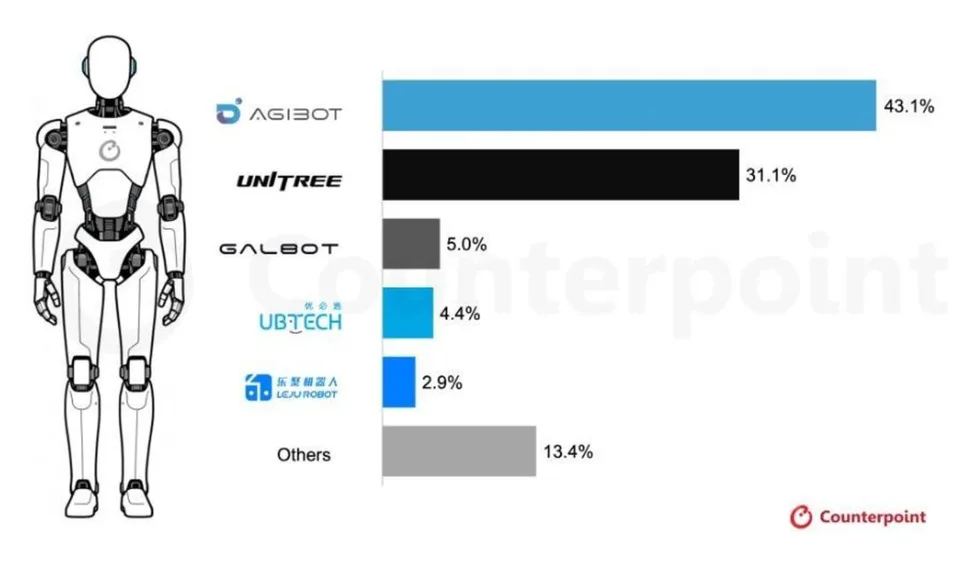
Counterpoint Research figures cited by TMTPost put global humanoid-robot shipments above 22,000 units in the first half of 2026, up nearly 300% from a year earlier. That means shipments were nearly four times the previous year’s level, not merely nearly three times as high.
AgiBot accounted for 9,700 reported units, followed by Unitree with 7,000, Galbot with 1,100, UBTECH with 1,000, and Leju with 650. TMTPost said these five companies together represented 86% of the reported market.
The destination of those robots matters more than the headline total. TMTPost, citing Counterpoint, reported that entertainment performances and education-related data collection together accounted for more than 60% of global humanoid-robot shipments during the first half of 2026.
Smart manufacturing represented 13%, while warehousing and logistics represented 5%. Combined, those categories accounted for less than one-fifth of shipments.
These are shipment-destination figures from Counterpoint as cited by TMTPost. They are not a direct count of robots that ran continuously in factories, completed production targets, or generated profits for their operators.
The same pattern appears in Unitree’s reported revenue mix. TMTPost said research and education generated 73.6% of Unitree’s humanoid-robot revenue during the first three quarters of 2025. Industrial and commercial applications accounted for about 5%.
Research demand can still help companies develop products and establish a customer base. But it differs from a factory operator repeatedly buying robots because they lower costs, raise output, or perform a difficult task more reliably than existing equipment.
Shipment numbers are not always comparable
Company figures also show why readers should separate sales, production, and full-size humanoid deployments.
UBTECH disclosed total first-half humanoid-robot sales of 16,123 units. According to TMTPost, only 921 were full-size humanoid robots. The remaining units included non-full-size or non-embodied products, including remotely controlled and pre-programmed robots.
Unitree’s widely reported figure of 18,000 units referred to cumulative production output for several bipedal humanoid models as of July 2026. It was not a count of first-half sales.
Those measurements answer different questions. Production output shows how many units a company made. Sales show how many it sold. Neither figure shows how many robots are working steadily in factories, how long they operate, how productive they are, or whether customers will place repeat orders.
TMTPost’s broader conclusion about limited factory use is therefore an analysis of the reported market mix, not independently verified deployment data for every company. The supplied figures do not establish repeat purchases, operating time, or measured productivity across factory and warehouse sites.
What should readers watch next?
The next meaningful milestones are not simply larger shipment totals. They are repeat commercial orders, documented operating time, measurable productivity gains, and evidence that deployments remain financially sensible after installation and support costs.
Unitree founder Wang Xingxing told the World Robot Conference that embodied intelligence had not yet reached its defining breakthrough. He described that threshold as a robot completing 80% of tasks in an unfamiliar environment from a verbal instruction alone. He said it could arrive in two or three years, or take five to ten.
For now, rising humanoid shipments show a growing market and serious technical investment. They do not yet show widespread, sustainable factory use or proven commercial returns. Humanoid robots are moving beyond laboratory prototypes, but industrial automation still depends on reliable, repeatable results from real production lines.