NVIDIA says cycle-by-cycle scheduling can predict demand, prepare power delivery, and leave more electricity for useful AI work.
NVIDIA’s Groq 3 LPX is a planned low-latency accelerator for the most interactive AI inference workloads, such as systems that must respond quickly while handling long prompts. NVIDIA says its main power advantage comes from making the chip’s work predictable before that work begins.
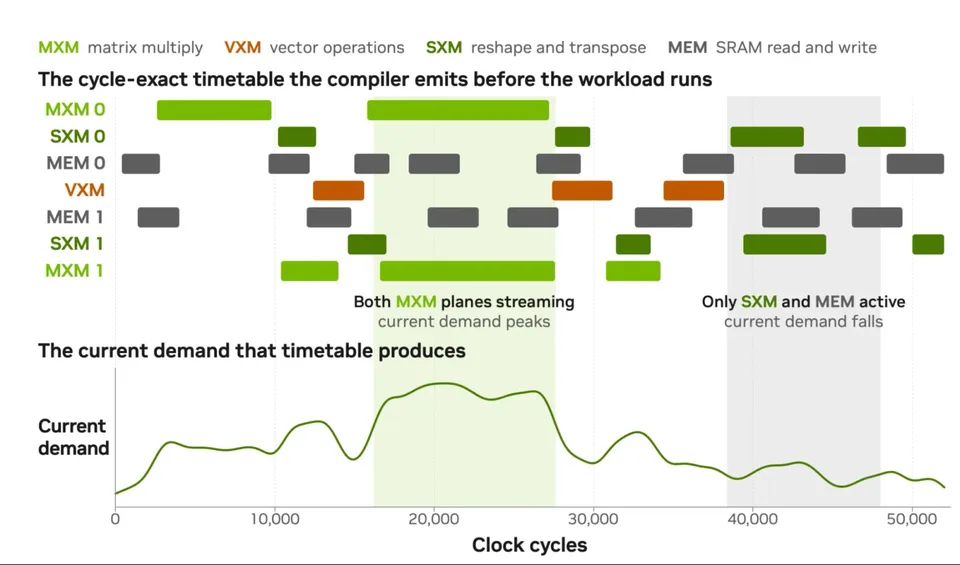
That matters because AI chips do not draw electricity at a steady rate. Operations such as matrix multiplication can cause a sharp rise in current within nanoseconds. The power system then has to react quickly, or the chip’s voltage can briefly fall.
Groq 3 LPX is announced technology, not a product that customers can currently buy. NVIDIA says it plans to bring these power controls to the Vera Rubin platform in the second half of 2026.
The basic idea: schedule the work first
Most modern accelerators decide dynamically which operation should run next as hardware resources become available. That flexibility helps keep the chip busy, but it also makes future power demand harder to predict.
NVIDIA says Groq 3 LPX takes a more fixed approach. Its compiler creates a schedule before the workload runs, specifying when data will move, which compute unit will handle it, and when each operation will execute.
The schedule works down to the clock cycle, the tiny repeated timing unit used to coordinate chip operations. NVIDIA says the same predictable timing applies across all 256 LPU chips in an LPX rack.
The compiler therefore produces more than an instruction list. It can also estimate how much electrical current the system will draw during each cycle. That forecast lets the power system prepare for changes instead of reacting after they happen.
Why sudden demand causes trouble
A chip’s power supply includes voltage regulators, which try to maintain a stable voltage. But those regulators cannot instantly deliver a large burst of additional current.
Nearby capacitors temporarily fill the gap. When they discharge, the chip’s voltage drops. This temporary drop is called voltage droop.
Chips are normally given extra voltage headroom, known as a voltage guardband, so they keep working during these sudden changes. That safety margin is useful, but it consumes power even when the chip does not need the extra voltage.
NVIDIA says Groq 3 LPX’s predictable schedule can reduce the need for that margin in two ways.
Preparing power before the spike
The first technique, which NVIDIA calls Preemptive Power, tells the power-delivery system to adjust voltage before a known increase in current arrives.
For example, if the compiler knows a demanding operation will begin on a particular cycle, the system can start moving the supplied voltage ahead of time. The nearby capacitors then have less work to do, so the voltage should fall less sharply.
The second technique, Clock Period Synthesis, changes the length of selected clock cycles. NVIDIA says the system can lengthen cycles that would otherwise create especially large current spikes.
That spreads the change over a little more time. In electrical terms, it lowers the rate at which current rises, which can reduce voltage droop.
Together, these techniques shape both sides of the problem: one prepares the supply, while the other smooths the workload’s demand. The goal is to run the chip closer to its minimum required voltage without dropping below it.
NVIDIA reports that internal testing on Groq 3 LPX systems showed more than 60% less voltage drop. It also estimates a high-single-digit percentage reduction in the baseline voltage that the electrical system must continuously provide.
Because power rises with the square of voltage, even a modest voltage reduction can produce a larger power saving. NVIDIA says the overall approach could reduce the power needed for the same workload by a potentially low-double-digit percentage compared with a similarly specified system without deterministic execution.
Those figures are NVIDIA’s own reported results and estimates. The supplied announcement does not provide the test setup, workload details, or independent measurements, so infrastructure teams will need comparable testing before using the claims for system planning.
What this changes for AI operators
The practical benefit is not simply that Groq 3 LPX might use less power. Predictable demand could make a fixed power budget more productive.
An AI facility has limits on how much electricity its racks can draw. Operators usually need extra capacity to handle sudden peaks safely. If the system can forecast and smooth those peaks, more of the site’s available power may go toward running models rather than covering electrical headroom.
That is especially relevant to high-interactivity inference, where users expect quick responses and workloads may involve long context. NVIDIA positions Groq 3 LPX for that part of the market, rather than as a universal replacement for every AI accelerator.
NVIDIA also claims that pairing Groq 3 LPX with the Vera Rubin NVL72 platform can deliver up to 35 times more throughput per megawatt than the previous-generation GB200 NVL72 for models larger than two trillion parameters under long-context, high-interactivity conditions. That comparison applies only to the conditions NVIDIA specifies, not to AI workloads generally.
The next meaningful step is deployment and independent measurement. When Vera Rubin systems incorporating Groq 3 LPX become available, operators will need to compare latency, throughput, energy use, and power stability against competing systems on the same models and workloads. Until then, deterministic execution is a promising power-control design, while its real operating advantage remains a vendor-reported result.