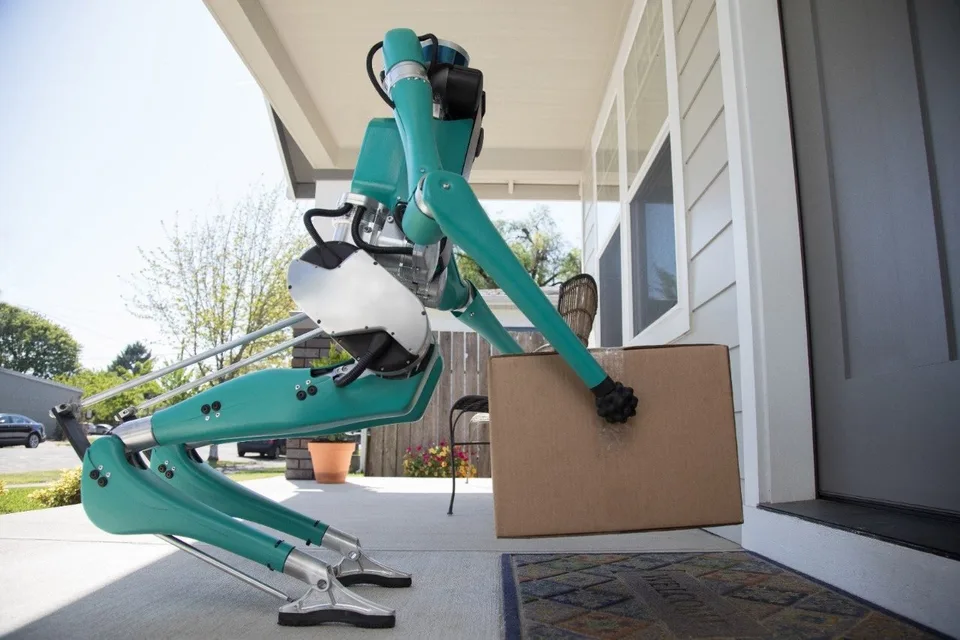
Agility Robotics says its newest humanoid is built for logistics and manufacturing, but its real-world rollout remains unclear.
Agility Robotics’ Digit program has moved from testing how a two-legged robot can move to designing one for warehouses and factories. The company’s latest version, Digit 5, adds new legs, longer battery life and a stated ability to work around people.
That does not mean Digit 5 is already a widely deployed workplace product. The Robot Report’s account describes the design direction and earlier Digit deployments, but it does not establish whether Digit 5 has entered a pilot, paid installation or large-scale operation.
From running robot to work robot
Agility’s work began with Cassie, a bipedal robot developed before Digit. Cassie took its first steps in 2016 and was designed mainly for research and fast running.
Its birdlike legs helped Cassie move quickly. In 2022, the robot ran 100 meters without falling in 24.73 seconds at Oregon State University, setting a Guinness World Record for the fastest 100-meter run by a bipedal robot, according to The Robot Report.
That achievement showed control and balance. It did not solve the harder problem of doing useful work for hours in a busy facility.
The first Digit arrived in 2017. Agility described that version as a robot for researchers, marking what Chief Robot Officer Jonathan Hurst called the company’s proof-of-concept era. In plain English, the team was showing that the basic idea could work before settling on the best job for the machine.
Digit 3, released in 2019, moved closer to commercial use. Agility focused on package delivery and warehouse work, including stacking boxes. The Robot Report says Digit 3 could pick up and stack boxes weighing as much as 40 pounds.
The company also sold its first two robots to Ford that year. Ford said it would explore using Digit with self-driving delivery vans to carry packages from vans to customers’ doors.
Those ideas used a humanoid’s potential advantage: legs can handle spaces designed for people. A robot that can walk through a doorway or approach a front porch may need fewer changes to a building than a specialized machine on wheels.
But walking is only one part of a useful job. The robot must also grip objects, manage its balance while carrying them, avoid people and recover when conditions change.
Digit 4 narrowed the job
Digit 4, released in 2023, was designed specifically for warehouses and distribution centers. It was also the last Agility robot with the company’s earlier birdlike legs.
At this stage, Agility demonstrated a more focused set of tasks: moving boxes, totes and bins. Its redesigned hands, called end effectors, were made for reaching, pulling, lifting and placing common warehouse items such as plastic totes.
The Robot Report says Digit 4 was deployed with Toyota Motor Manufacturing Canada, GXO Logistics, Schaeffler, Amazon and other organizations. Hurst said lessons from those deployments shaped the next generation.
This is an important engineering shift. A research platform can be judged by whether it performs a difficult maneuver once. A workplace robot must fit into an existing process, handle ordinary objects, operate near staff and provide enough uptime to justify its space and supervision.
The evidence here supports deployments of Digit 4. It does not show how often those robots ran, how many tasks they completed or whether the installations operated at production scale.
What changed with Digit 5
Digit 5 starts a new phase, according to Agility. The company says it is no longer designing mainly for speed. It is prioritizing strength and the practical demands of logistics and manufacturing facilities.
The new legs look more like human legs than the earlier birdlike design. That choice reflects a change in the target job, not a claim that human-shaped parts are always better. The useful question is whether the new design helps the robot carry, reach and move through the places where people already work.
Agility also says Digit 5 has longer battery life. Battery life matters because charging, battery swaps and downtime can interrupt a warehouse process. The supplied account does not provide a runtime figure, so operators still cannot calculate how many shifts the robot could cover.
The company’s most notable safety claim concerns people nearby. Agility says Digit 5 evaluates risk as a person approaches, slows down and eventually stops completely. It says the robot does this dynamically rather than relying on fixed roped-off zones.
A defined zone is a simple boundary: people stay out, and the robot operates inside. Dynamic behavior is more flexible, but it also puts greater demands on sensing, control software and safety validation. Agility’s claim is promising for mixed human-robot spaces, yet the supplied reporting does not independently verify the behavior.
What the program actually proves
Agility has spent more than a decade moving from Cassie’s running experiments to Digit’s warehouse tasks. The company says it has created five Digit versions, grown to more than 400 employees and built a factory capable of producing up to 10,000 robots annually, according to The Robot Report.
Those figures describe growing capacity, not proof that customers are buying or using Digit 5 at scale. No release date, price or Digit 5 customer list is established in the supplied reporting.
For operators, the next useful milestone is clear: documented work in a real facility. They will need to know what tasks Digit 5 completes, how it behaves around workers, how long it runs between charges and how much human supervision it requires.
Digit 5 represents a change in engineering priorities—from proving that a humanoid can move to making one fit a workplace. Whether it has become a practical product will depend on those operating details, not on its shape alone.