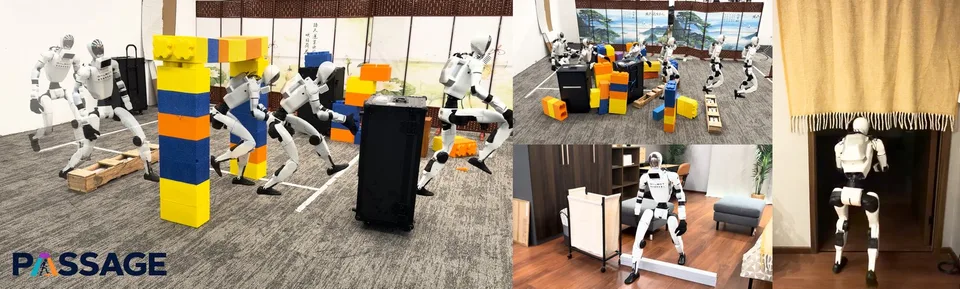
PASSAGE combines human motion capture, onboard terrain sensing, and two control loops. It is a research demonstration, not a ready-to-buy robot system.
A humanoid robot can step over a low barrier, duck under an overhang, or turn sideways through a narrow gap. The hard part is choosing among those movements while sensing the environment and keeping the robot upright.
PASSAGE, a system described by researchers from Galbot, the Shanghai Qi Zhi Institute, and ShanghaiTech University, tackles that problem with a planner-and-tracker design. The planner chooses a short burst of movement. The tracker converts that movement into joint actions while responding to the robot’s latest view of the terrain.
The authors tested the system in simulation and on 50 physical layouts using a Unitree G1. They report that the robot reached the finish area in all 50 physical trials. It avoided contact with obstacles in 45 of them. Those are useful research results, but they do not make PASSAGE a commercial autonomy package or a product consumers can buy.
The basic idea: demonstrate movement in context
PASSAGE begins with human demonstrations, but not ordinary video. Operators wear a virtual-reality headset and an inertial motion-capture suit, then move through virtual clutter.
The important detail is that the person and the scene are recorded together. A demonstration does not merely say, “walk this way.” It shows how a body moves when a low obstacle requires a step-over, when an opening is narrow, or when something hangs overhead.
The researchers collected 100 hours of scene-aligned motion across 1,500 cluttered scenes. They retargeted those movements to a 29-joint Unitree G1 model and filtered out demonstrations that collided with virtual obstacles.
This gives the learning system examples of whole-body choices. The robot can use its legs, torso, arms, and head together instead of selecting from a small list of preprogrammed skills.
What the planner sees
PASSAGE’s planner does not receive a complete map of the building. Instead, the robot builds a local representation around itself from onboard sensing.
The system uses egocentric 3D LiDAR, which measures distances with light pulses, and updates an occupancy map as the robot moves. From that map, it creates three terrain layers:
- the surfaces that can support the robot;
- obstacles blocking movement from the side;
- open space or blockage above the robot.
That third layer matters. A standard floor map may show a clear path even when a low beam or hanging object makes the route unusable.
The planner also receives recent motion history and a local destination. It then predicts 25 future motion frames, covering about half a second. In plain English, it repeatedly answers: “Given where I am moving, where I want to go, and what surrounds me, what should my body do next?”
The method used to generate those predictions is called conditional flow matching. Rather than choosing one fixed action from a menu, it learns a continuous path from random starting noise toward a plausible motion sequence. The result can include stepping over, ducking under, squeezing through, or combining several actions.
Why there are two control loops
A planner that updates only a few times per second would be too slow to handle every wobble or tracking error. PASSAGE therefore separates planning from execution.
The planner runs at 6.25 times per second. It produces a short motion chunk and then replans. The whole-body tracker runs at 50 times per second, using geometric feedback to adjust the robot’s joint commands.
This is similar to a person walking toward a doorway while making constant small corrections. One process decides the general movement; another keeps the body aligned with that movement as conditions change.
The system also uses “real-time chunking” to reduce jerky transitions between motion chunks. Without that step, two individually reasonable plans could meet with an abrupt change in pose, causing a foot slip or collision.
During later reinforcement-learning training, the researchers keep the tracker fixed and update only the planner. The planner learns from rollouts in which the tracker actually executes its references. That matters because a movement that looks valid as a kinematic pose may fail once motors, balance, and tracking errors enter the picture.
What the reported tests show
In simulation, the authors evaluated contact-free success: reaching the destination without touching an obstacle. Across three training seeds, increasing captured data from six to 100 hours raised mean contact-free success from 48.1% to 68.9% on held-out scenes. Their final model, which also used validated scene augmentation, reached 70.3%.
Those numbers describe the authors’ simulation protocol, not a general success rate for humanoids in homes or workplaces.
The physical test was smaller but more concrete. PASSAGE ran fully onboard on a Unitree G1 with a Jetson AGX Orin computer, using no prebuilt map or offboard computation. Across 50 unseen physical layouts, the robot reached the finish region without falling or a safety intervention every time. Human observers classified 45 of the 50 runs as contact-free.
The five contact-bearing completions are important. They show that reaching the goal was easier than avoiding every obstacle. For an operator, that difference matters: a robot that finishes while brushing furniture may still be unacceptable around people, products, or fragile equipment.
Demo today, deployment later
PASSAGE is best understood as a research demonstration of onboard traversal. The tests cover the reported physical layouts, not every environment a humanoid might face. The supplied results do not establish performance around moving obstacles, stairs, slopes, transparent surfaces, thin cables, or unscripted public spaces.
There is also no reported consumer price, sales date, or paid business installation for PASSAGE. The practical next step is broader testing: longer runs, more varied geometry, dynamic obstacles, and independent replication. Until then, the durable lesson is architectural: human demonstrations provide movement options, local sensing supplies the geometry, and a fast tracker turns short plans into physical behavior.