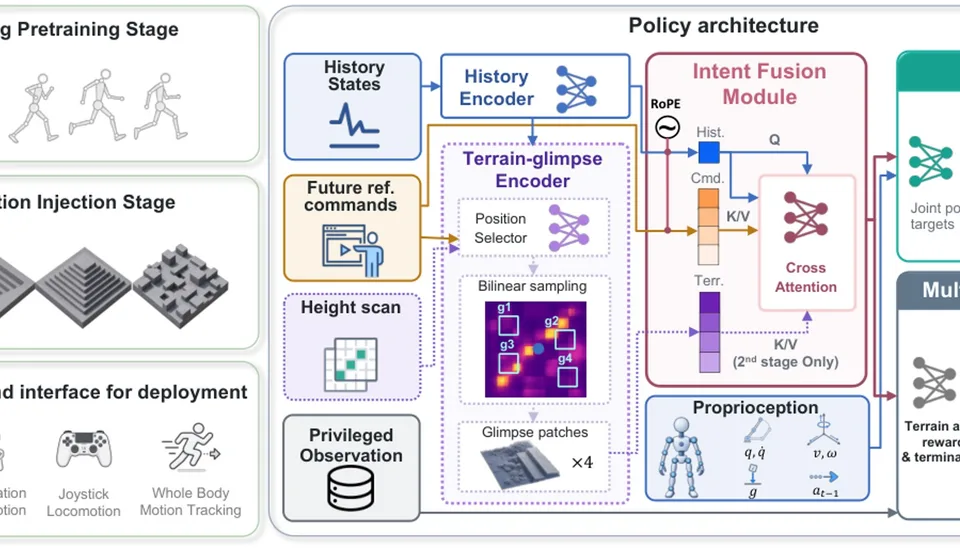
A two-stage policy combines commanded movement with local terrain geometry, helping a Unitree G1 adapt its feet and posture on uneven ground.
A paper published on arXiv reports PGMT, a research-stage control pipeline tested in simulation and on a Unitree G1. Its division of labor is straightforward: the motion reference says what the robot should do, while terrain observations help determine how that motion can be carried out physically.
PGMT first trains a terrain-agnostic whole-body tracking policy. A second stage injects elevation-map data and allows selected lower-body tracking objectives to relax when strict imitation would conflict with the ground. The robot can adjust footholds, swing clearance and body posture while preserving the commanded motion’s intent; upper-body tracking objectives remain strict.
The terrain module does not treat every map cell equally. It predicts four locations relevant to the current motion, crops a 5×5 terrain patch around each, and feeds those compact “glimpses” into the motion-intent representation. The elevation map covers a yaw-aligned 2-by-2-metre region, according to the authors.
In simulation, the paper reports 87.81% completion across 9,600 matched 30-second episodes and 83.33% at the highest difficulty level. The pre-perception policy reached 40.02% and 35.31%, respectively. These are benchmark results from the reported evaluation.
For the physical demonstration, PGMT ran zero-shot on a 29-degree-of-freedom G1 with a Livox Mid-360S LiDAR, onboard elevation mapping and an NVIDIA Jetson Orin NX. The authors report traversal of uneven ground, stairs with unseen geometries and boxes up to 37 centimetres high, alongside whole-body and locomotion teleoperation. They also report stable locomotion without real-world fine-tuning in those locomotion demonstrations.
The engineering boundary is semantic understanding. Elevation maps capture geometry, not environmental meaning or affordances, making it difficult to distinguish an obstacle from an object meant for interaction. The next step is richer perception if this terrain-aware motion execution is to extend toward broader humanoid interaction.