TypeSafe AI’s released model targets safety checks, email sorting, and other automation—not open-ended text generation.
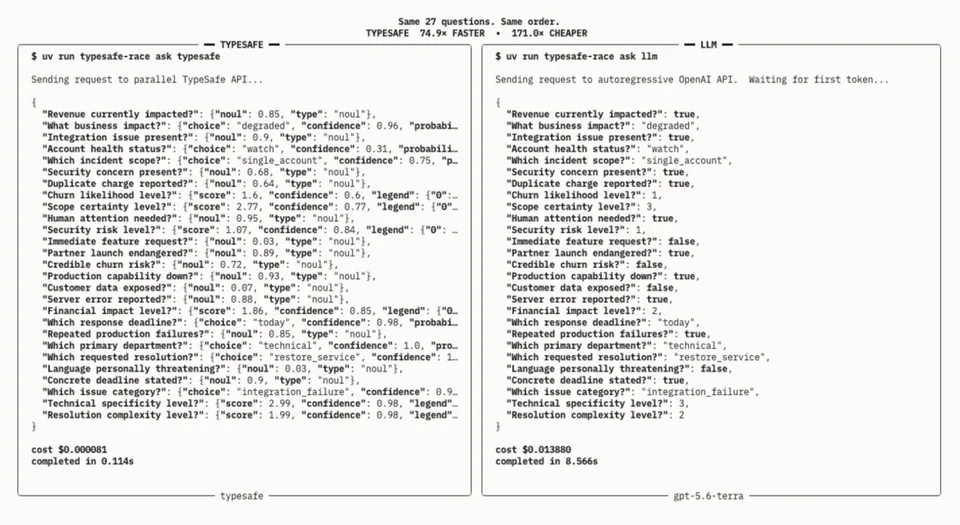
TypeSafe AI has released Jev, a transformer-based model that produces probabilities instead of written responses. The company describes those outputs as “calibrated decisions,” with developers defining the possible choices in advance.
That makes Jev different from a language model. A language model generates text, while Jev is designed for tasks such as deciding whether a command is safe or how an email should be classified. Because its outputs are predefined, TypeSafe AI says the model cannot hallucinate outside those choices.
The release is an announcement, and the reported performance comes from individual developer tests rather than independent benchmarks. Still, the examples show where this design could matter.
Pranit Sharma, a software engineer at Vercel, said his team replaced an OpenAI model with Jev for command-safety classification. He reported results five to 18 times faster, with greater accuracy.
Nikhil Mudholkar, chief technology officer at Bryo AI, tested Jev on business-email classification. Gemini was slightly more accurate in his test, he said, but cost 10 to 20 times more. Mudholkar highlighted Jev’s probability scores because software can use them to decide when confidence is high enough to act.
The same approach could support model routing, where software chooses which model should handle a task, or checks on language-model agents. Armin Ronacher, chief technology officer at Earendil, said a probability could help determine whether an agent’s result is reliable enough to use.
For engineers, Jev’s practical test is straightforward: compare its decisions and confidence scores on the team’s own data before replacing a language model.