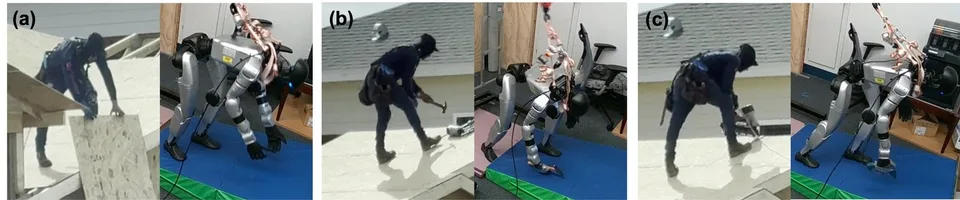
A University of Florida paper uses roof geometry to align the robot’s feet, hands, and body during simulated and physical tests.
The proposed system does more than copy a roofer’s movements. University of Florida researchers first capture human demonstrations, then retarget them to a Unitree G1 humanoid. Because motion tracking alone does not show the robot’s exact position relative to the roof, a metric roof model supplies that missing spatial reference, according to the paper published on arXiv.
The controller identifies when each foot should support the roof and anchors multiple points across each sole. It also assigns work phases, such as nailgun positioning or hammering, then sets the desired hand-to-roof distance. A body-mesh safety check discourages the hand or other robot geometry from passing through the roof surface.
The system trains in simulation with reinforcement learning, a method that improves behavior through repeated trials and feedback. Its rewards preserve foot support, hand clearance, and nonpenetration while the robot follows the demonstrated motion.
In simulation, the researchers report work-clearance errors of 0.256 to 0.531 centimeters for nailgun, hammering, and pushing tasks, with three successful evaluations out of three per task. Physical tests reproduced uphill walking, nailgun positioning, hammering, and bending on a Unitree G1; reported local motion errors stayed below 80 millimeters.
This remains a controlled research demonstration, not a roofing product or autonomous construction worker. The physical robot used a safety hoist, and the paper does not report hoist forces, operator interventions, or unassisted fall rates. It also used one nonprofessional demonstrator and did not test varied roof materials or construction sites.
The practical next step is testing whether the same geometry-based control survives changing slopes, surfaces, tools, and weather without that laboratory support.