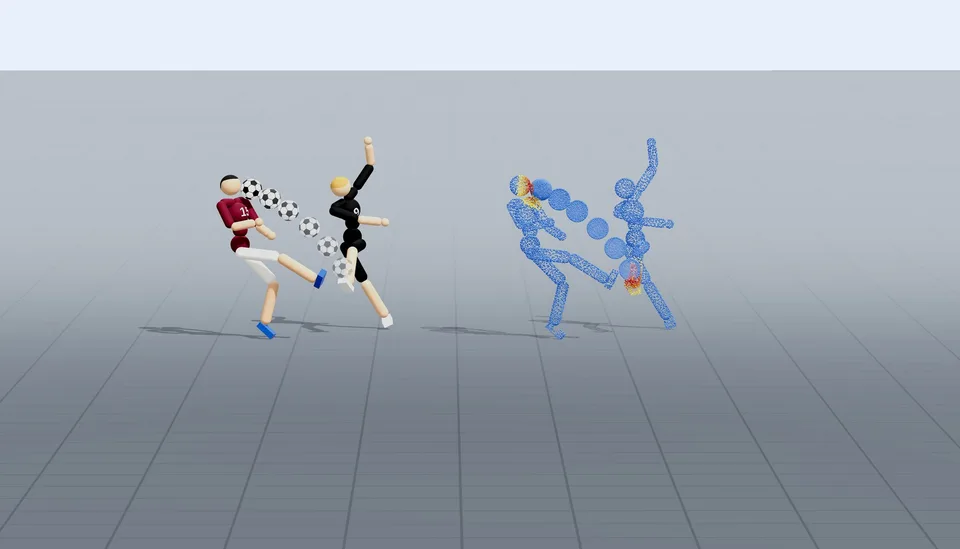
A paper on arXiv presents Unified Motion Retargeting, or UMR, a research framework for turning human motion references into training data for humanoid robots. Its central change is practical: instead of manually deciding that a human elbow must correspond to a particular robot joint, UMR learns relationships between the outer surfaces of the two bodies.
That matters because humanoids differ in proportions, joint layouts, degrees of freedom, and kinematic limits. A motion-transfer system built around a fixed set of human and robot joints can require new mappings when the target machine changes. The paper, whose authors are affiliated with HKUST(GZ), Noitom Robotics, Hanyang University, HKUST, and HKU, proposes a common surface-based interface instead.
The method is a research pipeline, not a consumer product. Its role is to prepare robot motion references and learning data across different motion sources and humanoid embodiments.
From joints to surfaces
Traditional motion retargeting treats movement as a set of skeletal instructions: place a joint here, keep an end effector there, and satisfy the robot’s limits while doing so. That approach can work, but it constrains only selected points on the body. It may provide limited guidance about how a shoulder, torso, hand, or foot should align with a nearby surface.
UMR samples the exterior of a human model and a robot as point clouds. A point cloud is simply a collection of three-dimensional points describing a surface. It offers a geometric interface even when the two bodies have different skeletons, proportions, and mesh structures.
The process begins with the source and robot models in canonical T-poses. UMR then learns an ordered correspondence between their point clouds. In plain English, it learns which location on the human surface should be paired with which location on the robot surface.
The pairing is not designed manually. The paper describes a PointNet-style encoder and a multilayer perceptron decoder that predict a robot-side point arrangement from the source points and target robot geometry. The learning objective encourages the reconstructed points to cover the robot’s surface, discourages several points from collapsing into one local region, and keeps neighboring points moving coherently.
Once learned, the point pairs are bound to the two meshes and reused as the bodies move. This is the key distinction: UMR learns the relationship in a canonical pose, then carries that relationship through a motion sequence. It does not require a new hand-designed body map for every frame.
Turning correspondence into robot motion
The learned pairs become targets for a constrained motion optimizer. At each frame, the optimizer searches for robot joint positions that bring corresponding surface points into alignment as closely as the robot’s body allows.
It matches more than position. UMR also considers local surface orientation—the direction in which a patch of the body faces. A robot point can be near the right location while presenting the wrong part of the body toward an object. Including orientation gives the optimizer a more detailed target than isolated joint positions.
The optimizer must reconcile those targets with the robot’s actual structure. The optimizer enforces joint limits and floor clearance. The method overview also describes maintaining consistency between frames. It uses a constrained Gauss-Newton quadratic-programming update to adjust the robot’s generalized coordinates.
That means the robot is not asked to copy every human coordinate exactly. Instead, the system finds a feasible robot pose that follows the human reference where the target body and its joints permit. The surface correspondence supplies detailed geometric targets; the optimizer negotiates with the robot’s mechanics.
This answers the core question of how the method works across different humanoids: the transferable object is not a fixed list of equivalent joints. It is a learned relationship between sampled surfaces, followed by an embodiment-specific optimization step that respects the target robot’s limits.
Why contacts are part of the transfer
Motion is not only about body shape. A foot may need to stay related to the floor, a hand may need to approach an object from a particular direction, or another body segment may need to maintain self-contact.
UMR represents these relationships with contact maps. For each relevant source point, the method identifies a nearby point on an object, the floor, or surrounding scene geometry and records the vector between them. The corresponding robot point uses the same environmental reference during optimization.
Because the correspondence is indexed across the source and robot surfaces, the contact relationship can be transferred without another manually designed list of human body parts and robot links. The paper describes the same construction for ground contact, manipulated objects, surrounding scene geometry, and self-contact between separate body segments.
The practical consequence is important for training data. A retargeted reference can preserve not only the broad appearance of a movement, but also what the movement is doing physically—such as keeping a foot near the ground or a hand near an object.
What the research reports
The paper reports qualitative results across four source representations and five humanoid embodiments. It also describes downstream evaluation across whole-body tracking, large-scale policy learning, and contact-rich interaction tasks, covering locomotion and interaction. A Unitree G1 appears in the paper’s visual explanation of the transfer process.
The paper includes numerical tracking comparisons and runtime measurements. Its runtime table reports an overall retargeting throughput of 65.29 frames per second on an NVIDIA GeForce RTX 4070 Ti SUPER GPU and Intel Core Ultra 7 265KF CPU. Those are the authors’ measurements for their setup, rather than a speed guarantee for every robot or computer.
The quantitative tracking tests use the Unitree G1. The results compare UMR with GMR and Unitree reference motions, while the broader demonstrations show transfer across different source representations and humanoid bodies. Demonstrating that a mapping can be reused across bodies is different from establishing the same measured performance on all of them.
UMR prepares motion references that the authors evaluate through downstream control and policy-learning tasks. Dense surface correspondence provides the map; constrained optimization turns that map into robot-feasible reference motion.
The method also has an important input requirement: it starts with surface meshes and a canonical template for the human motion source. The authors identify less structured motion observations as future work. For other teams, the useful test is whether the reported tracking and runtime results carry over to their own robot models and motion data.