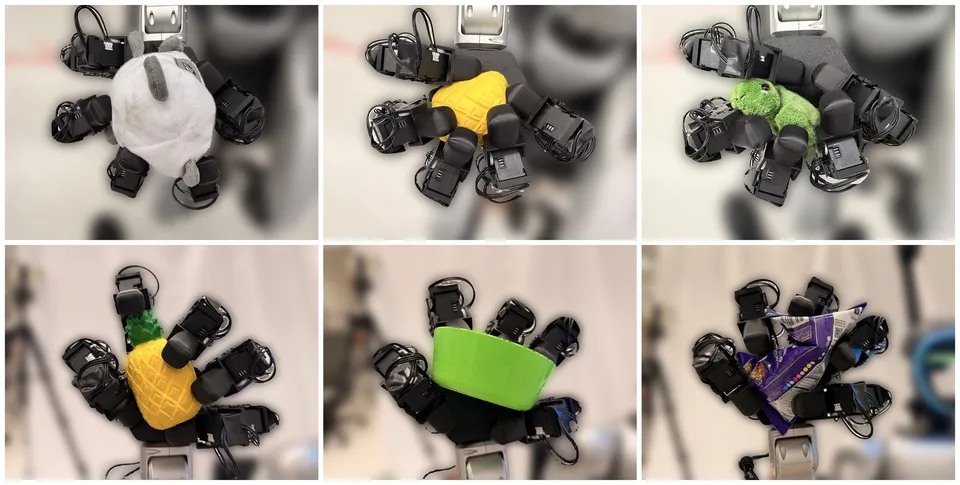
The proposed system adapts through noisy camera feedback, simulation training, and torque-aware control—not whole-body autonomy.
The paper Catch It All! reports a laboratory catching system for humanoid arms. Its authors, affiliated with UC San Diego and Harvey Mudd College, tested it on a seated Unitree G1 EDU with a 20-degree-of-freedom House of Dextra hand and one overhead-mounted camera.
The system first learns in simulation. A “teacher” policy trains with accurate object positions, then a “student” policy learns from noisier camera observations using demonstrations generated by the teacher. In plain terms, the robot practices with clean information before learning to react when depth readings are imperfect or the object briefly leaves view.
At catching time, the controller updates the arm and fingers as new images arrive. A fingertip-distance reward encourages the fingers to close around an object’s surface, even when its shape is irregular. Training also varies object mass, friction, size, toss timing, and other conditions.
Hardware limits shape the behavior. The authors describe Unitree G1 wrist torque limits as low as 5 newton-meters, so their training gradually increases allowed torque while penalizing actions beyond nominal limits. That helps the policy explore fast movements without simply commanding unlimited force.
In real-world trials, the authors tested nine objects unseen during training, including plush, deformable, and rigid-elastic items. They report 38.9% success for underhand catches and 36.1% for overhand catches across the test set, using one long, two medium, and one short toss per object.
This remains a demo of a seated arm, not a deployable humanoid product. The paper does not apply the method to whole-body control, so standing, walking, mobile catching, and commercial availability remain future questions.