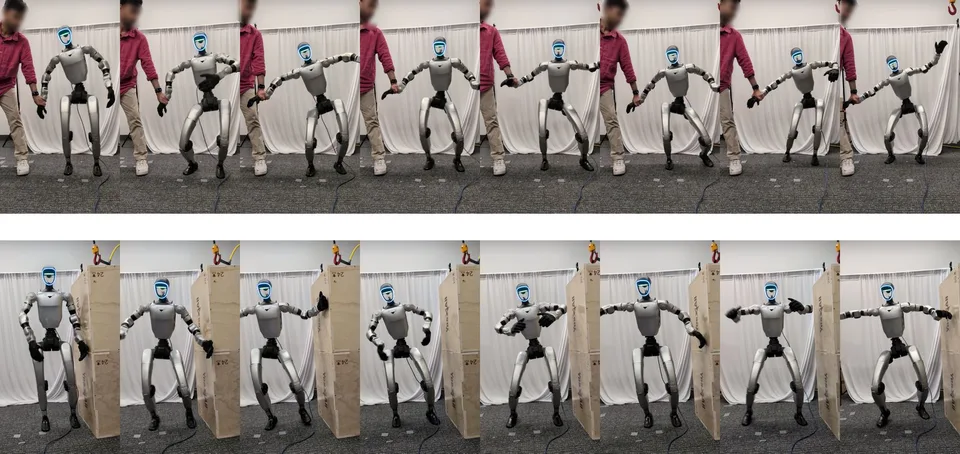
A proposed control system adjusts compliance through a small add-on, then tests it in simulation and real-robot demonstrations.
A Unitree G1 humanoid can yield when someone pushes it while continuing to follow a dance or other motion reference, according to the researchers behind Compliant GMT, or C-GMT. The work is a research demonstration, not a product available to buy.
The key idea is to separate two jobs. A force-robust motion tracker keeps executing the reference and maintains balance. A residual adapter—an added correction layer—changes that reference when outside forces appear, rather than replacing the tracker or retraining it from scratch, the paper reports.
During training, a privileged teacher uses a spring rule and an inverse-kinematics solver to calculate how the robot should move under a force. Inverse kinematics finds joint positions that achieve a desired body position while respecting the rest of the robot’s posture.
The adapter then learns to reproduce that behavior using the robot’s own motion data: a 10-step history of body-position and movement readings, previous actions, the motion token, and a commanded stiffness. Stiffness ranged from 40 to 600 newtons per meter in the reported work. Lower stiffness means more yielding; higher stiffness means a firmer response.
At deployment, the adapter modifies the motion reference, and the underlying tracker executes the updated version. The paper reports simulation tests and real-world G1 demonstrations, including yielding beside a wall and during human pulling.
Those results remain demonstrations under tested forces, motions, and hardware conditions. The practical next step is broader testing: whether the response stays stable across unpredictable contacts, and how operators set safe stiffness limits for real work.