The startup says simulation and demonstrations could ease reprogramming; BMW’s announced relationship is still described as an evaluation.
Factories often use robots for one narrow job. Changing that setup can require new programming, physical retooling, or replacement equipment, which Industrial Next says can take weeks or months.
The San Francisco startup presented its AI-powered robotic stations at TechCrunch Disrupt 2026. TechCrunch reports that the stations use proprietary foundation models—software designed to connect what a robot sees with the task and movement required.
Industrial Next says its stations could let manufacturers retool production lines in minutes without traditional programming. The company also says stations can be reconfigured, combined, and redeployed across product lines instead of remaining tied to one product.
How the proposed system works
Industrial Next says it teaches new tasks through demonstrations and high-fidelity simulation rather than hard-coded scripts. In plain terms, the robot uses a detailed virtual environment designed to approximate real-world physics for delicate, high-precision work.
“This is where we’ve made a lot of progress” with simulated environments for high-precision and high-dexterity tasks, co-founder Lukas Pankau told TechCrunch.
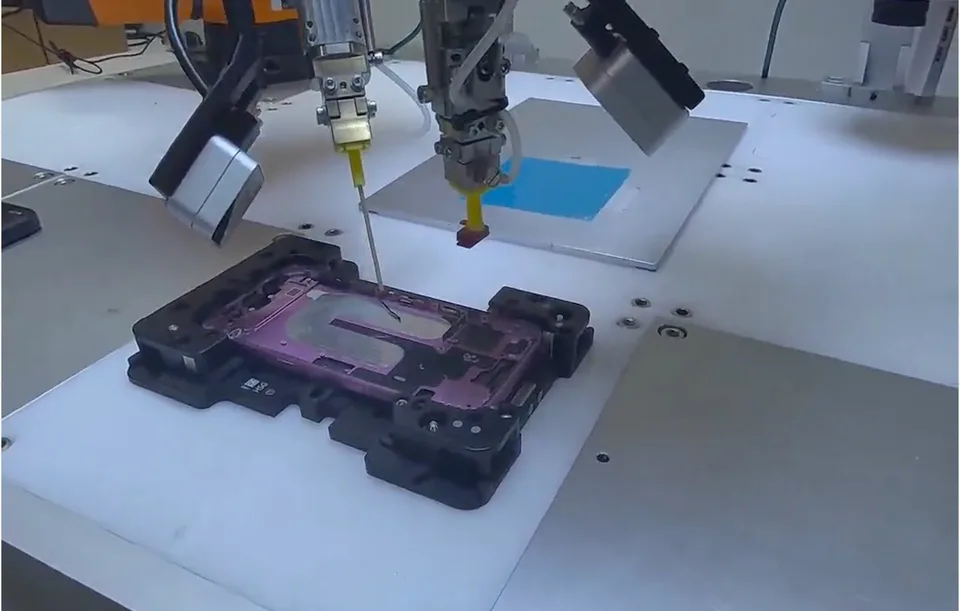
TechCrunch reports that some stations handle smartphone assembly tasks such as threading a delicate flex cable and fitting a tiny connector cap. Industrial Next also described a film-peeling station that it says worked at or above human speed with 100% accuracy after moving to a new phone model and production line. The customer was not identified, and those performance claims came from the company.
Industrial Next announced that BMW Group Technology Office will evaluate its dexterous manipulation for manufacturing. The announcement does not establish the evaluation’s site, timetable, task, success measures, or deployment status, and no evaluation results are reported. The useful next step is evidence showing how much supervision, simulation work, and physical retooling a product change requires.