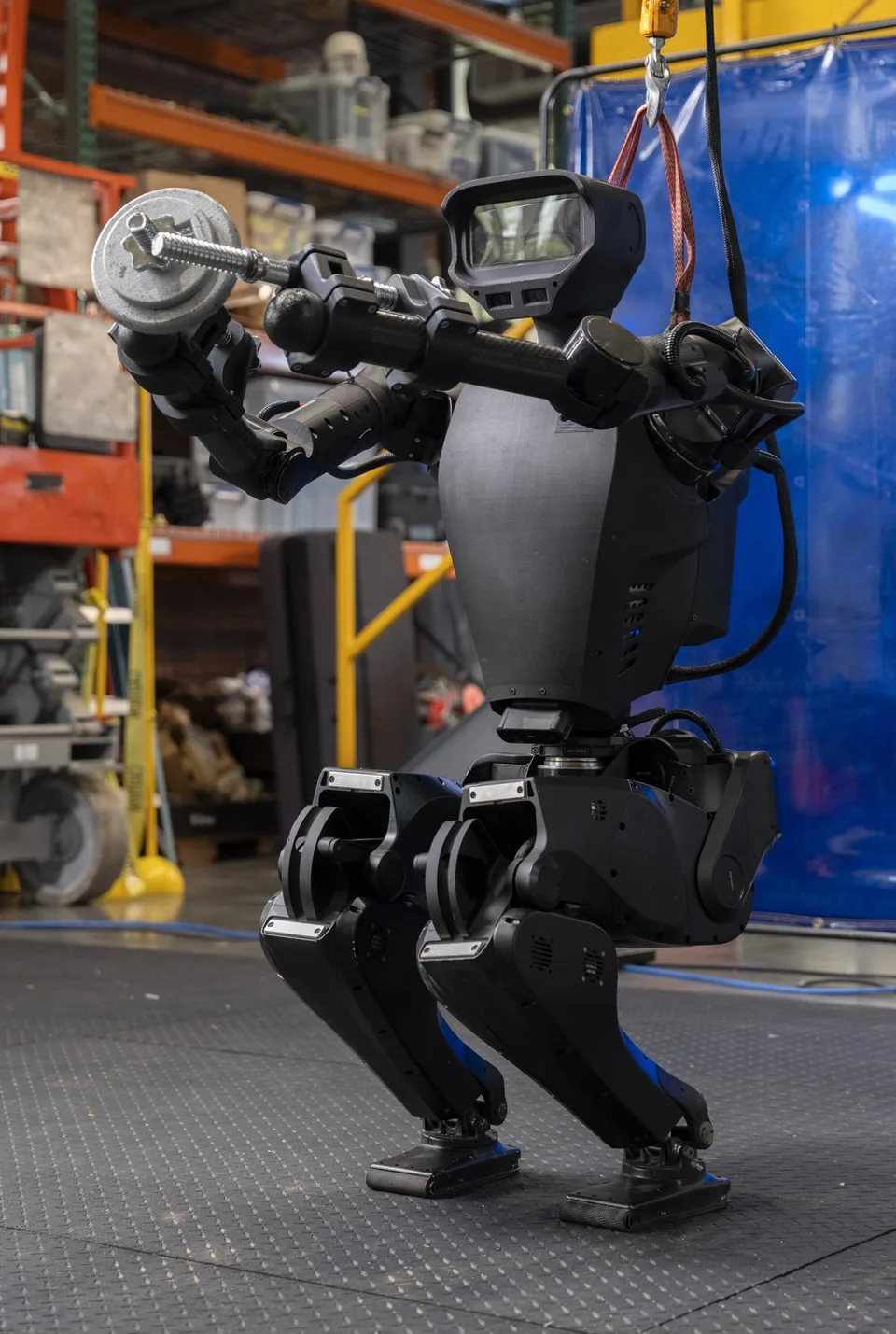
A proposed system estimates changing payloads during teleoperation, then updates balance and torque commands in real time. The work remains a research demonstration on one humanoid.
A humanoid carrying a tool cannot control itself accurately if it thinks the tool is weightless. The extra mass changes how quickly an arm moves, how much force its joints need, and where the robot must place its body to avoid tipping.
A paper from researchers at the Florida Institute for Human & Machine Cognition and the University of West Florida proposes a controller that updates that internal model while the robot works. The authors report simulations and hardware experiments on a 23-degree-of-freedom humanoid system, not a commercial product or deployed service.
The problem is more than added weight
Robots already use feedback: they compare where a joint is with where it should be, then correct the error. That helps, but feedback alone may react too late when a large or uneven load changes the robot’s motion.
The important quantity is inertia. In plain English, inertia describes how strongly an object resists changes in motion. A long, heavy object attached near the end of an arm can demand far more effort than its weight alone suggests.
A fixed robot model may know the arm’s mass before a task begins. It may not know that someone has added a tool or payload, especially when the operator is controlling the robot remotely.
The proposed system combines three parts:
- An extended Kalman filter estimates changing physical properties from the robot’s measurements.
- Whole-body model-predictive control uses those estimates to plan forces and posture.
- A virtual-reality interface lets a person command the robot’s motions.
The filter estimates parameters such as mass, center of mass, and rotational inertia. It also constrains the estimates so they remain physically plausible rather than producing impossible body properties.
How the controller responds
The filter does not simply tell the robot, “A load exists.” It estimates how the load changes the robot’s full rigid-body dynamics model.
That model predicts how the robot will move under particular joint torques and contact forces. The whole-body controller then repeatedly solves a short planning problem, balancing several goals at once: follow the operator’s motion, keep the robot stable, and limit undesirable forces or postures.
The updated model improves feedforward torque compensation. Feedforward means the controller applies an expected amount of force before waiting for an error to appear. If the controller knows an arm became heavier, it can command more support immediately instead of allowing the arm to sag and correcting afterward.
The operator still provides task references through virtual reality. But the operator does not have to manually compensate for every change in payload. The controller handles dynamic balance and load-related adjustments.
In the reported implementation, the estimator and whole-body controller ran on the robot’s onboard computer. State estimation and low-level control ran at 1,000 hertz, while the estimator and model-predictive controller ran at 100 hertz. The virtual-reality software ran on a separate computer.
What happened in the tests
In one simulation, researchers added a 5-kilogram payload to a forearm during a window-washing motion. Without online adaptation, the loaded arm’s vertical tracking error reached 389.2 millimeters. With adaptation, the paper reports an error more than 25 times smaller.
The hardware tests used manually mounted weight plates rather than autonomous grasping. Researchers first attached a 3.4-kilogram plate to the right forearm, then added four 1.1-kilogram plates one at a time. The total load reached 7.9 kilograms before removal.
The filter recovered between 88% and 96% of the cumulative loads during that experiment. The robot’s center of mass moved by no more than 32 millimeters horizontally and 7 millimeters vertically in the mid-foot reference frame, according to the authors.
That does not mean the arm held a perfect position. The forearm end moved down 94 millimeters from its unloaded to fully loaded height. The authors point to possible joint-friction and damping errors as one area for improvement. Electrical power also rose from 108 watts unloaded to 318 watts at peak load.
A second hardware test used a 4.5-kilogram asymmetric load on the right forearm. The robot was teleoperated through a squat and forward pitch, returned to a standing posture, and performed circular window-washing motions. The estimator recovered 95% of the added load during the load interval.
The paper reports modest degradation in arm tracking under that payload. The loaded forearm had a vertical root-mean-square error of 22.4 millimeters, compared with 13.2 millimeters when unloaded.
Why this matters—and what it does not prove
The useful idea is the closed loop between estimation and control. The robot measures how its motion and joint forces change, estimates the payload’s physical effect, and feeds that estimate back into the balance planner.
That could reduce the operator’s workload in jobs involving tools, carried objects, or changing loads. It could also help a robot adjust its posture rather than simply stiffening its motors and hoping feedback catches the error.
But these were controlled research experiments. The loads were manually attached because the team did not have heavy-duty grippers, so the tests did not demonstrate autonomous pickup. The reported work also does not establish performance across other humanoid designs, payload shapes, highly dynamic movements, or long-term operation.
For engineers and operators, the next important test is not another static weight plate. It is whether the estimator remains reliable while a humanoid grasps unfamiliar objects, walks, turns, and handles loads whose inertia is difficult to observe. Until then, the framework is a promising control method demonstrated in the lab—not a ready-to-buy payload-handling capability.