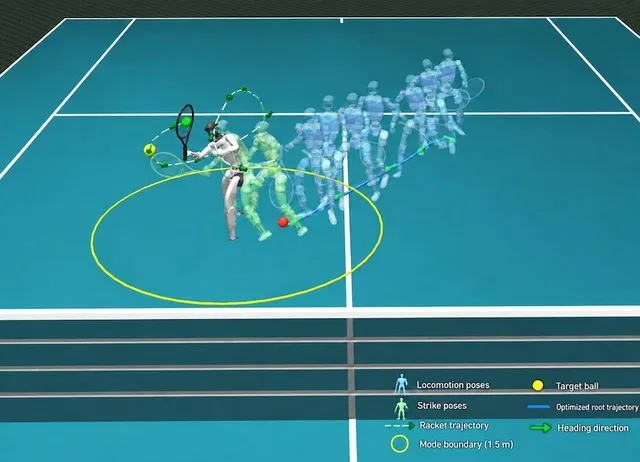
A research demonstration combines generic walking data with sparse striking clips, then tests the resulting policy on a real humanoid.
The ATHLETE framework, reported by researchers at The Hong Kong University of Science and Technology (Guangzhou), teaches a humanoid robot to move toward incoming balls and choose forehand or backhand swings. It is a lab-stage demonstration, not a product people can buy.
The key idea is to separate reusable movement from task-specific movement. The team used 16 walking sequences from the LAFAN1 dataset, plus 67 backhand and 97 forehand clips extracted from a 10-minute tennis-practice video. A method called Trajectory-Guided Motion Matching combines those pieces into full-body approach-and-strike motions.
The system then trains a stronger “teacher” controller in physics simulation. Online DAgger distillation—a process that lets a simpler controller learn from the teacher even after it makes mistakes—transfers that behavior into a student policy. Final fine-tuning with Proximal Policy Optimization improves tennis-specific results.
At deployment, the student does not need a stored reference motion or a motion planner. It reacts to robot-state and ball observations directly. In the reported real-robot test, it hit 27 of 30 forehand throws and 26 of 30 backhand throws. However, it cleared the net in only 14 forehand trials and 16 backhand trials.
The robot also managed observed rallies lasting five rounds with a novice and eight with a professional player. Those tests used external motion capture to track the ball and the robot’s root pose, within an approximately 10.5-by-5.5-meter area.
That makes ATHLETE an interesting data-reuse approach, but onboard ball tracking and broader court testing remain the next practical steps before deployment claims.