The research demo transfers support and pushing behaviors without copying a person’s exact body motion.
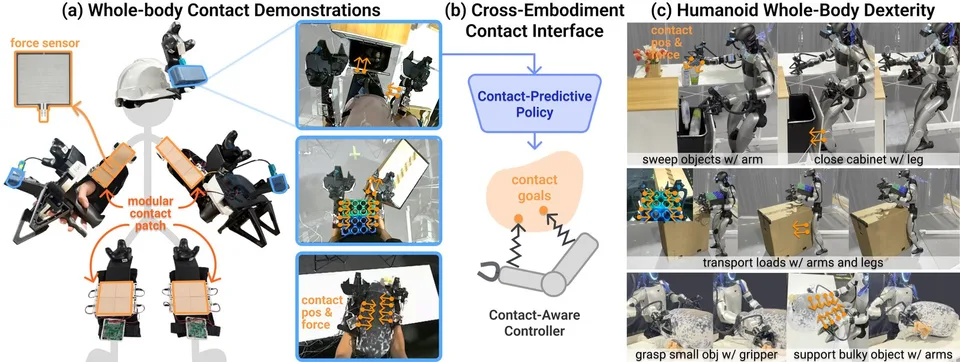
PanTact, a research demonstration from Stanford University, Amazon FAR, and Carnegie Mellon University, teaches a Unitree G1 humanoid to use more than its hands. The system learns body support, pushing, sweeping, and load-sharing from human demonstrations.
Its key idea is to transfer contact goals rather than full-body poses. A wearable interface records when and where a person’s forearms or knees touch an object or surface. Modular force-sensing patches provide those contact signals alongside cameras and gripper motion.
A vision policy then predicts two things: the hand movements and the body contacts needed for the task. The controller marks each contact as active or inactive. It only tracks active contacts, allowing the G1 to choose its own posture, balance strategy, and body surface. A human’s forearm contact might therefore become contact from the robot’s forearm, knee, or foot, depending on what the robot can reach.
That matters because human and robot proportions differ. Copying a human pose can place a robot’s joints near their limits or miss the object. PanTact instead preserves the physical interaction that carries the task.
The authors report 85% success across 20 Grasp-and-Embrace rollouts, where the robot supported a bulky object while holding another. In Sweep-and-Stow, it reported 90.63% end-to-end success across tests involving sweeping and lower-body cabinet pushing. These were controlled hardware experiments, not a commercial deployment.
The G1 used no added body-contact sensors during execution; contact goals came from the learned policy. The next practical test is broader variation: different humanoid bodies, unreachable contact points, fragile objects, and physical interaction near people.