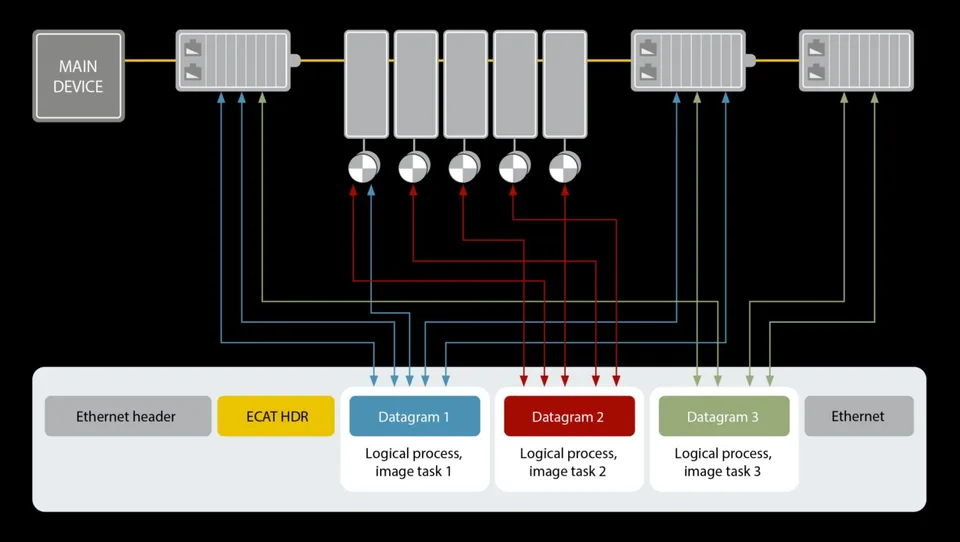
The industrial network checks both data integrity and device participation while passing control information through connected drives, sensors, and I/O.
EtherCAT moves control data through industrial devices such as servo drives, motors, sensors, and input-output modules. That makes it relevant to robotic arms and other machines that must coordinate several moving parts on a tight schedule.
Its main device sends a frame through the network. Each connected device can read or write its own data as the frame passes, then forward the frame to the next device. This differs from a conventional switched Ethernet layout, where a switch receives a frame, checks it, and sends it through another port.
The design does not guarantee a certain speed or payback period. But it gives engineers a specific way to detect transmission problems and confirm that expected devices took part in a control cycle.
Two checks catch different failures
EtherCAT uses an Ethernet frame check sequence, or FCS. This is a four-byte value at the end of a frame, calculated from the data inside it. The receiving equipment recalculates the value; a mismatch shows that the frame changed during transmission.
Design World reports that EtherCAT subdevices check the frame in both directions. If a device detects an error, it changes the FCS so devices farther along the network know the frame has already been flagged. The main device can then identify the affected network segment.
For a robot cell, that can point troubleshooting toward a section of cable or a group of devices instead of leaving the entire network as one large suspect area.
The FCS answers one question: did the transmitted bits arrive intact?
EtherCAT adds a second check for a different question: did the expected devices actually carry out their commands?
Each EtherCAT datagram carries a working counter. A datagram is a section of control information inside the larger Ethernet frame. The working counter is a 16-bit value attached to that datagram, not to the Ethernet frame itself.
A device increases the counter when it successfully executes a command. According to Design World, a successful read adds one, while a read-write operation adds three. The main device knows what value should return after the frame completes its trip.
If the returned value does not match, at least one device did not participate as expected. The device may have been unreachable, in the wrong state, or affected by another error.
That distinction matters on a production line. An FCS problem points toward corrupted transmission. A working-counter mismatch points toward a missing device response or an incomplete transaction. These checks do not repair the fault, but they can narrow the search before maintenance staff replace parts at random.
Devices forward the frame themselves
In ordinary Ethernet, a switch reads a destination address and forwards the frame through the correct port. At the fieldbus level, EtherCAT generally does not use standard Ethernet switches.
Instead, each EtherCAT device contains an EtherCAT subcontroller. This processing component has forwarding logic, and two or more Ethernet ports connect the device to the preceding and following nodes.
As the frame passes through, the device handles the data assigned to it and sends the frame onward. The process resembles a delivery truck stopping at several workstations without unloading the entire truck at each stop.
When a node does not detect another node after it, the node becomes the network terminus. It sends the transmission stream back as a receive stream, a behavior Design World describes as “boomeranging” the data.
This arrangement supports line, star, tree, and ring layouts. The best choice depends on the robot cell’s physical arrangement, cable routes, service access, and what happens when a connection fails.
The structure may reduce the need to buy, wire, configure, and maintain dedicated switches inside the machine network. That is a potential installation benefit, not a guaranteed saving. The Design World explanation does not provide an independent cost comparison, payback period, or measured uptime result.
Addressing uses a shared process image
EtherCAT also handles device addressing differently from protocols such as PROFINET and EtherNet/IP. At the fieldbus level, it does not use MAC and IP addresses in the same way.
Instead, the main device assigns addresses through fieldbus memory management units in the connected subdevices. These units map device information into a shared process image: a real-time memory view of the network’s inputs and outputs.
That lets the main device work with the mapped machine data rather than polling every device separately for one small value at a time. In a robot application, the shared image can hold information such as motion commands, drive status, and sensor signals that must be coordinated during the same control cycle.
EtherCAT can also carry standard TCP/IP connections through a mailbox channel for device communication without affecting real-time data transfer, according to Design World. This can support configuration or other non-time-critical exchanges alongside control traffic.
The tradeoff is configuration work. Design World says EtherCAT can have a steeper learning curve because engineers must correctly map devices into one contiguous address space. Some software tools hide much of this task, while others expose the details directly.
That affects commissioning. A network can have a well-designed forwarding method but still consume plant time if device mappings, startup states, and diagnostic tools are difficult to manage.
What should a plant check?
Start with the control job, not the protocol label. If a robot cell has several servo axes, drives, and I/O points that must exchange information regularly, EtherCAT’s shared process image and on-the-fly forwarding are relevant features.
Then verify the controller’s diagnostics. A useful system should help technicians distinguish a damaged transmission from a device that failed to respond, entered the wrong state, or disappeared from the network.
Finally, compare the full installation cost. Include controller software, supported devices, commissioning labor, training, spare parts, and troubleshooting tools. EtherCAT may reduce switch hardware inside a machine, but the supplied explanation does not establish a universal performance or savings advantage over competing protocols.
The durable answer is this: EtherCAT uses frame checks to detect damaged data and a working counter to detect missing device participation. Its devices process control data as the frame passes through, which can suit coordinated robots and motion systems. The practical return depends on how much the plant saves on network hardware—and how easily its team can configure and diagnose the finished machine.