An arXiv preprint describes onboard-data fine-tuning without motion capture, tested on selected tasks with one Unitree G1 robot.
A research team proposes HumanoidNDM, an online method for updating a humanoid’s motion-tracking policy after physical conditions differ from simulation. The work is an arXiv preprint, not a product people can buy.
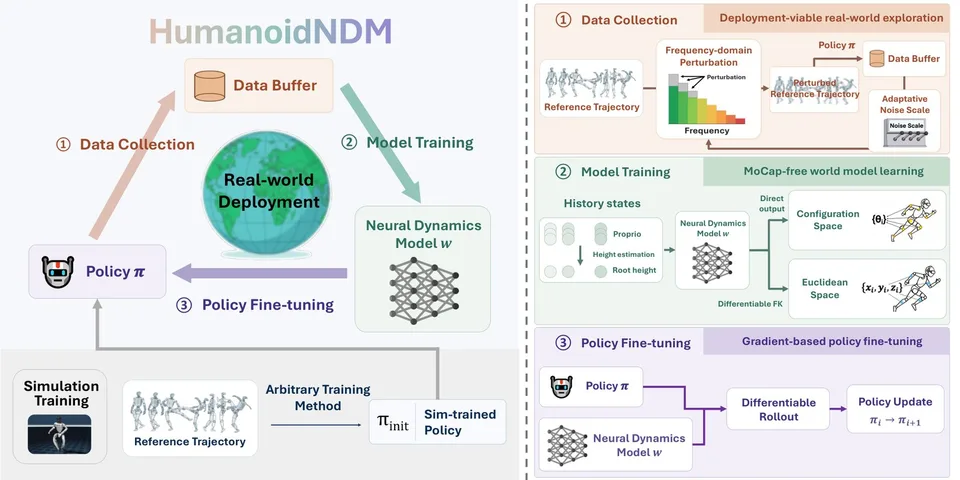
The system runs in three stages. First, its FENCE data-collection method adds low-frequency changes to the robot’s reference motion—the movement it is trying to follow. It adjusts the change level as it gathers examples, rather than injecting rapid action noise.
Next, HumanoidNDM trains a neural dynamics model, meaning software that predicts how the robot will move after an action. The model uses recent onboard measurements, including joint motion, gravity direction, and past actions. Differentiable forward kinematics—a body-geometry calculation designed to support optimization—helps it compare predicted whole-body positions and rotations without external motion capture.
Finally, the method sends analytic gradients through that model to update the policy. In ordinary terms, it uses predicted tracking errors to steer the next policy update with relatively little physical data.
The authors tested the approach on a Unitree G1 across six selected motions. Disturbances included added weights, elastic bands, a bucket containing 2 kilograms of water, and a damaged motor. They used 50 real-world trajectories for pen capping and 200 for each other task, reporting improvement across all six tasks in three repeated experiments.
The paper says the method is currently limited to disturbances that remain stable over time. It does not establish transfer to other humanoid designs or independent replication, so operators should view this as a focused research demonstration rather than general-purpose adaptation.