NVIDIA and the University of Texas report a simulation-first method that reuses a few demonstrations, then adds safer timing for multiple arms.
A new NVIDIA–University of Texas paper describes ScheduleGen, a research system for creating multi-arm robot training data without collecting every motion by hand.
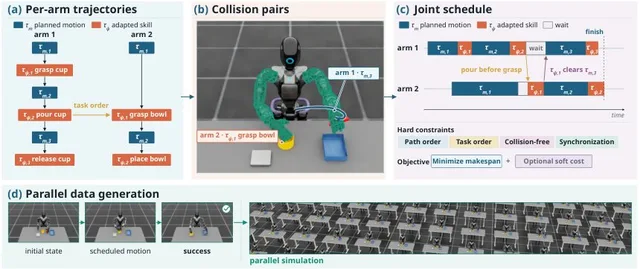
The method starts with a small set of demonstrations, such as grasping, pouring, or placing. It adapts those object-related skills to a new scene, plans the connecting movements, then coordinates the arms so they do not collide.
Its key step is scheduling. ScheduleGen uses a mixed-integer linear program—a mathematical search that chooses among discrete options—to decide when each arm should move or wait. GPU-accelerated collision checks flag conflicts involving robot arms and grasped objects. The scheduler also preserves task rules, such as pouring before another arm picks up the bowl.
In the paper’s humanoid example, one arm grasps and pours from a cup while the other grasps and places a bowl. The arms can work in parallel where safe, but the second arm must wait when moving early would block the pour.
The authors report 79.6% average success when generating data across 28 simulation variants. Policies trained on that data reached 65.5% average success in the reported simulation tests. In a separate real-world evaluation on the bimanual YAM robot, policies achieved 50% to 80% success across eight variants without real-world fine-tuning, according to arXiv.
This is still a research method, not a humanoid product or deployment. The reported humanoid results are simulated; the physical tests used YAM. The practical next test is whether this scheduling approach survives full humanoid problems such as balance, perception errors, and changing objects.