The announcement combines natural-language deployment planning with a way to skip repeated video processing, but teams still need their own tests.
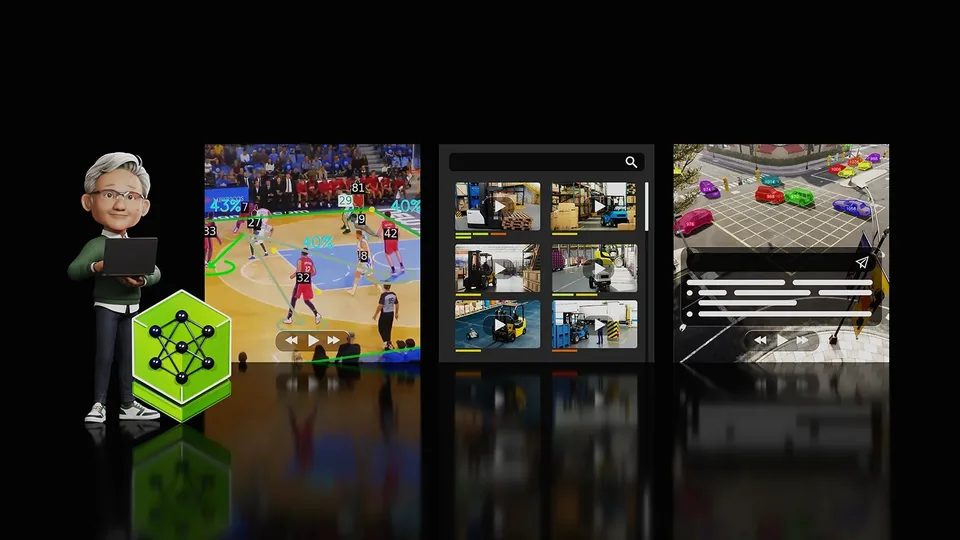
NVIDIA’s VSS Blueprint 3.3 aims to make visual AI agents easier to assemble and cheaper to run. The update adds a Build Vision Agent skill for combining video workflows, plus Adaptive Efficient Video Sampling for reducing repeated work by visual-language models.
This is a developer tool announcement, not a consumer product people can buy. NVIDIA presents the tools for applications that watch live or recorded video, find events, answer questions, search clips, and create reports.
From separate workflows to one deployment
A visual AI agent is software that uses video models to interpret camera footage and take useful actions. In a warehouse, for example, it might track forklifts, flag near misses, search earlier incidents, and produce a shift summary.
Earlier VSS tools handled individual jobs such as camera setup, alerts, search, analytics, and summarization. NVIDIA says the new Build Vision Agent skill can combine those workflows into one application, then extend a running deployment without rebuilding the entire stack.
Developers describe the desired system in ordinary language. The skill translates that request into a plan covering services, settings, models, and runtime operations.
Rather than creating everything from scratch, the skill starts with one of four validated developer profiles. These profiles cover dense captioning and question answering, real-time alerts, long-video summarization, and search. The tool then calculates the smallest set of changes needed for the requested application.
That approach matters because video systems often repeat the same infrastructure. Alerting, search, and summarization may all need video ingestion, messaging, storage, and databases. NVIDIA says VSS 3.3 can reuse those shared services instead of creating separate copies.
The tool also shows an architecture diagram for review before deployment. It then runs validation, deployment, and readiness checks. Developers still need to inspect the generated setup, especially its GPU placement, model endpoints, storage, network access, and security boundaries.
For an orange-juice bottling line, NVIDIA’s example combines camera ingestion, overflow and spill detection, alert verification, searchable clips, summaries, and operator reports. NVIDIA says a recorded-alert deployment reached a live, previewable state in under 30 minutes on a host with two RTX PRO 6000 Blackwell GPUs.
That is a company-reported demonstration, not a guarantee for every camera layout or hardware configuration.
Less processing for unchanged video
The second change targets runtime costs. Video contains many repeated images: a fixed floor, a machine frame, or an empty hallway may look nearly identical from one moment to the next.
Adaptive Efficient Video Sampling compares parts of a frame with the previous frame. NVIDIA says it removes visual tokens—small pieces of image information—from areas that have not changed, while grouping more processing around moments when activity occurs.
In practical terms, the model can spend less effort rereading static parts of a scene. The feature runs inside the real-time visual-language-model container and is optional.
NVIDIA reports three results from testing Adaptive Efficient Video Sampling on an RTX PRO 6000 Blackwell with Cosmos 3 Super FP8:
- Alert contextualization latency fell 17%, from 1,021 milliseconds to 844 milliseconds.
- Concurrent real-time video streams rose 46%, from 13 to 19.
- A 60-minute video summary took about half as long while using 80% fewer visual-language-model input tokens.
These figures are NVIDIA’s benchmarks, so teams should not treat them as universal capacity estimates. NVIDIA says results can change with scene motion, video chunk length, and the similarity threshold used to decide whether content changed.
The feature is most relevant when a model reads many frames and produces short responses, such as alert verification or long-video summarization. NVIDIA says it may help less when a model examines only a few frames but produces a long response.
What developers should do next
VSS 3.3 changes the engineering task from manually wiring every video service toward reviewing a generated deployment plan. That could reduce setup and change work for teams already using NVIDIA’s stack.
The bigger practical question is accuracy. Removing repeated visual information may save GPU time, but an overly aggressive setting could miss a subtle event. Teams considering production use should test their own footage and compare accuracy, throughput, latency, and token usage before selecting defaults.
The release also leaves important choices for each organization: which components fit its licensing and security requirements, how reliably the generated plans work across different workloads, and whether the system performs outside NVIDIA’s example configurations. For now, the useful next step is a controlled trial with representative cameras—not assuming that a fast demonstration equals a ready-made deployment.