One controller moves a foot before touchdown; another adjusts ankle force during walking. Both use prediction to handle instability.
A bipedal robot does not simply decide to “walk forward.” Before each step, its controller must answer a harder question: where should the foot land, and how should the robot manage its weight when the ground pushes back?
Two arXiv research papers describe different answers. One uses a predictive safety check to adjust Digit’s planned foothold in simulation. The other combines ankle-torque control with foot placement and reports hardware tests on Cassie across sand, gravel, rocks, wet grass, and stairs.
These are research demonstrations, not products available to buy. They show useful control methods, but the reported records do not establish commercial or operational deployment.
Digit checks the next step before taking it
The Ohio State University study gives Digit a learned walking policy, then places a mathematical guardrail around its decisions. The policy uses reinforcement learning, in which software improves through repeated trials in a physics simulation.
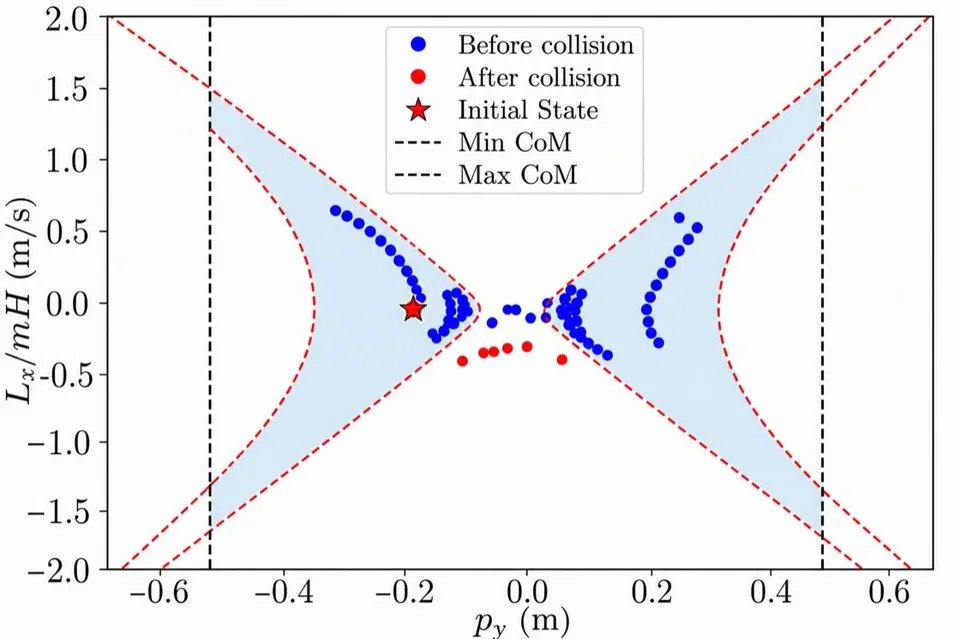
The researchers anchor that learning to an Angular Momentum Linear Inverted Pendulum model. In plain English, this is a simplified model of walking that predicts how the robot’s body position and rotational motion change from one foot strike to the next.
The model estimates what could happen if Digit places its swing foot at a particular location. The controller checks conditions such as whether the feet will remain far enough apart, whether the center of mass will move too far, and whether the robot’s motion could cross the supporting foot.
The system uses a discrete exponential control barrier function. Despite the technical name, the idea is straightforward: the next predicted state must remain inside a defined safe region. The check happens at the step-planning level, before the foot touches down.
The approach works in two layers. During training, the safety rule penalizes foot placements that would lead outside the safe region. This encourages the learned policy to choose safer actions.
During execution, a projection filter makes the smallest possible change to the planned foothold if it violates the rule. Instead of throwing away the walking command, the filter nudges the landing target to the nearest acceptable location.
The Digit policy runs at 33 times per second, while a lower-level whole-body controller runs at 1,000 times per second. The policy selects swing-foot placement and torso pitch; the lower-level controller turns those commands into coordinated joint motion. The simulated step duration was fixed at 0.35 seconds.
In the reported MuJoCo test, Digit walked on flat terrain while periodic external forces disturbed it. With safety shaping but no runtime filter, the study reports that its normalized violation score fell from 1.0 for the unguided policy to 0.13 for the guided policy—an 87 percent reduction in that trial.
When the filter was also enabled, the guided policy recorded zero measured violations in the reported test. But the robot showed larger sideways velocity swings and took longer to settle. That is a practical tradeoff: stricter foot-placement corrections can protect a boundary while making motion less smooth.
The result is narrower than a hardware demonstration. The test used a simulated Digit, flat terrain, periodic disturbances, and a fixed step time. The paper says full-order safety was evaluated empirically, so the result is not a guarantee that every part of a physical robot would remain safe.
Cassie uses the ankle as an active stabilizer
The Cassie research takes a different route. Cassie is an underactuated biped, meaning it has fewer independently powered motions than its full body would ideally require.
The controller uses passivity-based control for most of Cassie’s motion. This approach drives the robot toward planned body and leg trajectories while relying less on a perfectly accurate model of every mechanical detail.
A model-predictive controller handles the stance ankle torque. Model-predictive control looks ahead over a short time horizon, tests possible control inputs, and chooses a sequence that best meets the target while respecting limits.
Here, ankle torque helps manage balance on slopes and irregular surfaces. A separate lateral foot-placement method adjusts where the swing foot lands to control side-to-side motion.
The researchers also introduce a new impact map. An impact map estimates how the robot’s state changes when the swing foot hits the ground. Their version is linearized around a planned motion, meaning it approximates the real transition near a known trajectory.
That matters because poor impact estimates can make the ankle controller demand sudden torque spikes. The Cassie paper says the revised map reduced those spikes, helping the robot handle loose and compliant ground.
The reported hardware tests are more varied than the Digit simulation. Cassie walked through sand, gravel, and small rocks, then crossed a steep wet grassy slope with an estimated average gradient of about 22 degrees.
Cassie also climbed a five-step staircase. Each step was 2.5 inches high and 12 inches deep. The robot used neither visual foothold data nor pre-programmed foothold positions during that demonstration, but an operator timed the transition from ordinary walking to stair climbing.
That detail matters. Cassie demonstrated that its controller could handle the staircase after the task transition was selected. It did not independently recognize every staircase and decide how to climb it. The paper says perception will be needed for stairs with varying heights and depths.
What changes before or during a step?
Both systems predict the consequences of a step, but they act on different parts of the problem.
Digit’s controller mainly changes the planned landing location. It asks, “Will this foot placement keep the next state inside the safe region?” If not, it moves the target to the nearest acceptable location before the swing foot lands.
Cassie’s controller changes the forces supporting the robot while the foot is planted. It asks, “Given the terrain and expected motion, how should the stance ankle push back?” Its foot-placement system then manages lateral balance.
The reported benefits support a useful engineering point: prediction can make bipedal walking more deliberate and less dependent on a learned policy’s unchecked choices. But the results are not directly comparable. Digit and Cassie are different robots, and the studies used different terrains, tests, and performance measures.
The next step is practical validation. Digit needs testing on physical hardware and uneven terrain. Cassie needs automated perception and task transitions for stairs and changing terrain.
Until those pieces are demonstrated repeatedly beyond selected experiments, these controllers remain promising parts of walking systems—not general-purpose autonomy ready for everyday deployment.