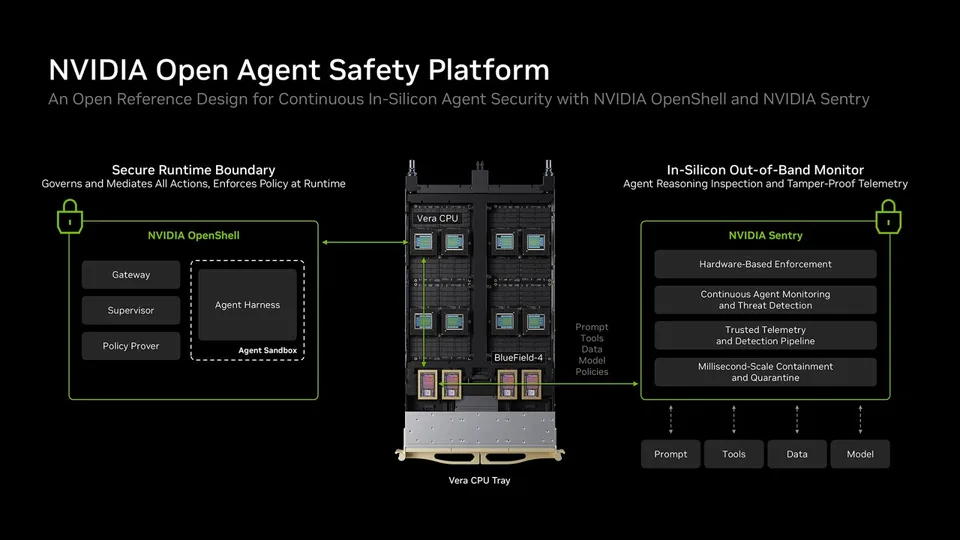
Its proposed stack checks permissions before an agent starts, then enforces them while it works.
NVIDIA has announced the Open Agent Safety Platform, a proposed system for keeping autonomous AI agents within operator-defined limits. The company describes OpenShell as an open-source runtime that runs each agent in a sandbox with kernel-level isolation.
In plain terms, the agent does not receive unlimited access to a computer. Operators can specify which files, networks, tools, processes and credentials it may use. NVIDIA says OpenShell converts those instructions into a verifiable policy, checks the limits before launch and enforces them during execution.
That enforcement happens outside the agent itself. This matters because an agent can drift from its assigned task after a blocked action, software bug or confusing instruction. NVIDIA argues that agents should not be trusted to police their own behavior.
The platform has three layers: the application, the runtime and the infrastructure. OpenShell handles the runtime layer, while the application supplies the model, tools and data.
Organizations can optionally add NVIDIA Sentry, which extends monitoring and enforcement into BlueField hardware. NVIDIA says its DOCA software connects that hardware with OpenShell policies and records agent interactions, policy decisions, and tool and data access. The goal is to spot unusual behavior and provide a way to intervene.
NVIDIA says the platform is optimized for its Vera CPUs and BlueField data-processing units, while also supporting other hardware. This is an announcement, not an independently tested product result: teams will still need to check policy coverage, compatibility and monitoring overhead in their own environments.