TensorRT Model Connect is a public-preview C++ project that uses isolated model work and GPU-backed checks to review agent output.
NVIDIA says TensorRT Model Connect began as an experiment with coding agents and grew into an open-source collection of AI model reference implementations built on TensorRT. The goal is to help model developers use NVIDIA’s inference software without becoming TensorRT specialists.
The project does not treat generated code as ready to ship. NVIDIA’s approach gives agents a desired outcome—such as supporting a model family or closing an accuracy gap—along with reference behavior, tests and other acceptance criteria. The agent can choose an implementation, but the result must pass the same technical gates as other contributions.
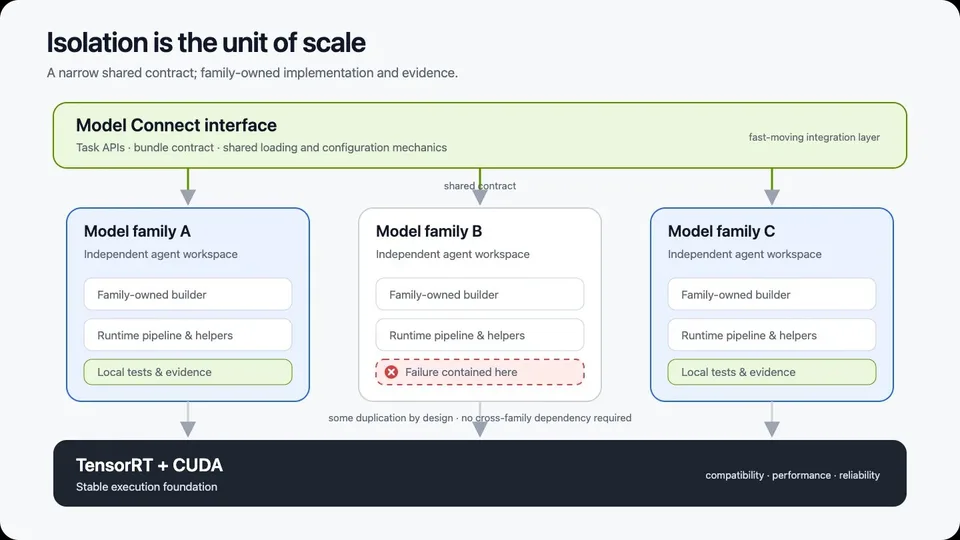
The key safety measure is isolation. Model-family changes stay with the family they affect, so a failure is less likely to spread across unrelated work. NVIDIA also favors changes that are easy to evaluate and undo. Shared build, runtime, packaging and continuous-integration systems can still create wider failures, but smaller independent units make problems easier to contain.
Validation combines automated tests, comparisons with reference implementations, benchmarks and human review. NVIDIA describes quality assurance as an independent challenge: reviewers try to disprove a change’s claims using reproducible checks. Human-readable task results, such as text or images, also let reviewers spot obvious failures quickly.
NVIDIA says the project covered 128 model families tested on its GB300 platform in a July 29 release comparison. That figure shows the scale of the integration problem, not that agents improved productivity.
TensorRT Model Connect is currently in public preview, and NVIDIA says the workflow is still being refined. Teams considering it should test supported models and targets themselves, especially where shared infrastructure or tightly connected tasks could weaken the isolation benefits.