The open-weight d1 models classify, route, and score text, images, or audio in one pass instead of writing replies token by token.
Liquid AI has released two open-weight d1 decision models through Hugging Face: d1-3B and the experimental d1-omni-600M. They are designed for structured answers, such as a label, choice, or score, rather than open-ended text.
The larger d1-3B accepts text and images. The experimental d1-omni-600M accepts either text and images or text and audio. Liquid AI describes the family as an option for fast decisions at the edge, though it reports speed measurements only for d1-3B.
A different job from a chatbot
Most generative models answer by producing text one piece at a time. They might read a customer message, write an explanation, and then identify the likely issue.
Liquid AI’s d1 models take a different path. Built on the company’s Liquid Foundation Models, they answer in a single forward pass rather than generating tokens. In plain terms, they directly evaluate the input instead of composing a conventional written response.
That design fits tasks with a known output. Liquid AI’s examples ask whether a customer wants a refund, which team should handle a ticket, and how urgent the issue is. The release also shows image classification and batches of requests.
This does not make d1 a replacement for a general-purpose writing assistant. Its practical appeal is structured output that another software system can use immediately.
The edge-inference pitch
“Edge inference” means running a model near the device collecting the data instead of sending every request to a remote server. That approach can be useful when a system needs quick responses or handles data that should remain nearby.
Liquid AI reports that d1-3B answered one question in 16 milliseconds on an NVIDIA Jetson AGX Thor, 26 milliseconds on a Jetson AGX Orin, and 50 milliseconds on a Jetson Orin Nano. On an RTX 4090 and AMD MI325X, the company reports response times of 8 and 9 milliseconds.
The release also reports that three questions took 20 milliseconds on the Jetson AGX Thor, compared with 16 milliseconds for one question. In Liquid AI’s test, several decisions over the same input therefore added less time than running each question separately.
Possible uses include sorting support tickets, checking images from a camera, or combining audio with text in a local workflow. The useful pattern is not “ask a robot anything.” It is “turn incoming information into a small number of software actions.”
The d1-omni-600M could be interesting where a smaller footprint matters, especially because it supports audio as well as text and images. But Liquid AI calls it an early research release and reports no speed figures for that model.
What the early results show
Liquid AI tested the models on seven public datasets covering reading comprehension, toxicity detection, intent classification, medical questions, and cross-language understanding.
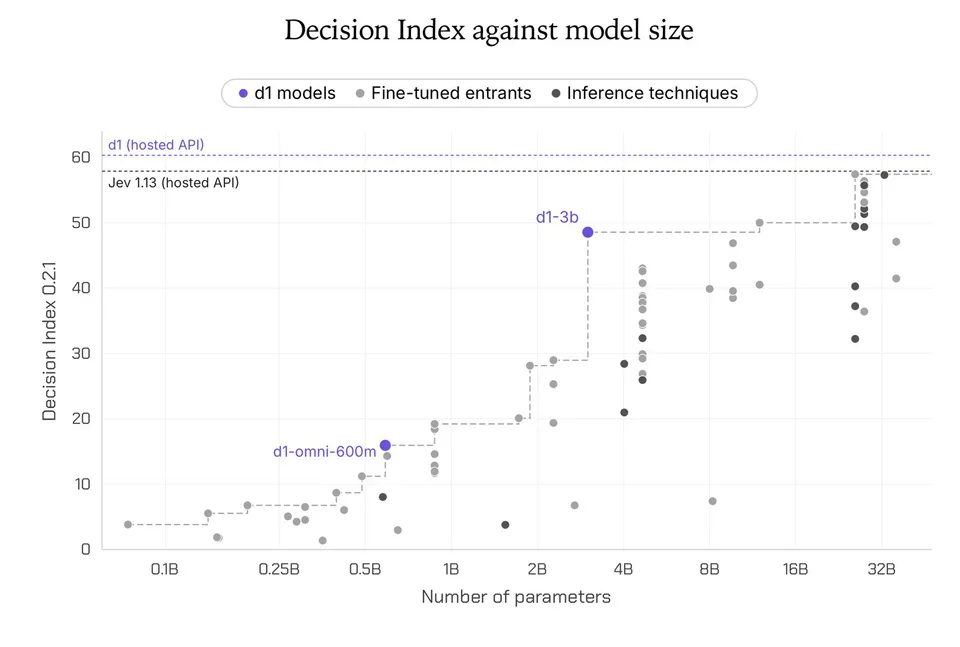
In the company’s reported table, d1-3B achieved a mean score of 82.9, while d1-omni-600M scored 78.4. Liquid AI says d1-3B led the listed models below 10 billion parameters on its Decision Index 0.2.1, while d1-omni-600M exceeded the reported 77.1 mean for Decider 2B with one-quarter as many parameters.
Those results are signals, not a guarantee for a particular application. The benchmark scores and latency measurements come from Liquid AI’s release. The company also says it did not report vision or audio benchmark scores because the relevant decision evaluation does not yet include public coverage for those areas.
For developers, the key question is how the models perform on the exact images, sounds, languages, and labels their systems use.
What developers still need to check
Open-weight models can be downloaded and modified. MIT Technology Review notes that this can support local processing and customization, but practical use still depends on having hardware capable of running the models.
The release does not settle several production details, including licensing terms, full hardware requirements, memory footprint, or safety performance. It also does not establish customer deployments or sustained results outside Liquid AI’s tests.
Both models are available now on Hugging Face, with demos offered through Liquid AI’s System One Arcade space. The sensible next step is to test them on real workloads and measure accuracy, latency, and failure rates before connecting their decisions to customers, machinery, or other high-impact systems.