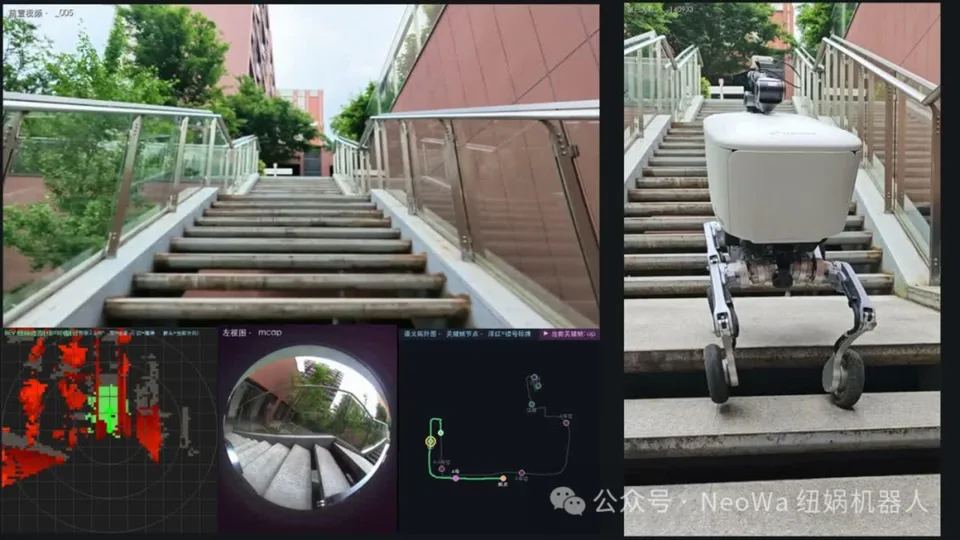
The Chinese startup is piloting robots that explore residential compounds, enter buildings, and use elevators on their own.
Nüwa Robotics is testing a delivery model for the hardest part of parcel service: the few hundred meters between a residential road and a resident’s door.
According to TMTPost, the company’s robot can enter residential compounds and buildings without advance surveying, manually placed delivery points, or changes to roads and buildings. Outdoors, it reuses information from public navigation maps. Where that information is missing, the robot explores and builds a simple topological map—a map of connected places and routes. Indoors, it explores without a pre-existing map.
The approach is being tested, not sold as a proven large-scale service. On Aug. 1, Nüwa opened a human-robot pickup station in Tonglu, Zhejiang. People process incoming parcels, sort them, and handle exceptions; the robot carries deliveries from the station to residents’ doors.
Nüwa says Tonglu tracks completion, human takeovers, and recovery from problems. The company reproduces issues in simulation before testing updated behavior on site. TMTPost reports that the system can be deployed at a residential compound within about a day, with operation possible within two days including acceptance testing. Those timing and performance claims come from the company’s reported operating experience, not independent testing.
The company also completed a proof of concept with UAE technology firm K2 Group in a high-rise apartment building in Abu Dhabi. The reported UAE activity is a demonstration rather than an established paid service.
Nüwa plans three additional proof-of-concept sites by the end of 2026 and says some could become paid engagements. It targets larger deployments later, with genuine large-scale deployment planned from 2028. For now, buyers cannot treat this as a broadly available consumer delivery service; its next test is whether the model works across different buildings, elevators, access systems, and property rules.