Chinese technology coverage shows models designing and debugging robot systems, while dedicated software still handles many physical actions.
TMTPost reports two recent examples of general-purpose foundation models entering robotics development and deployment. The cases suggest these models are helping design solutions, write code, debug systems and coordinate experiments—not broadly replacing specialized robot-control models.
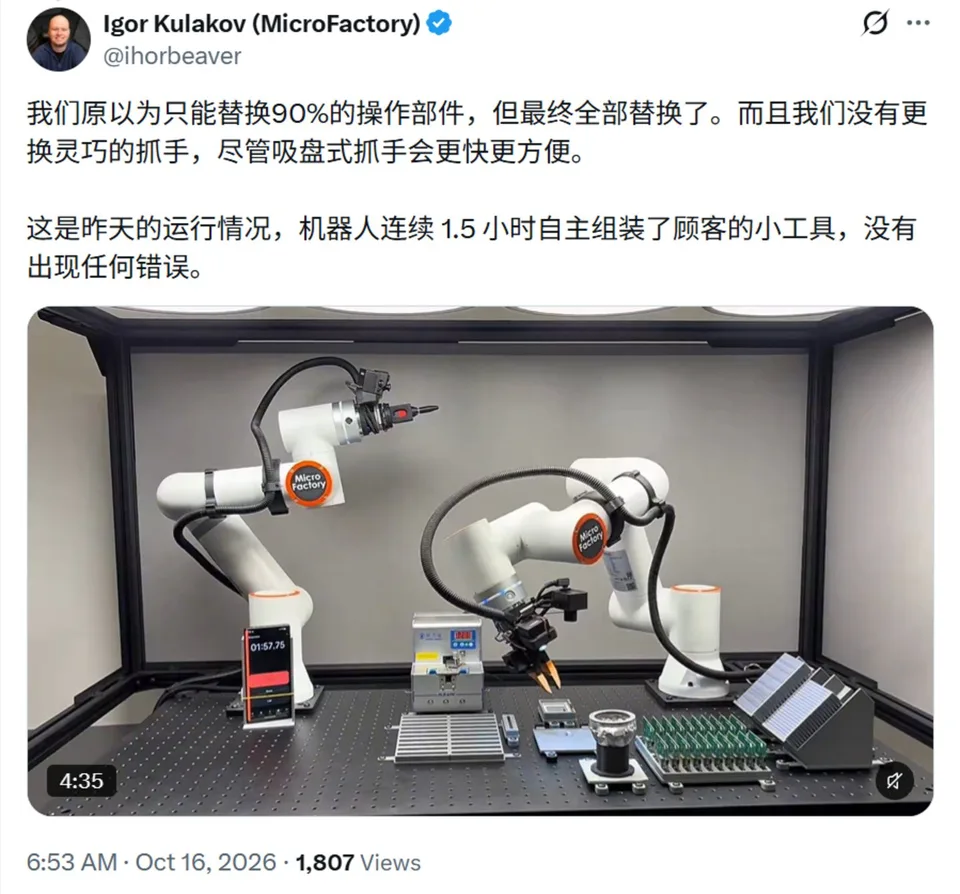
In one customer-deployment project, industrial-automation startup MicroFactory used models including Claude Opus and GPT-6 Astra to understand tasks, select control methods and generate automation programs. Dedicated vision and control programs then performed repeated actions.
MicroFactory reported that a robot assembled electronic products for 1.5 consecutive hours without operational errors. That remains a company-reported result from one deployment, rather than independently verified performance across multiple sites.
This split reflects a practical engineering choice. A foundation model can handle changing tasks and generate a control program, while tested software executes routine movements quickly and consistently. This avoids asking a large model to make every low-level decision during production.
Poke & Wiggle applied the idea to research. TMTPost says its platform used Claude Opus 5.5 to read papers, write algorithms, train models and arrange real-robot tests while attempting to reproduce findings from 10 robotics papers. Staff still prepared workstations, reset environments and performed quality checks.
The platform also reported an 87% success rate on a screw-driving task after integrating Microsoft’s Rho, a specialized model that generates robot actions. Claude handled integration, training and evaluation; the result applied to Poke & Wiggle’s own platform and testing conditions.
The immediate change is therefore in development workflow, not robot control as a whole. The important next step is repeatability across different robot bodies, factories and task changes.