The Robot Report describes autonomous roof-rack sorting, but does not identify a pilot or routine production deployment.
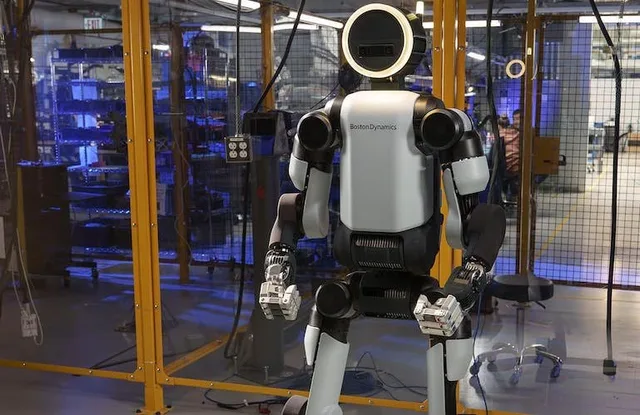
Boston Dynamics is training its Atlas humanoid for factory tasks using human demonstrations, artificial intelligence, and simulation. The Robot Report says Atlas sorted roof racks for an assembly line without human intervention and operated autonomously.
In supervised training, a teleoperator wears a virtual-reality headset and guides Atlas’s hands and arms through a task. Data from that demonstration then helps train the robot’s artificial-intelligence models to perform the task independently, the report says.
Engineers also train digital versions of Atlas in simulation. More than 4,000 digital Atlases trained for six hours while facing challenges such as slippery floors, bending, and stiff joints, according to The Robot Report. This creates many virtual training examples for the robot’s movement system.
The factory account remains narrow. The report does not identify the precise roof-rack handling steps, operating conditions, test duration, intervention rate, safety record, or production comparison. It also does not say whether the activity was a demonstration, pilot, paid installation, or routine work.
That matters because Atlas is not yet a general-purpose worker. The Robot Report says it still cannot perform many ordinary activities, including getting dressed or pouring and carrying coffee. Those examples show why success on one factory task should not be read as proof of broad independence.
For operators, the useful next test is sustained work on the assembly line with changing parts and conditions. Until those results are reported, Atlas has a reported autonomous factory demonstration—not confirmed scaled deployment.