Siemens tests physical AI in factory with HMND 01
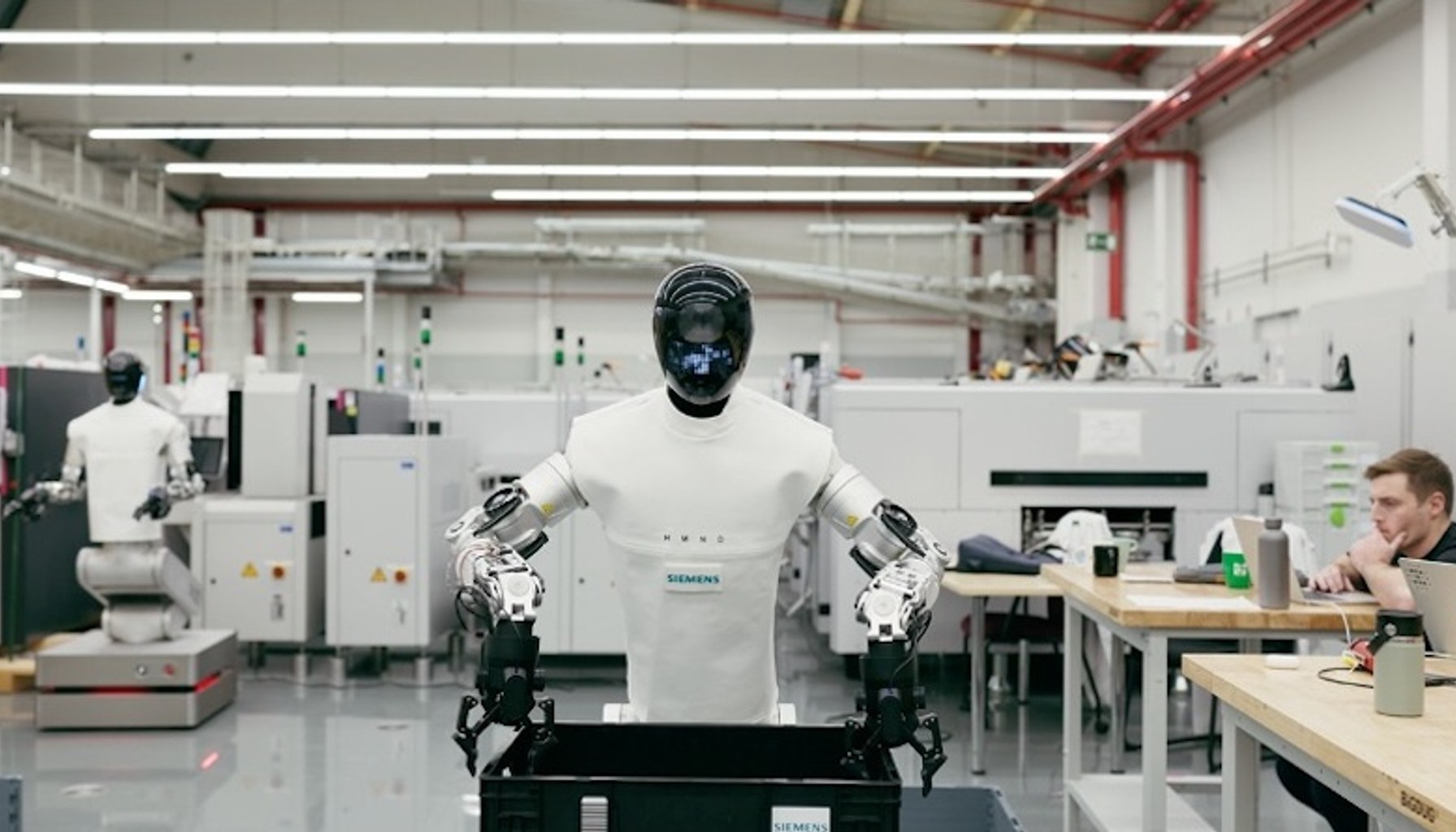
Autonomous logistics just leveled up on the factory floor.
Siemens, Nvidia and Humanoid have announced a milestone: the HMND 01 wheeled Alpha humanoid, built around Nvidia’s physical AI stack, has been tested in live operations at Siemens’ electronics plant in Erlangen, Germany, performing autonomous logistics tasks. If you’ve watched automation evolve from demos to deployments, this is exactly the kind of step that makes line managers sit up: a humanoid robot that isn’t merely following a scripted path but interpreting a real, dynamic environment and acting on it.
The arrangement marries Humanoid’s HMND 01 with Nvidia’s physical AI stack to run perception, planning and action in concert. In Erlangen, the robot has been tasked with autonomous logistics—navigating busy factory aisles, identifying pallets and bins, and moving goods to designated locations without constant human direction. This isn’t a one-off test in a lab corridor; Siemens positions the pilot as a genuine operational probe, conducted inside a functioning production area rather than a showroom demonstration.
What makes this deployment noteworthy is the “physical AI” premise: data from cameras and sensors is fused on the edge, interpreted in real time, and translated into deliberate motion within a live industrial landscape. The HMND 01 operates as a mobility-enabled asset in a factory ecosystem that includes conveyors, racks, and human workers sharing narrow walkways. The aim is to bring a level of autonomy that can absorb occasional hiccups—like a temporarily blocked aisle or a mislaid item—without triggering a cascade of manual interventions.
The integration reality is less glamorous than the glossy demo. Analysts expect a heavy lift to align the robot with Siemens’ existing OT and IT infrastructure, including industrial networks, MES interfaces, and safety systems. Floor space, charging/ docking zones, and reliable power supply become a non-trivial part of the equation, as does training for operators, technicians, and shift leaders who’ll supervise or intervene when exceptions occur. As with any bold step toward autonomy on the plant floor, safety governance and risk assessment must be front and center to avoid conflicts with human workers and other autonomous systems in dense production environments.
From a practitioner’s standpoint, this is about more than a single robot proving a point. Production data shows the potential for autonomous material handling to trim internal transport times and reduce manual shuttling, but the true value hinges on how the system scales across multiple cells and shifts. Integration teams report that success in Erlangen will depend on robust edge computing, dependable network latency, and the ability to fuse HMND 01’s outputs with existing logistics logic. Floor supervisors confirm that the robot’s behavior is being monitored in real time, with escalation rules for exceptions and clear handover protocols when human intervention is necessary.
Two-to-four concrete considerations jump out for any plant operator eyeing a similar move. First, the ROI is product- and process-dependent; a pilot that eliminates many manual transports can pay back quickly, but you won’t know until the broader workflow is sketched and measured over months. Second, the human-work component does not disappear; robots must be paired with humans for exception handling, quality checks, and problem-solving in unfamiliar scenarios. Third, hidden costs lurk in software licenses, ongoing edge updates, cybersecurity hardening, and the specialized maintenance required for a high-availability AI-enabled cell. Fourth, the infrastructure footprint—space for docking/charging, stable power, and quiet integration with plant networks—matters as much as the robot’s sensors.
If anything, Erlangen signals a maturation path for physical AI in manufacturing: a stack-enabled robot that can operate with real material flows and human co-workers, not just a clever demo. The real question now is payback: how quickly the deployment accrues measurable improvements in cycle time and throughput across multiple lines, and how fast the model scales across a factory floor. The numbers will tell the truth in the coming months.
- Siemens, Nvidia and Humanoid partner to bring physical AI into factory operationsroboticsandautomationnews.com / Source role not classified / Published APR 16, 2026 / Accessed APR 16, 2026